

Is the developer partnering with the bank?
In reality, many projects, before selling houses to customers, have had the entire project mortgaged to the bank. Instead of releasing the mortgage before selling to customers, the developer did not do so and has not repaid the debt to this day, leading to the bank foreclosing on the residents' homes. Even in many high-rise buildings, after selling the houses to customers, the developer continues to mortgage those houses to the bank to borrow money for other purposes. Only when they are unable to repay the debt and the bank forecloses to recover the principal and interest do the residents realize the truth. Therefore, individual ownership certificates for each apartment cannot be issued.
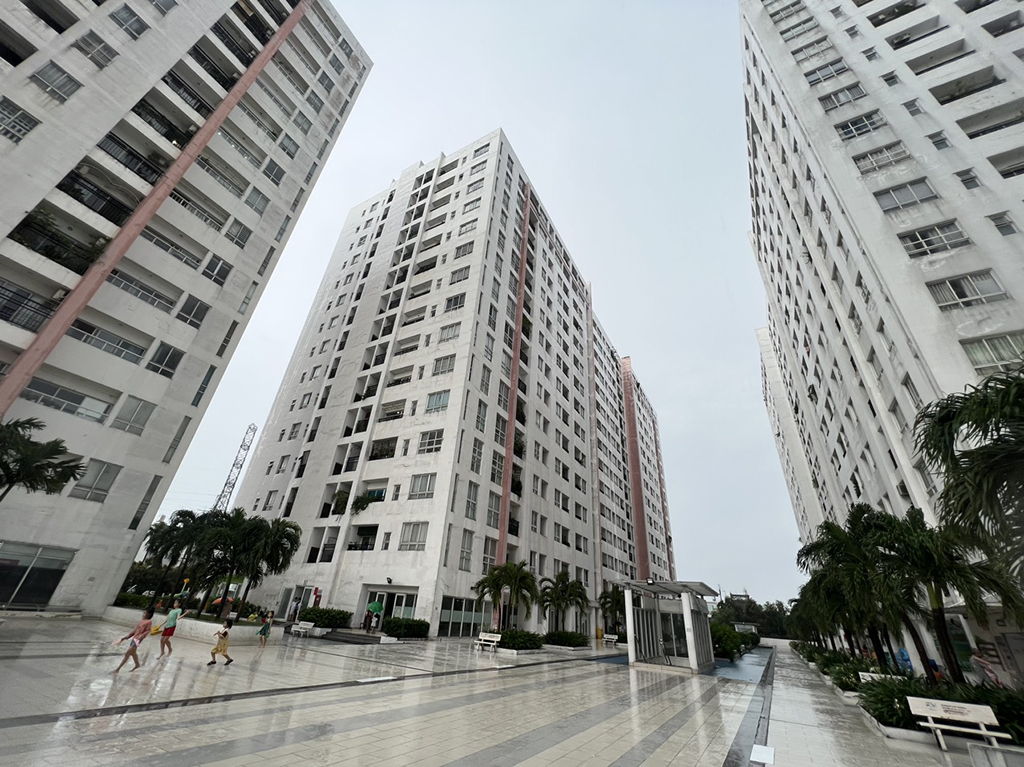
An apartment building in Ho Chi Minh City is using residents' ownership certificates as collateral for bank loans.
A resident whose home was suddenly foreclosed asked: "When individuals borrow money, banks scrutinize collateral assets very carefully, checking their legal status, value, and documentation... I don't understand why developers can easily use already-sold apartments as collateral and still get past the bank's procedures?" This is also a question many people have when witnessing this paradoxical situation.
In reality, according to regulations, when signing a real estate purchase contract with a customer, the developer must release the mortgage if the property is mortgaged to a bank. When handing over the house to the customer for occupancy, the house must be inspected and deemed to meet all requirements. After a certain period, the developer is responsible for obtaining the ownership certificate (pink book) for the customer. That's the regulation, but in reality, many apartment buildings, even those not yet inspected and deemed to meet all requirements for occupancy, or even those lacking fire safety certification, or projects built illegally, are still sold and handed over to customers. In particular, the practice of "selling apartments prematurely" is one of the reasons leading to the risk of residents losing their homes. Specifically, even before the project is completed, and even before the procedures are finalized, with only the land available, many developers begin selling. Buyers can pay in one lump sum or in installments according to the project's progress. Thus, while the project is officially registered under the developer's name, the property actually belongs to the customer. In many cases, banks are aware that the developer has already sold the houses to customers but still turn a blind eye, allowing the developer to mortgage the properties to borrow money.
Lawyer Nguyen Mau Thuong, Deputy Director of Hoang Thu Law Firm, said: "There are cases where the developer has mortgaged the real estate beforehand, then sold it to customers without the customers' knowledge. There are also cases where the developer has already sold the houses to customers, and then mortgages the project to a bank to borrow money. Because the sales contracts are not registered with any agency but are only stored at the company, the bank is unaware whether the real estate has actually been sold by the developer. It's also possible that the developer intentionally concealed this, coupled with insufficient bank appraisal, leading to loans being granted to the developer even though these apartments have actually been sold."
"During construction, the developer lacked capital and mortgaged the land use rights and future assets (the houses) to the bank. Buyers had no way of knowing that the apartments they bought were mortgaged. Ideally, the bank holding the mortgage should have publicly announced this information so that people would know. Only after the developer had released the mortgage should buyers sign the sales contract. But here, the developer circumvented the law, vaguely signing cooperation agreements or agreements promising to buy and sell. Now that the matter has come to light, the buyers are suffering all the losses. Clearly, the fact that the real estate was mortgaged to the bank and the developer still sold it to customers proves that the developer defrauded the customers. The developer must be held criminally responsible. Even the bank is responsible in this case; it cannot be absolved," lawyer Nguyen Mau Thuong analyzed.
Mr. Le Hoang Chau, Chairman of the Ho Chi Minh City Real Estate Association
Homeowners must be issued ownership certificates.
Analyzing the legal aspects, Mr. Le Hoang Chau, Chairman of the Ho Chi Minh City Real Estate Association, stated that the 2006 Real Estate Business Law was not as stringent as the 2024 Real Estate Business Law, because the law only prohibited developers from illegally raising and misappropriating capital from buyers and leaseholders. The law also allowed projects to be marketed after completion or in the future.
"However, the Civil Code stipulates that an asset cannot be traded twice. If the entire building has been mortgaged to a bank, it cannot be sold to customers. If the developer continues to sell the mortgaged property to customers, they are violating the law. The bank is also at fault because when accepting a mortgage, it must manage the mortgaged asset; it cannot claim ignorance of the developer selling it to customers. Especially if the mortgaged asset is a future residential property, it must be carefully monitored to ensure the loan funds are used and disbursed for the intended purpose. Thus, the bank is at fault and responsible; while the buyer is an innocent party, a victim," Mr. Chau analyzed, adding: "If the developer fully disclosed that the project was mortgaged and the customer still bought it, the customer is responsible. Conversely, if the developer concealed the mortgage and still sold the project to customers, the customer is a victim. In the case where an apartment has been sold to a customer but then mortgaged, the developer is at fault and the bank is also at fault." There was also a fault due to insufficient assessment. In that case, the customer is innocent and protected. Therefore, the state needs to issue land ownership certificates to customers; the developer and the bank should handle the matter themselves or take each other to court."
"We have been making such recommendations since 2013, but to this day, the people have still not had their legitimate rights protected," Mr. Le Hoang Chau emphasized.
Lawyer Vu Anh Tuan (Ho Chi Minh City Bar Association) also affirmed: It is fraudulent for a developer to sell real estate to people while using the property as collateral for a bank loan. Banks and buyers must file a complaint against the developer with the police and initiate civil lawsuits against the developer in court to protect their customers. When a bank sues a developer, the homebuyers, as parties with related rights and obligations, will have their rights considered and resolved by the court. Furthermore, if the developer is investigated and prosecuted in a criminal case, the civil aspects involving the bank and the homebuyers will also be addressed; there can be no seizure of the customers' properties.
It is known that, to date, there are approximately 60,000 houses in Ho Chi Minh City that have not yet been issued ownership certificates. Many of these projects involve developers who mortgaged residents' homes to borrow money from banks but failed to repay the loans, resulting in the banks withholding the ownership certificates. Recently, the Ho Chi Minh City People's Council also held a meeting to question the People's Committee regarding its responsibility in managing apartment buildings and issuing ownership certificates. Accordingly, in addition to the violations of developers and banks, there is also a degree of responsibility on the part of the authorities for their lax management and enforcement, even showing signs of covering up and condoning wrongdoing. Therefore, it is necessary to separate the handling of violations by developers and banks from the issuance of ownership certificates to homebuyers.
Source: https://thanhnien.vn/bong-dung-bi-ngan-hang-siet-nha-ngan-hang-khong-the-vo-can-185240624210628743.htm













































































































Comment (0)