

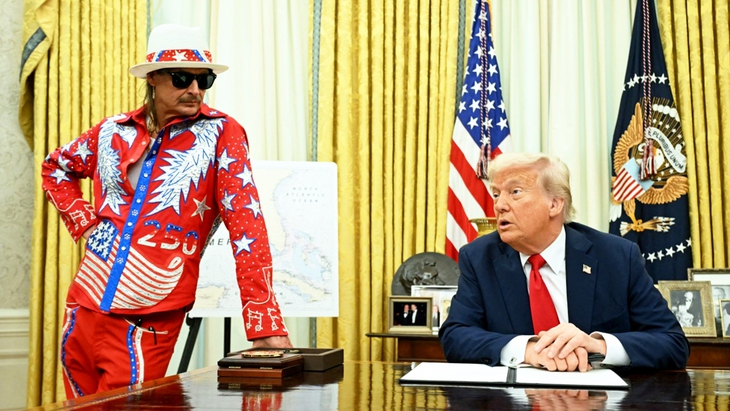
President Donald Trump signs an executive order in the Oval Office of the White House on March 31, standing next to him is American singer and rapper Kid Rock - Photo: AFP
For weeks now, US President Donald Trump has been calling April 2nd "Liberation Day" for America. That's the day the White House plans to impose a series of tariffs on various countries to realize his ambitious economic program.
Washington's calculations
According to the plan, at 4 PM on April 2nd (US time), which is 3 AM on April 3rd (Vietnam time), Mr. Trump announced what he called large-scale "reciprocal tariffs" on various countries. "The word 'reciprocal' is very important. What they do to us, we do to them," Mr. Trump emphasized to the press recently.
White House press secretary Karoline Leavitt confirmed this timeline at a press briefing on April 1. She said President Trump had consulted with his trade team to finalize key points in the strategy to end "decades of unfair trade."
According to the New York Times, from one perspective, "Liberation Day" is a logical continuation of the goal that Trump announced in his inaugural address.
"Instead of taxing our citizens to enrich other countries, we will tax foreign countries to enrich our own people," Trump once said.
This suggests that Trump does not intend to use tariffs as a negotiating tool, but rather expects them to become a long-term source of revenue for the United States.
US Commerce Secretary Howard Lutnick said: "They will help reduce the deficit and balance the budget. Let the people who live off our economy pay and we will pay less."
However, viewed from a less optimistic perspective, imposing such tariffs could destroy three pillars of the alliance: the transatlantic, the trans- Pacific , and with Canada. Defense relations, trade interdependence, and the bonds forged over decades in these regions are always closely intertwined.
When asked whether the administration was concerned these tariffs were a misstep, Ms. Leavitt expressed confidence: "They are not wrong. This policy will work."
In recent weeks, the Trump administration has considered various tariff strategies. One option being considered by the White House is to impose a uniform 20% tariff on all imports – a proposal that advisers believe could generate more than $6 trillion for the U.S. government .
Trump's advisers also discussed applying different tariffs depending on the trade barriers each country places on American goods. They also said that some countries could avoid tariffs entirely if they reached a trade agreement with the U.S.
The White House press secretary revealed that many foreign governments had called President Trump and his team to discuss tariffs, but Trump focused solely on America's interests.
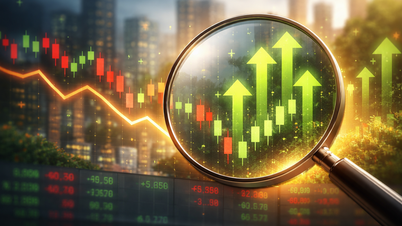
The prospect of tariffs in recent days has unsettled markets, and investors are seeking a clear picture of Trump's retaliatory tariff policies.
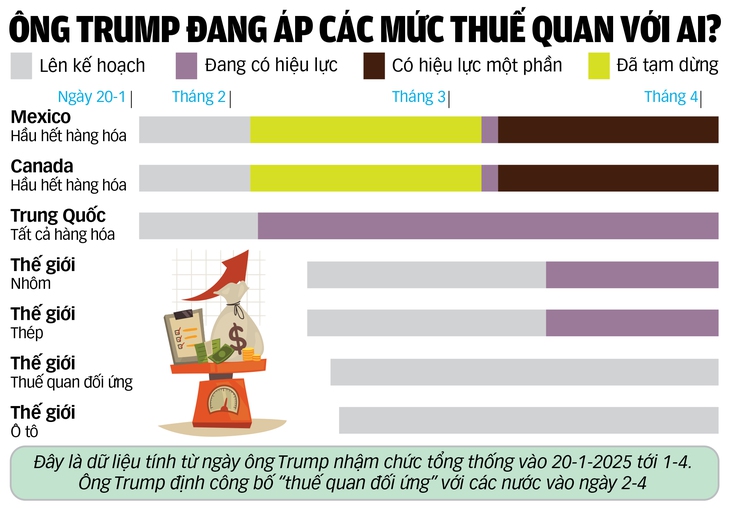
Source: New York Times - Data: THANH BINH - Graphics: TUAN ANH
Does the harm outweigh the benefits?
President Trump is seeking to reshape the global economic order through a series of tariffs on goods imported from Canada, Mexico, China, and many other countries. He argues that these measures will boost domestic manufacturing in the United States and generate revenue.
However, Trump's strategy is disrupting decades-old free trade agreements with America's close allies. This policy has triggered retaliatory measures from major trading partners, rattled markets, and strained diplomatic relations.
Canada has declared it will defend its workers, businesses, and economy against new tariffs and threats from President Trump. Canadian Prime Minister Mark Carney recently made it clear that the US "is no longer a reliable partner."
On April 1st, European Commission President Ursula von der Leyen emphasized that the European Union "is not the instigator of this confrontation, but if necessary, we now have a strong plan for retaliation."
Meanwhile, China imposed retaliatory tariffs in March on a range of US goods and warned it would retaliate if the Trump administration continued to impose counter-tariffs on the country.
Chinese media revealed that China, Japan, and South Korea have also agreed to jointly respond to US tariffs, after the three countries held their first economic dialogue in five years.
Trade experts point out that tariffs cannot simultaneously help Trump achieve all of his stated goals. In fact, many of those goals are contradictory.
For example, if Trump's tariffs encourage businesses to manufacture more in the U.S., American consumers will buy fewer imported goods. But the consequence is that the U.S. government's revenue from import tariffs will decrease, contrary to initial expectations.
Trade policy experts point out that American consumers are likely to bear the brunt of the new tariffs, just as they did during Trump's first term.
Retailers often raise product prices, while manufacturers using imported materials face higher costs.
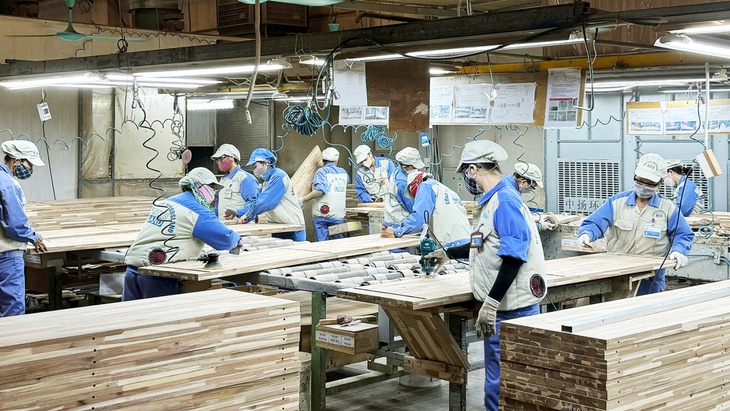
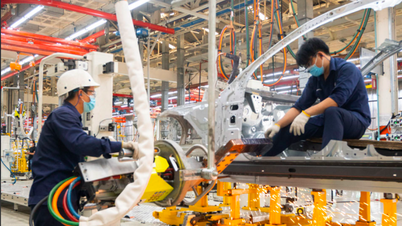
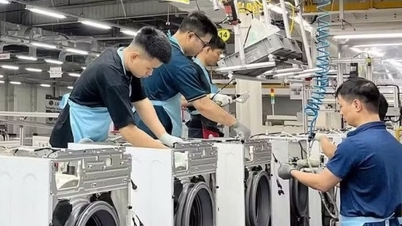
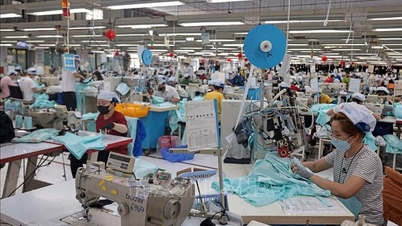
Businesses believe that the tax reduction measures are expected to help exports avoid being subject to retaliatory tariffs - Photo: P.THANH
The risk of recession is increasing.
According to Goldman Sachs, the US economy is facing an increasing risk of recession as high taxes threaten to stifle growth, trigger a resurgence of inflation, and push unemployment higher.
Goldman Sachs has just assessed the risk of a US economic recession in the next 12 months at 35%, up from its previous forecast of 20%.
Vietnam has the capacity to weather the tariff storm.
Speaking to Tuoi Tre newspaper, Adam Corrall, managing partner for trade and investment in Asia at Australasian Premium Partners, believes that Vietnam will have sufficient capacity to weather any tariff storm that may arise.
According to Mr. Corrall, it remains unclear what the consequences of the tariffs or the next tariff scenario will be, but Vietnam is pursuing a diversification strategy that few other economies possess.
With 17 free trade agreements (FTAs) already signed and 2 more under consideration, along with comprehensive strategic partnerships with 12 countries, Mr. Corrall believes Vietnam has "room to diversify trade and adapt to international supply chains."
While emphasizing that the decision on tariffs rests with the White House—they are the ones who decide which countries to tax and for what reason—Vietnam has taken preparatory steps, currently ranking among the best in ASEAN in terms of openness to foreign relations, cooperation, trade expansion, and responsiveness to both bilateral and multilateral partners.
"Vietnam always wants to cooperate with all parties. Your country has many opportunities to make choices, but Vietnam remains steadfast in its approach of open cooperation, without taking sides. I think Vietnam has done very well in this," Mr. Corrall emphasized.
The expert also expressed confidence in Vietnam's ability to withstand and develop amidst global economic fluctuations: "I believe Vietnam will overcome any storm, because your country has solid capabilities both economically and socially. Vietnam will know how to adapt to seize new opportunities when global supply chains are forced to adjust to adapt to US tariff policies."
Read more Back to Homepage
Back to the topic
PEACEFUL - NORTHWEST
Source: https://tuoitre.vn/ngay-giai-phong-o-my-da-den-20250402223037734.htm



![[Photo] Prime Minister Pham Minh Chinh receives the Chinese Ambassador to Vietnam](https://vphoto.vietnam.vn/thumb/1200x675/vietnam/resource/IMAGE/2026/04/05/1775397481797_ndo_br_dsc-5512-jpg.webp)





























































![[INFOGRAPHICS] Exploiting children's personal images for profit can result in fines of up to 50 million VND.](https://vphoto.vietnam.vn/thumb/402x226/vietnam/resource/IMAGE/2026/04/06/1775442200854_1775442148.webp)



















Comment (0)