

Nghe An province possesses diverse plant resources, including many valuable, endemic, and high-value medicinal plants. Medicinal plants are becoming a key crop for poverty alleviation and contributing to socio -economic development in mountainous districts and ethnic minority areas.
Nghe An province has identified the development of medicinal plants, especially those grown under the forest canopy, as a way to exploit the potential advantages of land and forest resources, and to maximize the multi-purpose value of forests, in accordance with the Politburo 's policy in Resolution No. 39-NQ/TW dated July 18, 2023, which states: "Developing forestry economy, forest economy, economy under the forest canopy, medicinal plants, and high-tech applied agriculture linked with processing industries."
Planting under the forest canopy
Despite being over 70 years old, Mr. Vu Tong Va, residing in Huoi Son village, Tam Hop border commune (Tuong Duong district), still regularly works with his family members to care for his bo bo (southern cardamom) garden, which is intercropped under the forest canopy. Starting in 2017 as part of a pilot program, his family's bo bo cultivation has now reached 8 hectares. "Each hectare of intercropped bo bo yields about 1 ton of fresh fruit. With a price of around 8-10 thousand dong per kilogram of fresh fruit, after deducting expenses, bo bo brings my family over 100 million dong annually," Mr. Va said.
In Pha Lom village, in 2021, with support from the National Target Program for socio-economic development in ethnic minority and mountainous areas, Mr. Xong Ba Ca's family was the first household in the commune to cultivate seven-leaf one-flower ginseng. To date, their 200 m2 ginseng garden is thriving. According to Mr. Xong Ba No, Deputy Secretary of the Tam Hop Commune Party Committee, seven-leaf one-flower ginseng sells for between 700,000 and 1,000,000 VND per kilogram of fresh roots. Following the positive results of Mr. Ca's ginseng garden, four other households have adopted the model, bringing the total area planted with this type of ginseng in the commune to nearly 1,000 m2. Instead of propagating ginseng from seeds, these households now venture deep into the forest to find seedlings, thus shortening the plant's growth time. The households find their own seedlings, with government support for labor costs and seed expenses as per the project's regulations. Seven-leaf one-flower ginseng and sorghum have been identified locally as potential crops to help ethnic minority people in the commune improve their income and gradually escape poverty.
Na Kho village, Nga My commune, is located deep within the core of the Pu Huong Nature Reserve. For generations, the local people have only harvested the roots of the *Stemona tuberosa* plant from the forest for sale. No one has ever cultivated *Stemona tuberosa* under the forest canopy. In 2022, 15 households participated in caring for a 3-hectare *Stemona tuberosa* garden with approximately 9,000 seedlings, benefiting from the project "Supporting communities in buffer zone communes to develop medicinal plants under the forest canopy to increase income and conserve biodiversity in the Western Nghe An Biosphere Reserve," coordinated by the Small Projects Programme (Global Environment Fund). The dried *Stemona tuberosa* roots are purchased by traders at a price of 400,000 VND per 10 kg or 80,000 VND per 10 kg of fresh roots.
According to information from the Department of Agriculture and Rural Development of Tuong Duong district, with support from the aforementioned project, from September 2022 to June 2024, 18 hectares of medicinal plants were planted under the forest canopy in Nga My and Yen Hoa communes, mainly golden camellia, purple croton, purple ginseng, and stemona. Two medicinal plant nurseries also produced tens of thousands of seedlings of purple ginseng, Chinese yam, purple croton, golden camellia, and Gynostemma pentaphyllum…
For example, in Na Ngoi commune (Kỳ Sơn district), home to Puxailaileng peak, which is over 2,700m above sea level and the highest peak in the northern Trường Sơn mountain range – the natural border between Vietnam and Laos – in addition to growing ginger and selling peaches for Tet (Lunar New Year), many households have invested in cultivating Codonopsis pilosula and Puxailaileng ginseng. Typical examples include the family of Mr. Xồng Bá Lẩu in Buộc Mú village; Elder Bá Lữ and Elder Tồng Thù in Buộc Mú 2 village… According to Mùa Bá Vừ, Chairman of the Na Ngoi Commune People's Committee, the area planted with medicinal plants has increased significantly in recent years. Besides the production area of businesses, people in the commune are currently cultivating nearly 3 hectares of Codonopsis pilosula and over 1 hectare of Puxailaileng ginseng and Panax notoginseng.
According to statistics from the Department of Agriculture and Rural Development of Nghe An province, to date, approximately 30 species have been planted intensively in several districts throughout the province, covering a total area of over 1,459.29 hectares.
Of this, approximately 410 hectares are cultivated on large-scale crops (passion fruit, gac fruit, turmeric, Job's tears); about 620 hectares are cultivated on large but non-concentrated areas (cinnamon, Artemisia annua, shallots); about 64 hectares are cultivated sporadically as medicinal plants (Sophora japonica, Solanum nigrum, Portulaca oleracea, Plantago major, Gynostemma pentaphyllum, Leonurus artemisia, Mentha arvensis, Perilla frutescens, Lysimachia nummularia, Lonicera japonica, Andrographis paniculata, Rhus chinensis); and over 22 hectares are cultivated on rare and valuable experimental species (Centella asiatica, Codonopsis pilosula, Polygonum multiflorum, Dendrobium nobile, Amomum xanthioides, Panax notoginseng, Panax vietnamensis, Panax pseudoginseng, Eucommia ulmoides, Salvia miltiorrhiza, Ginkgo biloba). The medicinal plant cultivation sites are divided into sub-regions: the mountainous sub-region (Con Cuong, Tuong Duong, Ky Son, Que Phong, Quy Chau, Quy Hop, Tan Ky, Nghia Dan) has approximately 25 species. The midland sub-region (Yen Thanh, Hoang Mai, Nam Dan) cultivates approximately 12 species; the lowland sub-region (Quynh Luu, Nghi Loc) cultivates 11 species.
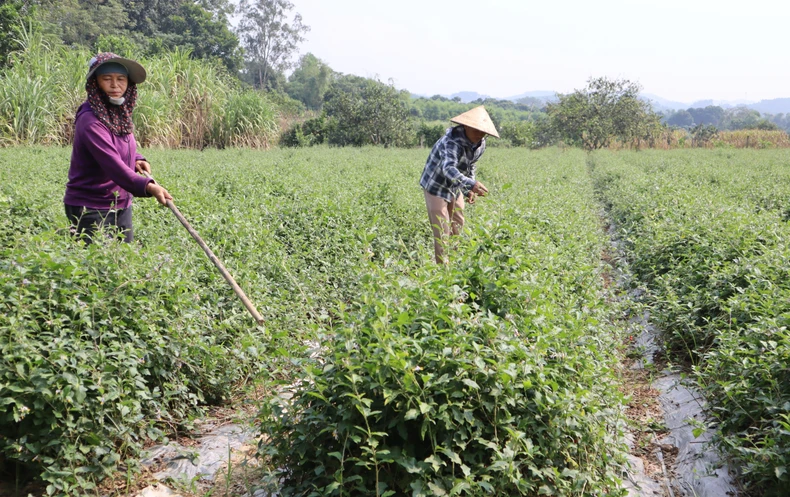 |
The people of Quyet Tien village, Chi Khe commune, Con Cuong district, are cultivating Solanum torvum. |
Strengthening linkages
In Con Cuong district, in addition to over 7 hectares of land planted with Solanum torvum, Gymnema sylvestre, and wild bitter melon, Pu Mat Medicinal Herbs Joint Stock Company is collaborating with 86 households in Chi Khe, Chau Khe, Thach Ngan, and Lang Khe communes to cultivate 15 hectares of Solanum torvum and Gynostemma pentaphyllum.
Having joined the cooperative since 2018, Mr. Phan Dinh Thuan (Head of Hamlet 2/9, Chau Khe Commune) said: Compared to other crops, Solanum torvum provides a higher and more stable income. The hamlet currently has 57 households growing Solanum torvum, covering approximately 9.5 hectares. Ms. Nguyen Thi Lam's family (Quyet Tien Hamlet, Chi Khe Commune) is cultivating 0.2 hectares of Solanum torvum. Previously, this land was used by the family to grow tea and then oranges, but the economic efficiency was low. Seeing that a family acquaintance in Hamlet 2/9 was successfully growing Solanum torvum, her family registered to cultivate it. “My family started growing them in November 2023. This past April, we had our first harvest of nearly 7 tons of fresh produce, selling it at 6,100 VND/kg. The first crop involved significant costs for seedlings, plastic sheeting for covering, and labor, but subsequent crops required very little investment. We harvest about every six months and only need to replant after a few years,” Mrs. Lam said excitedly.
Currently, Pù Mát Medicinal Herbs Joint Stock Company plants and purchases approximately 400 tons of raw materials annually to produce products such as tea bags, instant tea, herbal pills, and herbal extracts. Many of these products have become typical OCOP products of Nghe An province. According to Phan Xuan Dien, Director of Pù Mát Medicinal Herbs Joint Stock Company, medicinal herbs are a crop that is opening up many prospects in agricultural production for people in the buffer zone of Pù Mát National Park. The company guides households on what crops to plant, provides technical procedures during cultivation, and guarantees the purchase of their produce. "With a price of 4,500 VND/kg of fresh herbs, after deducting costs, people will earn about 130-150 million VND/hectare of Gynostemma pentaphyllum annually. Meanwhile, if they plant sugarcane, the profit is only about 35-40 million VND/hectare. Not to mention, medicinal herbs are less susceptible to pests and diseases and are easy to care for," Mr. Dien explained.
In Decision No. 1187/QD-UBND dated April 3, 2018, approving the overall plan for medicinal plants in Nghe An province until 2025, with orientation to 2030, the People's Committee of Nghe An province advocates focusing on developing 14 species/groups of medicinal plants in 11 districts/towns in the province, categorized by high mountainous, medium mountainous, lowland, and plain areas, with a total planted area of 905 hectares.
According to Ms. Vo Thi Nhung, Deputy Director of the Department of Agriculture and Rural Development of Nghe An province: Medicinal plants have much higher economic efficiency than some traditional crops (corn, rice, acacia). Therefore, attracting resources in terms of land, labor, and capital for the development of medicinal plants has received strong support from all levels, sectors, and people in the planned area. Many types of medicinal plants are shade-tolerant, suitable for intercropping under the forest canopy, so the development of medicinal plants also enhances the production value of forest land, contributing to forest protection and development. Encouragingly, the participation of pharmaceutical companies and businesses that purchase and guarantee the sale of medicinal products has ensured relatively stable output, creating conditions for the formation of a link between production and the market…
The development of medicinal plants in Nghe An is of particular importance to mountainous districts and ethnic minority communities. Most medicinal plants grow within natural forests, under the forest canopy, in mountainous areas – the main habitats of ethnic minorities. Therefore, if this work is done well, it will leverage strengths and open up great opportunities for ethnic minority communities. However, Nghe An needs a comprehensive and appropriate policy to encourage the participation of various economic sectors, especially attracting processing enterprises with advanced and modern technology; and to promote the linkage of the four stakeholders (the State, scientists, businesses, and farmers)…
Source: https://nhandan.vn/nghe-an-phat-trien-cay-duoc-lieu-post838293.html
































































![[Infographic] Intellectual Property Development in Dong Thap Province, 2026-2030](https://vphoto.vietnam.vn/thumb/402x226/vietnam/resource/IMAGE/2026/03/08/1772939768643_phat-trien-tai-san-tri-tue-tren-dia-ban-tinh-dong-thap-giai-doan-2026-203020260308064829.webp)












Comment (0)