The profession of pulling "floating cities" ashore.
When a giant container ship approaches the port from offshore, the dockworkers are the first to arrive. Through sheer strength, skill, and seamless coordination, they safely bring the ship to shore, regardless of sun, rain, or the dead of night.
Báo Xây dựng•03/07/2026
Behind the mooring ropes
In the last days of June, the scorching sun beat down on the HTIT International Deepwater Port (Lach Huyen, Hai Phong ). The burning concrete surface radiated intense heat, mingling with the salty sea breeze and the sound of ship horns echoing from the open sea.
The task of securing ships with moorings requires considerable physical strength and professional skill to accomplish.
Amidst the vast expanse of container ships, a container ship with a deadweight tonnage of hundreds of thousands of DWT slowly enters the channel. From a distance, the ship looks like a giant "floating city" making its way from the ocean to shore.
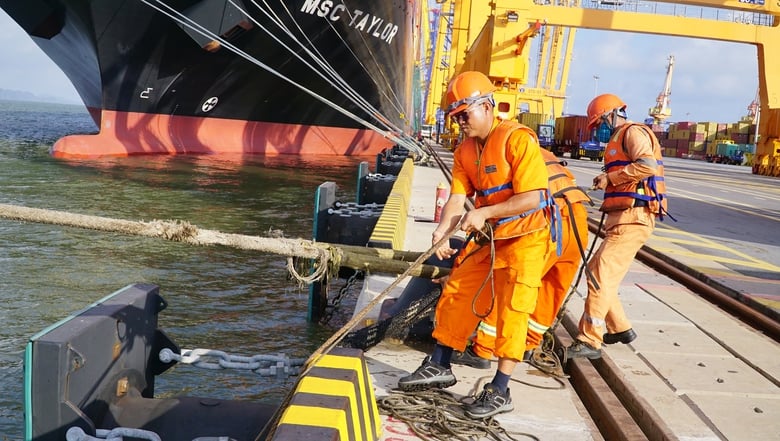
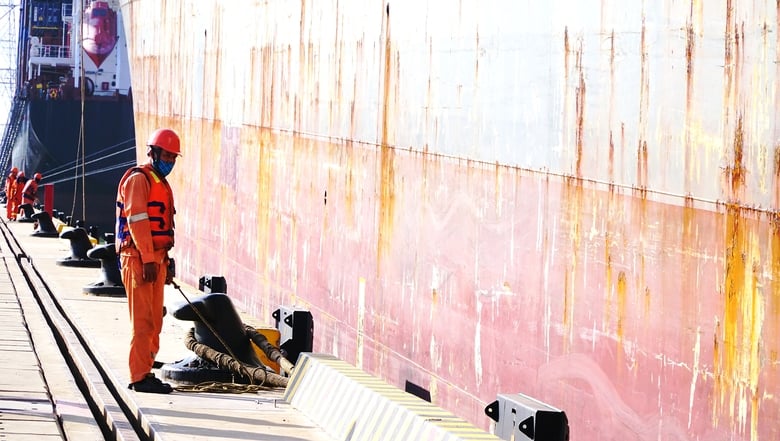
Along the dock, figures in orange protective clothing quickly fanned out and took their positions. These were the workers securing the ships with moorings – the men often referred to as "those who pull the ocean ashore."
Few people know that behind the moment a massive ship safely docks lies a seemingly simple task: tying and untying the ship's mooring ropes. In reality, it's a profession that demands skill, strength, courage, and even sacrifices of sweat, health, and life.
Having been involved in this job for 15 years, Pham Van Thuy, a worker at Hai Phong Port Technical Services and Training Joint Stock Company, squinted as he watched the ship approaching the pier.
To outsiders, each ship that docks is just another shipment. But for him and his colleagues, it's a technical process requiring almost absolute precision.
When the ship was only about 30-50 meters from the dock, the sailors on deck threw down guide ropes. In an instant, the workers below had to quickly catch them, pulling in the enormous mooring ropes.
"There are ropes as thick as an adult's thigh, weighing over a hundred kilograms. Pulling them is even harder when the tide is low," Thuy said, wiping the sweat from his sun-tanned face.
Facing danger
Securing a ship is never simply a matter of pulling ropes. It's a highly trained technical process. The workers must understand each type of rope, each anchor point, and each coordinated maneuver. First, there are four diagonal ropes – two at the bow, two at the stern – to temporarily secure the hull. Then come the longitudinal ropes that help keep the ship stable against waves and currents.
Depending on the size of the ship, each docking may require 8 to 16 mooring ropes. Each rope is soaked with seawater, heavy, and requires coordination from several people to position them correctly.
Having been involved in the profession for over two decades, Nguyen Ba Tien, Team Leader of Loading and Unloading Team 2, has experienced countless ship deliveries in all weather conditions. According to him, days with low tides are always the biggest challenge.
The distance from the ship to the shore is greater, the ropes are heavier, and the slope is steeper, so after just a few pulls, the crew is exhausted. Some ports even have to mobilize forklifts to assist.
Latest traffic accident news today, July 3, 2026Latest traffic accident news today, July 3, 2026: One person died after a collision between a truck and a motorbike on National Highway 6; Man riding a motorbike killed in collision with a truck...
Cape Verde is confident of causing an upset against Argentina.Ahead of their clash with Argentina in the Round of 32 of the 2026 World Cup, Cape Verde coach Bubista asserted that his team has the character to cause an upset, even against the reigning champions.
But machines only help to some extent. The most important factor remains the human element. If just one person is slow or doesn't coordinate properly with the forklift operator, an accident can happen immediately.
"Gambling" with deadly jumps
In the rope-making profession, danger is ever-present. Some have slipped and fallen into the sea. Others have been strangled and pulled down by the ropes. The most terrifying thing is when those giant ropes are taut under the pulling force of ships weighing tens or hundreds of thousands of tons.
For large cargo ships, the ropes are usually thick and heavy, so the rope-making crew has to use a lot of strength.
If the rope suddenly snaps, it will whip back at extremely high speed, potentially claiming the lives of anyone standing in the danger zone. Many sailors and port workers around the world have died from such rope snapping incidents.
Mr. Thuy still hasn't forgotten the time he witnessed a ship docking right in the middle of a strong wind. The ship swayed constantly, the force so strong that the anchor bolt was ripped off. Professionals can tell when danger is imminent and avoid it. But even a moment of carelessness can cost lives.
Besides occupational hazards, the weather also presents a major challenge. In the summer, the dock surface is scorching hot, like a blazing furnace. Just a few minutes standing outside is enough to soak your clothes with sweat. In the rainy season, the dock surface is slippery, and visibility is limited. Strong winds from the sea cause the ship's hull to constantly shift, making towing the mooring ropes even more difficult.
Each time, the entire team had to muster all their strength, clinging tightly to the dock like living anchors, chanting in unison to gradually steer the giant ship into the correct position.
Special emotions
Behind those strong hands lie the silent, persistent effects of occupational diseases. Many long-time wire workers suffer from spinal problems, osteoarthritis, or herniated discs due to the constant pulling and carrying of very heavy objects.
The pressure also comes from the relentless pace of port operations. Ships don't wait for days off, holidays, or Tet (Lunar New Year). The port operates 24 hours a day, seven days a week. When a ship arrives, the rope installers must be present.
"We go whenever there's a train, regardless of whether it's midnight or early morning," shared Mr. Nguyen Van Chuyen.
Working in shifts for many years has disrupted the biological clocks of the workers, often leading to hurried meals and irregular sleep schedules that fluctuate according to the ship's itinerary.
However, amidst all the hardships, one thing has never changed: camaraderie. In this job, no one can do it alone.
Every shout when pulling the rope, every glance, every nod—all represent absolute trust in their teammates. It is this bond that helps them overcome stressful shifts and face ever-present danger.
Vietnam encourages US businesses to expand investment in high technology.On the morning of June 26th, at the Government Headquarters, Deputy Prime Minister Ho Quoc Dung received Mr. Jeff Place, Supply Chain Director of Coherent Group (USA). During the meeting, the Deputy Prime Minister affirmed that Vietnam encourages US businesses to expand investment, especially in high-tech, innovation, and semiconductor industries.
Only when the massive ship was safely docked at the pier, with the mooring ropes securely fastened to the anchor, did the entire crew breathe a sigh of relief. Their sun-tanned faces broke into relieved smiles.
"The feeling of watching a huge ship safely dock, bringing new shipments ashore, is truly special," said Tien.
For workers like Mr. Thuy, Mr. Chuyen, and Mr. Tien, happiness is sometimes very simple. It's when the ship arrives on schedule. It's when the ship is unloaded quickly. And above all, it's when all the crew members return home safely after a shift.
As dusk falls over Lach Huyen, the last rays of sunlight bathe the docks and the mooring ropes that are taut, holding the ships securely at the pier in golden hues.
Behind those ropes lies the hard work of workers who have toiled for hours under the scorching sun, strong winds, and ever-present risks. They don't directly create the cargo shipments, but they are the ones who initiate and close each ship's arrival, contributing to the safe and smooth operation of the seaport.