

Early in the autumn morning, the weather in the highlands of Quan Ba was slightly chilly. The morning sun's rays filtered through the leaves, illuminating the hillsides and blending with the fragrant scent of ripening rice, creating a poetic and enchanting atmosphere. In this setting, I suddenly heard the gentle, heartfelt sound of the Hmong flute, sometimes low, sometimes high, echoing throughout the mountains and forests. Following the sound, I found my way to the home of Mr. Lu Mi Thao, born in 1969, in Lo Thang 2 village, Thai An commune, Quan Ba district, Ha Giang province. Mr. Thao is known as one of the exemplary artisans and a respected figure in Quan Ba district; he has dedicated his life to preserving and conserving the Hmong flute, a unique traditional musical instrument of the Hmong people.
In our conversation, artisan Lu Mi Thao shared: “The sound of the Hmong flute is closely linked to the life and culture of the Hmong people. From ancient times until now, only men have performed solo Hmong flute performances. Elderly people like us used to all know how to make Hmong flutes.”
"Anyone skilled at making beautiful khaen (a type of bamboo flute) with a resonant sound would be secretly admired and desired by many girls in the area. Thanks to the guidance of the elders in the village, I quickly learned to dance and play dozens of khaen songs proficiently by the age of 15. A year later, also thanks to the guidance of the artisans, plus my own diligent research and learning, I learned how to make khaen myself."
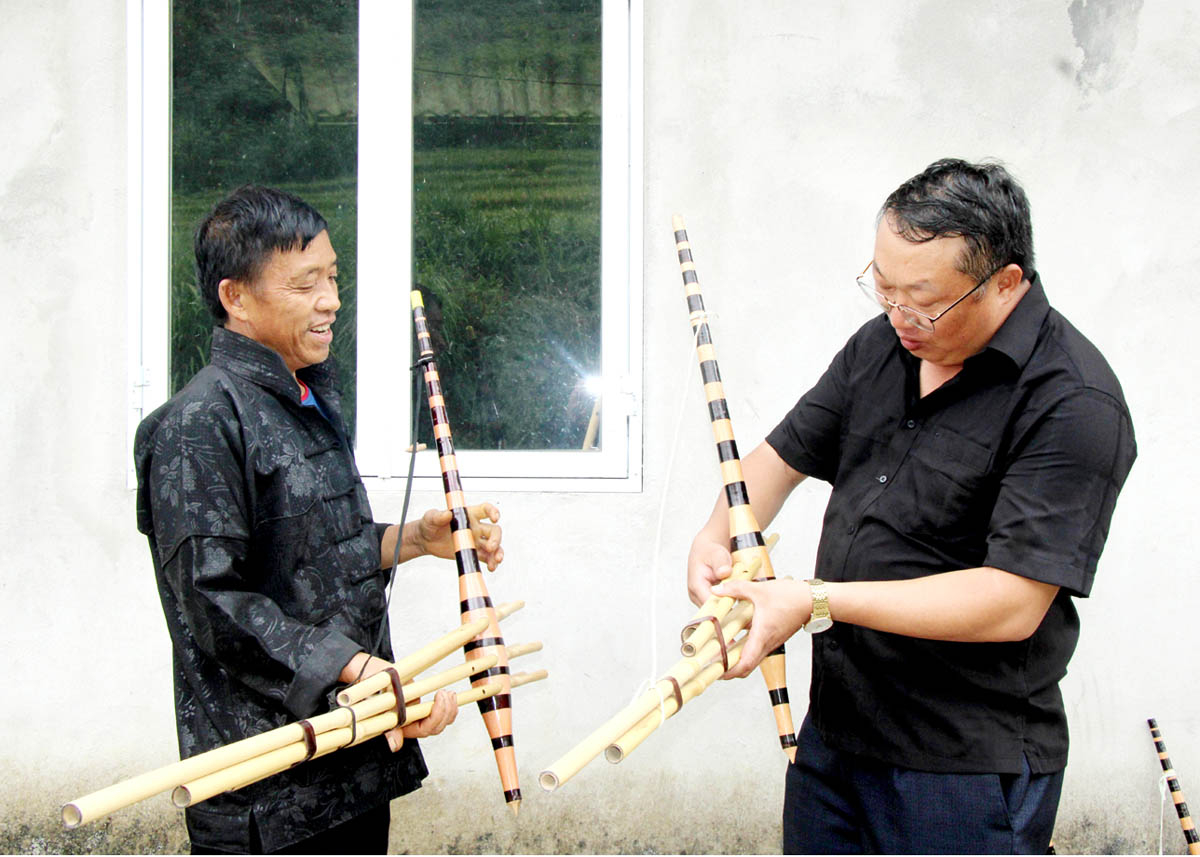
Artisan Lu Mi Thao (left) introduces the khaen (a type of bamboo flute) he crafted.
The Hmong mouth organ is unique because of its shape, structure, and sound-producing function. Typically, the mouth organ has six bamboo tubes attached to a hollowed-out wooden body. The only metal part is the brass reed (tongue). The body of the instrument is usually made from pine, cypress, or other hardwoods. From sourcing materials and processing to crafting, every step requires meticulousness and patience. Most importantly, the instrument must be tuned to produce a resonant and soulful sound to be considered authentic.
Through a conversation with Mr. Thào, we learned that his Hmong flutes come in many types, varying in length and size, with prices ranging from 1.5 to 5 million VND per piece. On average, it takes Mr. Thào about two days to make one flute, and he makes about 100 flutes a year. He doesn't need to take his flutes to the market; customers come to his house to order them, mainly to the Hmong people in the district and other provinces in Northwest Vietnam. Making Hmong flutes has helped improve Mr. Thào's family income, allowing them to build a sturdy house and enjoy a more comfortable life.
Besides crafting, artisan Thào is also very skilled at playing and dancing the Hmong flute. He is always invited to participate in the district's folk art festivals, local cultural activities, and flute competitions organized in the region. Now, with weary legs and graying hair, artisan Lù Mí Thào is still striving to pass on his passion, sharing his basic knowledge, skills, and experience in playing, dancing, and crafting the Hmong flute with many young people in his village and commune, as well as young people in neighboring districts and provinces.
Mr. Lu Mi Thao shared: “I feel very happy because the Hmong flute not only brings income but also preserves the cultural identity of my homeland. In addition, I actively teach the craft of making and playing the Hmong flute for free to relatives and young people in and outside the locality who want to learn. Over the past time, I have taught the craft to 30 young people in the commune, 10 of whom have earned money from making and selling Hmong flutes, and many can perform and participate in local festivals and cultural performances.”
Comrade Hang Mi Ngoc, Chairman of the People's Committee of Thai An commune, said: "With 98% of the population being Mong ethnic people, in order to preserve and promote the traditional cultural values of the Mong ethnic group in the area, the People's Committee of the commune is encouraging and supporting Mr. Lu Mi Thao to teach the techniques of playing, performing, and crafting the Mong flute to the younger generation. Mr. Thao has been an artisan and a respected figure in Quan Ba district since 2012. In addition to maintaining and developing the Mong flute craft, he also actively encourages the people to develop the economy , eliminate outdated customs, build a civilized lifestyle, and introduce and promote the unique cultural values of the people of Thai An commune to friends and tourists from near and far."
Farewell to artisan Lu Mi Thao - the keeper of the "soul" of the Hmong flute. We believe that his efforts will keep the rhythm of the flute forever echoing the melodies of the mountains and forests, connecting souls and harmonizing people with nature. And those melodies will awaken the hearts of countless tourists who have and will have the opportunity to enjoy and explore the cultural identity of the Hmong people when they come to the Dong Van Karst Plateau.
Nguyen Dieu/Ha Giang Newspaper
Source: https://baophutho.vn/nghe-nhan-lu-mi-thao-nguoi-giu-hon-khen-mong-221051.htm


![[Photo] General Secretary and President To Lam presides over a working session with the Central Policy and Strategy Committee on the development of the materials industry.](https://vphoto.vietnam.vn/thumb/1200x675/vietnam/resource/IMAGE/2026/05/21/1779359935432_a3-bnd-3129-1412-jpg.webp)
![[Photo] National Assembly Chairman Tran Thanh Man working with the Standing Committee of the Law and Justice Committee](https://vphoto.vietnam.vn/thumb/1200x675/vietnam/resource/IMAGE/2026/05/21/1779378929214_ndo_br_1-4610-jpg.webp)

















![[Photo] Capturing the moment the tide recedes at Yen Binh Son rapids - a million-year-old scenic spot in Quang Ngai.](https://vphoto.vietnam.vn/thumb/1200x675/vietnam/resource/IMAGE/2026/05/19/1779175463885_yen9-1199-jpg.webp)















































Comment (0)