

The oldest temple in Thanh Hoa preserves a pair of chopsticks used for testing poison and an ancient stone plate ( Video : Thanh Tung).

The Le Hoan Temple, a special national historical site, is located in Trung Lap village, Xuan Lap commune, Thanh Hoa province. It is a place of worship for Emperor Le Dai Hành (given name Le Hoan) and his father, mother, wife, and son.
According to historical records, Le Hoan was born in the year Tan Suu (941). After assisting Dinh Tien Hoang in suppressing the rebellion of the 12 warlords and achieving many merits, in the year Tan Mui (971), he was appointed as the Ten-Route General.

In the year of Ky Mao (979), before the turmoil in the Dinh dynasty court, Le Hoan led the people to defeat the invading Song army, securing the border. In the year of Canh Thin (980), he ascended the throne as emperor, taking the reign name Thien Phuc, and opening the glorious Early Le dynasty (980-1009).
During the reign of Le Dai Hanh, many important reforms were implemented. In the 3rd year of Thien Phuc (982), the king abolished the Northern copper coins and minted Thien Phuc coins – the first widely circulated currency of our country. He also opened commercial centers such as Truong Yen, Tong Dinh, and Long Bien. Besides military and diplomatic achievements, the king also focused on developing agriculture and small-scale industries such as blacksmithing, pottery making, and silk weaving.

Emperor Le Dai Hanh passed away in the year At Ty (1005) in the ancient capital of Hoa Lu, Ninh Binh, at the age of 65 after 24 years of reign. To commemorate his contributions, the villagers of Trung Lap built a small temple made of bamboo and leaves on the land where the king and his mother once lived. During the reign of King Ly Thai To, the temple was rebuilt, and during the Hong Duc era (1442-1497) under the reign of King Le Thanh Tong, the temple was built on the scale it is today.
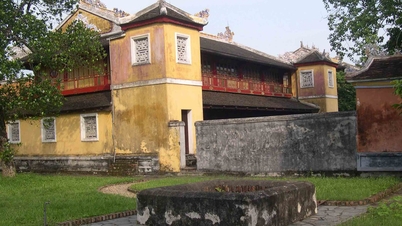
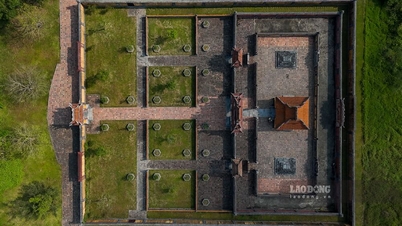
According to cultural officials in Xuan Lap commune, the Le Hoan temple boasts the oldest architectural style in Thanh Hoa, with the main temple built in the "Inner courtyard, outer enclosure" style. However, the two long buildings on either side forming the character "Quoc" (meaning "nation") have been dismantled, leaving only the character "Cong" (meaning "work" or "work"), consisting of three sections: the front hall, the middle hall, and the rear hall.

The main gate leading to the Le Hoan Temple has four green stone pillars, topped with mythical creatures (Nghê).

The ceremonial gate of the Le Hoan Temple remains relatively intact, with its structure of three bays, two wings, four trusses, and twelve wooden columns. Based on the main beam, the gate was renovated in 1921 (during the reign of Khai Dinh of the Nguyen Dynasty).

In the temple dedicated to King Le Dai Hanh, a large, gilded plaque bearing the words "Thanh Minh" (Bright King) is prominently displayed in the central hall.

The bronze statue of King Le Dai Hanh is placed in the center of the rear hall.

The rear hall also houses altars dedicated to Queen Mother Dang Thi (the king's mother), Truong Hung King Le Mich (the king's father), King Le Long Dinh (his son), and Queen Mother Duong Van Nga (the king's wife).


The temple was built of ironwood, with a tiled roof, and features many intricately carved patterns on the walls, beams, and rafters.
The temple dedicated to King Le Dai Hanh still preserves many artifacts of great historical and cultural value, such as royal decrees, edicts, couplets, large inscriptions, incense altars, shrines, statues, jars, and ancient bowls. Particularly noteworthy are a stone plate (jade plate) and a pair of ancient chopsticks made of alloy.


According to documents from the People's Committee of Xuan Lap commune, this jade plate was a gift from the Song dynasty to the Le dynasty. The inside of the plate is engraved with two lines of Chinese characters: "A piece of snow in Jiangnan. A precious treasure for eternity," along with a seal.
Mr. Hoang Hung, Chairman of the Tho Xuan - Yen Dinh Historical Science Association (Thanh Hoa), commented that these are rare artifacts of historical and cultural value. The jade plate can be dated to the period (981-1005), while the alloy chopsticks were used by the king to test for poison in food. Currently, due to concerns about theft, these precious artifacts are strictly preserved at the headquarters of the Xuan Lap Commune People's Committee.

Within the grounds of the Le Hoan Temple, there are also two ancient steles erected in the early 17th century.
The first stele, erected in the 2nd year of Hoang Dinh (1602) during the reign of King Le Kinh Tong, records that in the 15th year of Hong Duc (1484), King Le Thanh Tong granted Trung Lap village 67 acres of rice fields to be used for worshipping at the temple of King Le Dai Hanh.
The second stele, erected in the 8th year of Vinh To (1626) on the occasion of the temple's renovation, tells the legend of Mrs. Dang Thi giving birth to the king and that Le Hoan's ascension to the throne was in accordance with the will of heaven and the wishes of the people.

Location of the Le Hoan Temple, a special national historical site (Photo: Google Maps).
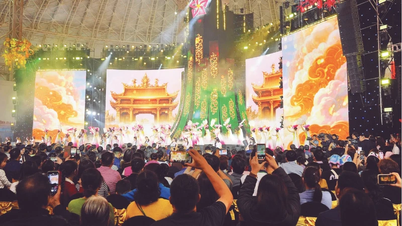
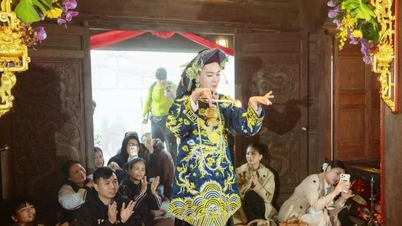
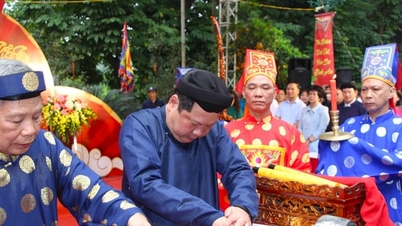
The Le Hoan Temple Festival takes place over four days, from the 6th to the 9th of March in the lunar calendar every year.
During the festival, the image of a military camp from the Early Le Dynasty will be recreated on a large scale, rich in historical detail. In addition, many folk games and performances, as well as other sports activities such as traditional wrestling, volleyball, chess, tug-of-war, and a competition to make rake-shaped cakes will be organized for the enjoyment of locals and tourists.
Notably, the festival also features a traditional rice cake-making ceremony to offer to the king.
Source: https://dantri.com.vn/du-lich/ngoi-den-co-co-doi-dua-thu-doc-va-dia-da-co-20260321161934496.htm























































Comment (0)