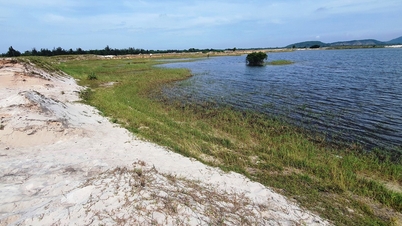
On the sandy coastal fields of Hai Tien village (Co To Special Economic Zone, Quang Ninh province), lush green watermelon fields are in the midst of harvest season. Amidst the characteristic sunshine and wind of the island region, the plump, ripe red watermelons are the result of many years of dedication to watermelon farming by the islanders.

Ms. Do Thi Quyen stands beside her watermelon field, ready for harvest. Photo: Cuong Vu.
The family of Ms. Do Thi Quyen, from Hai Tien village, is a household with extensive experience in watermelon cultivation on the island. This year, her family is planting about 2 acres of watermelons, with an expected yield of approximately 4 tons. This is an important source of income for the family.
Ms. Quyen said that her family started growing watermelons in 1997. Having been involved with this crop for nearly 30 years, she realized that watermelons are particularly well-suited to the island's natural conditions. The sandy soil, combined with the sunny climate, sea breeze, and characteristic salinity, creates a unique flavor for Co To watermelons.
Unlike many watermelon-growing regions on the mainland, watermelons from Co To Island are not overly large but have a rich, sweet flavor, red flesh, firm texture, and are very juicy. The natural conditions allow the fruit to accumulate a high sugar content, resulting in a delicious, refreshing taste that is rarely found elsewhere.
Sharing her farming experience, Ms. Quyen said that to have melon fields with consistently sweet and high-quality fruit, soil improvement plays a very important role.

"One of the secrets to the distinctive flavor of Co To watermelons lies in our environmentally friendly farming methods. For many years, our family has been using shrimp heads purchased from seafood processing facilities in the area to compost and improve the soil. After composting, this byproduct becomes a natural nutrient layer rich in minerals, making the soil loose, increasing its fertility, and reducing the need for chemical fertilizers," Ms. Quyen shared.

Watermelons from Co To are fertilized with decomposed shrimp heads, resulting in a rich, sweet flavor. Photo: Cuong Vu.
Thanks to being nurtured with organic fertilizers combined with the unique sandy soil and climate of the island, Co To watermelons have a rich, sweet flavor, red flesh, a crisp, firm texture, and a natural aroma. The model of utilizing seafood by-products for agricultural production not only contributes to improving the quality of agricultural products but also minimizes environmental waste, moving towards green, circular, and sustainable agriculture on the island.
Besides providing economic value, the lush green watermelon fields also contribute to the diverse agricultural landscape of this strategically important island region. Each watermelon season, the product is favored by locals and tourists alike for its delicious taste, safety, and the distinctive flavor of the Co To island.
In the context of developing agriculture in conjunction with experiential tourism, Co To watermelons are gradually asserting their value, becoming one of the local agricultural products, contributing to promoting the image of a green, friendly island with rich development potential.

Many tourists visiting the island seek out Mrs. Quyen's family garden to experience the green agricultural environment. Photo: Cuong Vu.



In addition to developing agricultural production, Ms. Do Thi Quyen's family is also gradually becoming involved in experiential tourism. Besides watermelons, her family also grows cantaloupes, sweet potatoes, and many other characteristic agricultural products of Co To Island.
In recent years, many tourists visiting the island have sought out Mrs. Quyen's family garden to experience green agricultural practices, directly learn about the planting and harvesting processes, and enjoy fresh produce right from the garden. This is a promising direction, contributing to diversifying tourism products, promoting the image of clean agriculture, and showcasing the unique values of Co To island to tourists.
Source: https://nongnghiepmoitruong.vn/ngot-lanh-dua-hau-co-to-d818448.html