

Spirit Horse
In the treasury of Vietnamese religious symbols, the horse is a special image. Unlike the mythical dragon, phoenix, or unicorn, the horse is a real animal that emerges from life, embodying perseverance, loyalty, and closeness. Deep within the spiritual realm, the horse has become a sacred animal, a guide, and is closely associated with deities, saints, and national heroes.
In the heart of Hanoi's Old Quarter lies the Bach Ma Temple, one of the four guardian temples of the ancient capital. The temple is dedicated to the deity Long Do – the tutelary god of Thang Long. The special sacred animal here is the white horse. According to legend, when King Ly Thai To moved the capital from Hoa Lu to Dai La and ordered the construction of city walls, the walls kept collapsing. The king set up an altar to pray, and heaven and earth responded, causing a white horse to emerge from the temple. The king followed the horse's footprints to rebuild the city walls, and from then on, they remained strong. The people revered the white horse as a guardian animal of the capital. Through time, the Bach Ma Temple remains solemn amidst the bustling city streets, an echo of a thousand years of history.

The White Horse Temple in Thanh Hoa tells a different historical story. It is where the people worship General Vu Duy Duong, who fell in a fierce battle against the Mac Dynasty's army. He was beheaded on the battlefield, his head not yet severed from his body, but General Vu Duy Duong clung tightly to his horse. The horse galloped to Muong Don before collapsing from exhaustion. The villagers discovered him and found the white horse weeping for its master. Moved by the general's bravery and the loyalty of his horse, the people buried him and erected a temple for worship . The Le Dynasty bestowed upon him the title "White Horse Linh Lang, Supreme Deity."
In Nghe An, the Bach Ma Temple is dedicated to General PhanDa , who played a significant role in helping Le Loi repel the Ming army in the 15th century. Legend says General PhanDa had a white horse that accompanied him in battle, protecting his village. The story of the general riding his horse into battle has become ingrained in the lives of the local people as an example of loyalty and integrity. Every year, on the festival day, a majestic procession with a statue of the white horse circles the village, the sound of drums blending with the mountain wind, creating a mystical and spiritual atmosphere.
The temples dedicated to white horses in many parts of the country have weathered countless ups and downs, becoming a source of understanding for successive generations that the peaceful land and nation we have today are thanks to the heroes and warhorses who contributed and sacrificed to protect it.
A source of emotional support
When mentioning sacred horses, one cannot fail to mention the legend of Saint Gióng's iron horse, one of the Four Immortals in Vietnamese folk beliefs. In 2010, the Gióng Festival was recognized by UNESCO as a Representative Intangible Cultural Heritage of Humanity. Sóc Temple (Sóc Sơn, Hanoi) is where Saint Gióng rode his iron horse to heaven after defeating the An invaders. Within the complex of historical relics, the statue of Saint Gióng riding his horse majestically and proudly on Sóc Mountain is a popular destination for many visitors to worship.

During the Giong Festival, the horse procession attracts a large number of visitors from all over. Furthermore, unlike many other festivals where only a few people carry offerings to be burned, in the horse burning ritual at the Giong Festival, all the people and visitors participate in carrying the giant sacrificial horse to the burning site as a farewell from the people to the sacred horse. According to local beliefs, anyone who touches the offerings to the Saint will have good fortune in life.
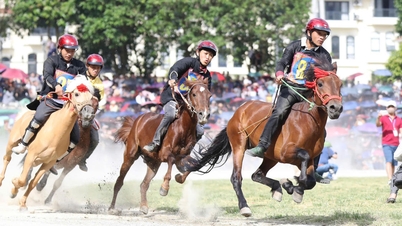
The horse as a sacred symbol is also present in many other spiritual spaces of the Vietnamese people. In processions during festivals, the horse is an almost indispensable symbol, representing the strength of our ancestors. Each hoof symbolizes courage and the spirit of victory in defeating invaders and protecting the borders. During these processions, horse statues are elaborately decorated, gleaming with gold, red, and white colors, evoking a sense of sacredness mixed with pride.

In Hue, the Nguyen Dynasty tombs feature stone horse statues. Ancient people believed that even the saints in heaven used horses for transportation. Particularly in many temples, shrines, and pagodas in Hue, the image of the Dragon Horse is heavily decorated, adding to the solemnity and symbolism of this sacred animal.
As cities develop and the fast pace of life sweeps people along, the temples dedicated to sacred horses, the statues of holy horses, still stand there as spiritual anchors, as reminders from our ancestors about the strength of a nation in preserving its history and showing gratitude to its forefathers. The hooves of horses from yesteryear have traversed battlefields, plains, and mountains. They are the echoes of tradition, the breath of culture, and the enduring identity that each generation must preserve.
Source: https://baophapluat.vn/ngua-thieng-trong-tam-thuc-viet.html




















































































Comment (0)