

A love affair with the loom.
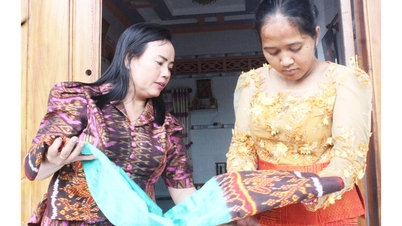
In a small house nestled along the clean concrete road of the Dak R'moan neighborhood, the corner of Mrs. Thi Dje's living room is always illuminated by the vibrant colors of unfinished brocade fabrics. There, the simple loom has been her companion for more than half her life. Whenever she has free time, whether early morning or late afternoon, she sits down, her hands nimbly moving the shuttle, her eyes following each bright thread as if seeing the harvest seasons and festivals of her village from the past.
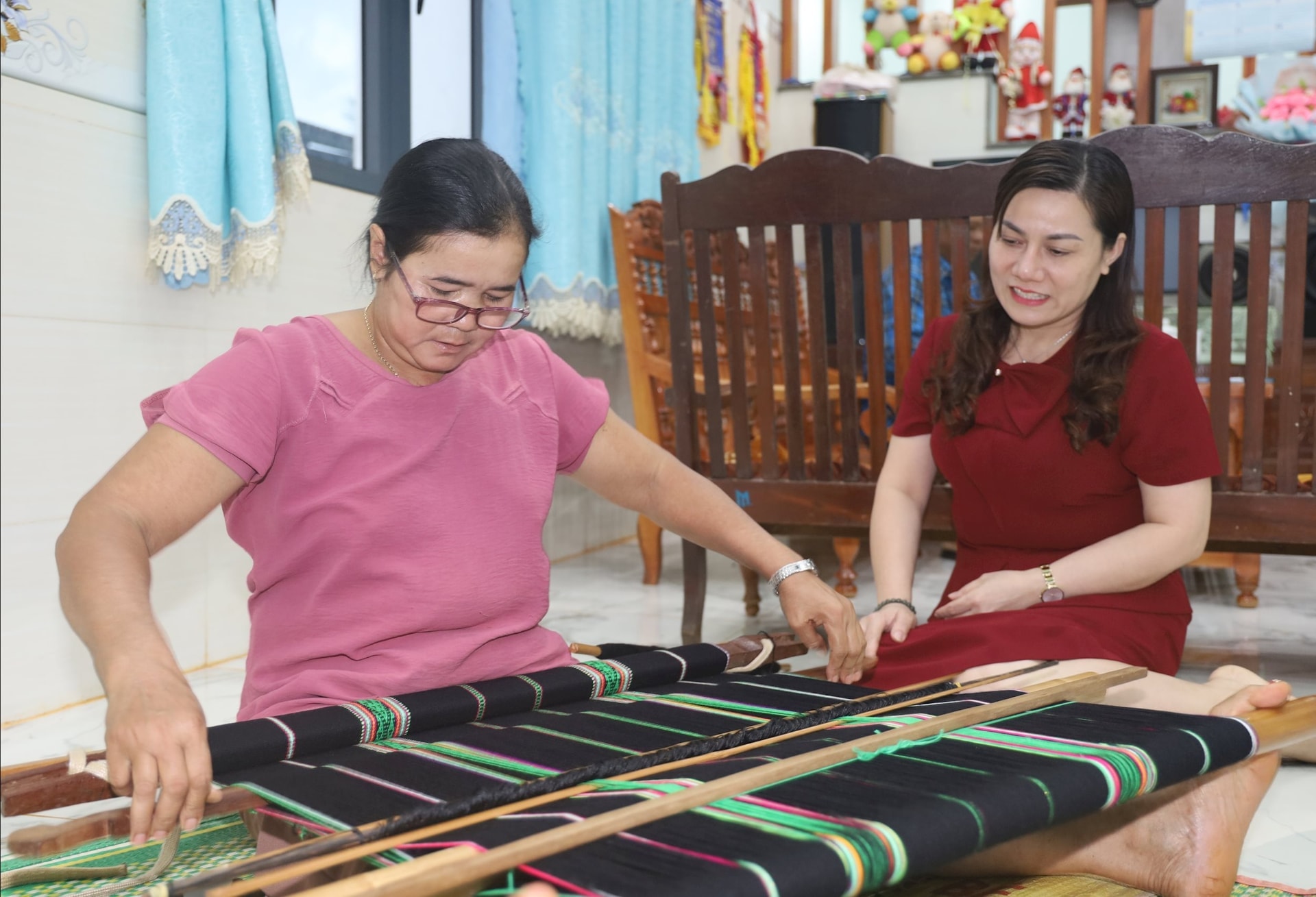
Born in 1969, from a young age, Ms. Thi Dje was familiar with the sound of her mother's and grandmother's looms. Thus, her passion for weaving became ingrained in her blood, a part of her life. She recounts that when she was a young girl, after school each day she would sit and weave with her mother. Even after getting married and having children, that passion never faded. The fabrics, shirts, and dresses she makes all bear the rich traditional patterns of the M'nong people, both delicate and requiring meticulous craftsmanship. Her husband is always proud to wear the clothes his wife wove. And her children eagerly wear the outfits she made during Tet (Vietnamese New Year) and other festivals.
Ms. Thi Dje confided: “In the past, weaving was very hard work. From selecting the yarn and dyeing the colors to stretching the loom and weaving the fabric, everything was done by hand. Now, with the help of sewing machines, I only need to weave the fabric and then hire a seamstress to finish it, which is much less strenuous. Even so, each thread and each pattern still has to be done by hand to preserve its uniqueness. “I weave mainly out of passion, because selling them doesn't bring in much profit. Each dress or outfit costs about 400,000 - 800,000 VND, some more elaborate ones cost over 1 million VND, but seeing my relatives and friends wear the clothes I woven makes me happy.”
Everyone in the neighborhood knows that Mrs. Thi Djê is a skilled and dedicated weaver. Ms. Thi Rơi shared: “Nowadays, few people weave like Mrs. Djê anymore. She weaves slowly and carefully, putting her love for her ethnic group into each product. She enthusiastically helps anyone who asks for her help. Her brocade is both beautiful and durable, so everyone appreciates and trusts her to make their own work.”
Passing the torch to the next generation.
Learning the craft from her grandmother and mother, Ms. Thi Djê learned to weave at the age of 10. Initially, she only wove small pieces of fabric to make clothes for dolls, then later learned to weave skirts, loincloths, blankets, and eventually more complex patterns. She explained that weaving brocade requires not only skillful hands but also a good memory, as each pattern carries its own meaning and is arranged according to the M'nong people's own rules. Some patterns depict mountains, forests, and streams; others symbolize the sun, wildflowers, or aspirations for a prosperous and united life.
To date, Ms. Djê can weave about 80% of the traditional M'nông patterns, including many difficult designs that few young people can still replicate. According to her, the most difficult part is crocheting and embroidering the patterns. The worker must have a steady hand and be precise down to each thread; even a slight deviation will ruin the pattern. She has three daughters and always hopes they will preserve the traditional craft of their ethnic group. "I teach my daughters to weave not so they can make a living from it, but so they understand how skillful and talented their ancestors were. When they appreciate that value, they will be proud and not lose sight of their roots," she shared.
Thanks to their mother's perseverance, two of Djê's three daughters learned to weave and could make simple products. On their days off, the daughters would sit with their mother at the loom, listening to her tell stories about the first fabrics, the meaning of each pattern, and about the M'nông women of the past who wove cloth while raising children and working in the fields.
Even now, amidst the hustle and bustle of modern life, when ready-made clothing is ubiquitous, there are still women quietly sitting by their looms, ensuring that the rhythmic "clicking" sound doesn't fade into oblivion. For Mrs. Thi Djê, each stitch not only connects threads of fabric but also connects memories, culture, and love for her homeland. In her small room in the Dak R'moan residential area, the sound of the loom still resonates like the heartbeat of a woman who loves her craft and her homeland, and like the enduring breath of M'nong identity in everyday life.
Source: https://baolamdong.vn/nguoi-giu-hon-tho-cam-giua-doi-thuong-399737.html




![[Photo] “Red Journey” 2026: Vietnamese Youth Continue Building the Bridge of Friendship Between Vietnam and China](https://vphoto.vietnam.vn/thumb/1200x675/vietnam/resource/IMAGE/2026/04/20/1776629730866_4055880775670638308-9618-4200-jpg.webp)




























































Comment (0)