

19:41, 30/03/2023
 |
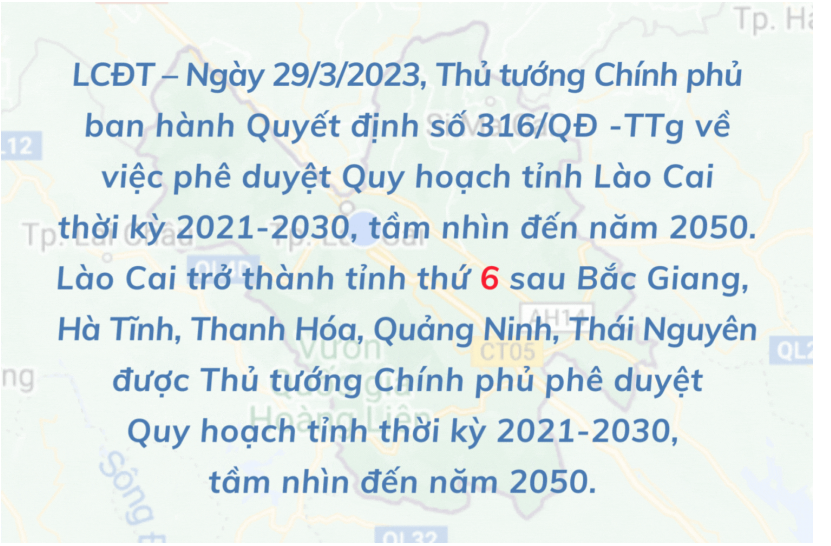
It can be said that the Planning for the period 2021-2030, with a vision to 2050, is a "golden opportunity" for Lao Cai to take off because before the Planning Law came into effect (from January 1, 2019), the overall socio -economic development plan and the development plans for key industries, sectors, and products were implemented according to various regulations, resulting in many shortcomings, limited quality, and a lack of inter-regional and inter-sectoral linkages.
The management and inspection of planning implementation are not clearly defined, penalties for violations in planning are not strict, and the mobilization of resources for planning implementation is limited, leading to prolonged "suspended" planning and wasting development resources.
Recognizing this issue, Lao Cai province pays special attention to planning, considering it a key political task. Therefore, the province always prioritizes allocating financial and human resources to planning work. During the planning process, the province has mobilized the entire political system to ensure that the plan is realistic, has a strategic vision, and reflects innovative thinking.
On December 13, 2019, the province submitted and received approval from the Prime Minister for the task of developing the provincial planning. The planning process took place from April 2020 to November 2021... After numerous revisions based on recommendations from 20 central ministries and agencies, and provinces in the Northern Midlands and Mountains region, Lao Cai has completed the Lao Cai Provincial Planning for the period 2021-2030, with a vision to 2050, and submitted it to the Prime Minister for approval.
 |
 |
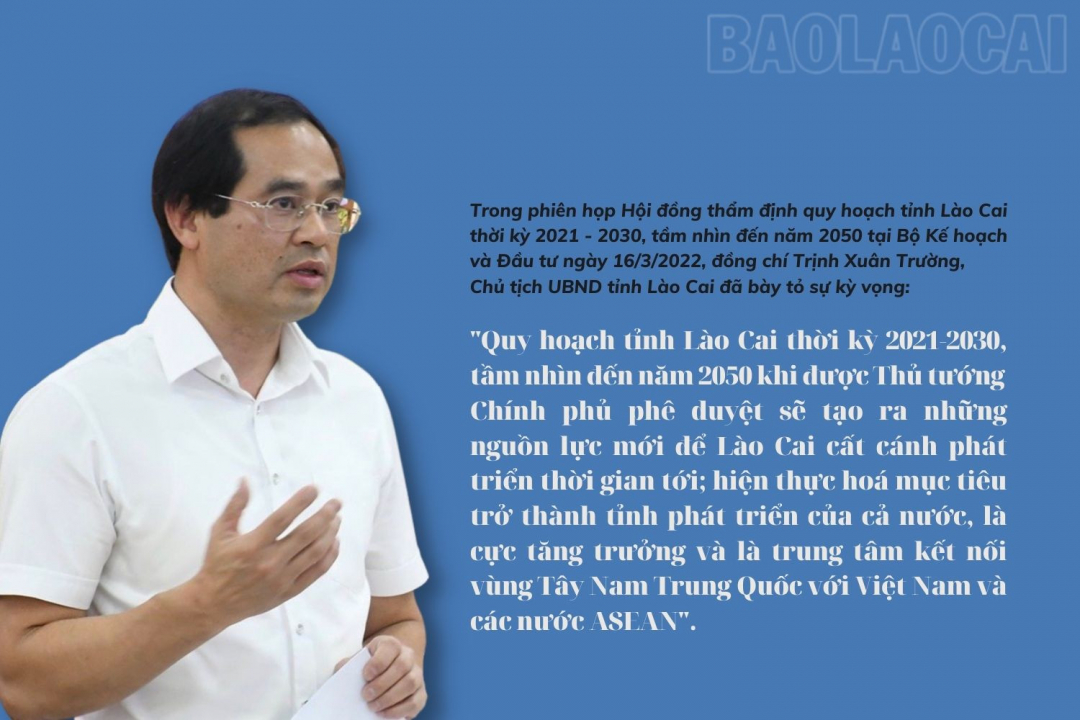
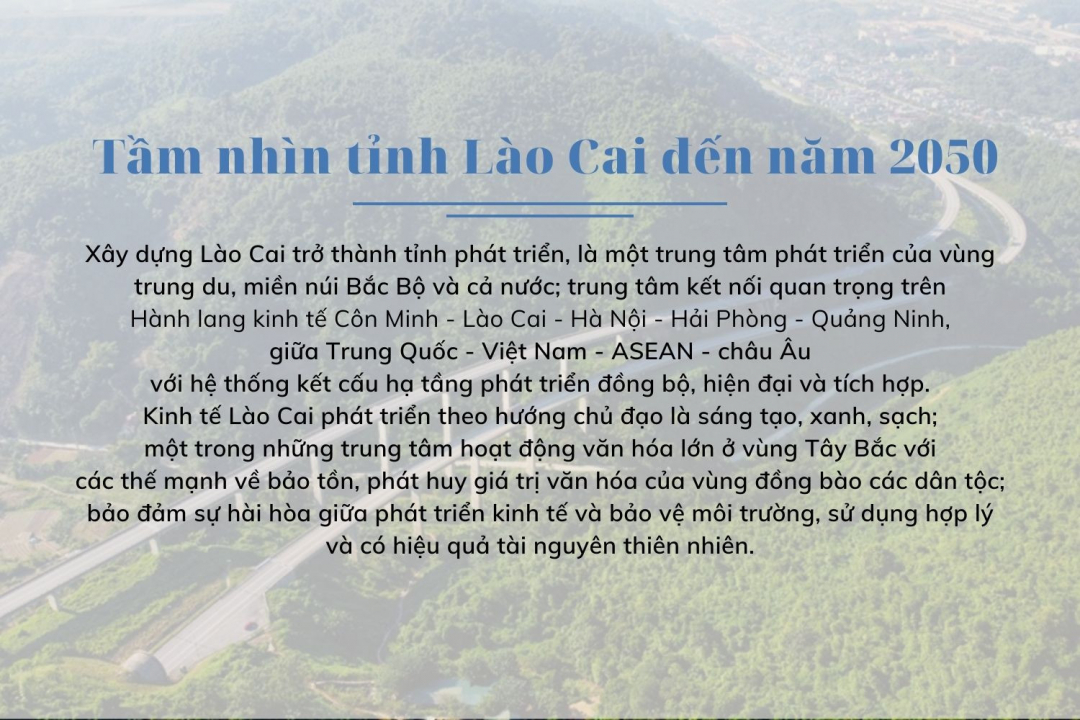
Looking at the Lao Cai provincial planning for the period 2021-2030, with a vision to 2050, it is clear that Lao Cai province has the will and aspiration to rise to the top by 2030. The goal is to have a per capita GRDP among the top 10 provinces and cities nationwide; per capita income among the top 30 provinces and cities nationwide; and to become a regional and national center for tourism, border trade, services, and manufacturing. By 2050, Lao Cai aims to become a developed province, a development center of the Northern Midlands and Mountains region and the whole country; a crucial connecting center on the Kunming - Lao Cai - Hanoi - Hai Phong - Quang Ninh economic corridor between China, Vietnam, ASEAN, and Europe, with a synchronously developed, modern, and integrated infrastructure system.
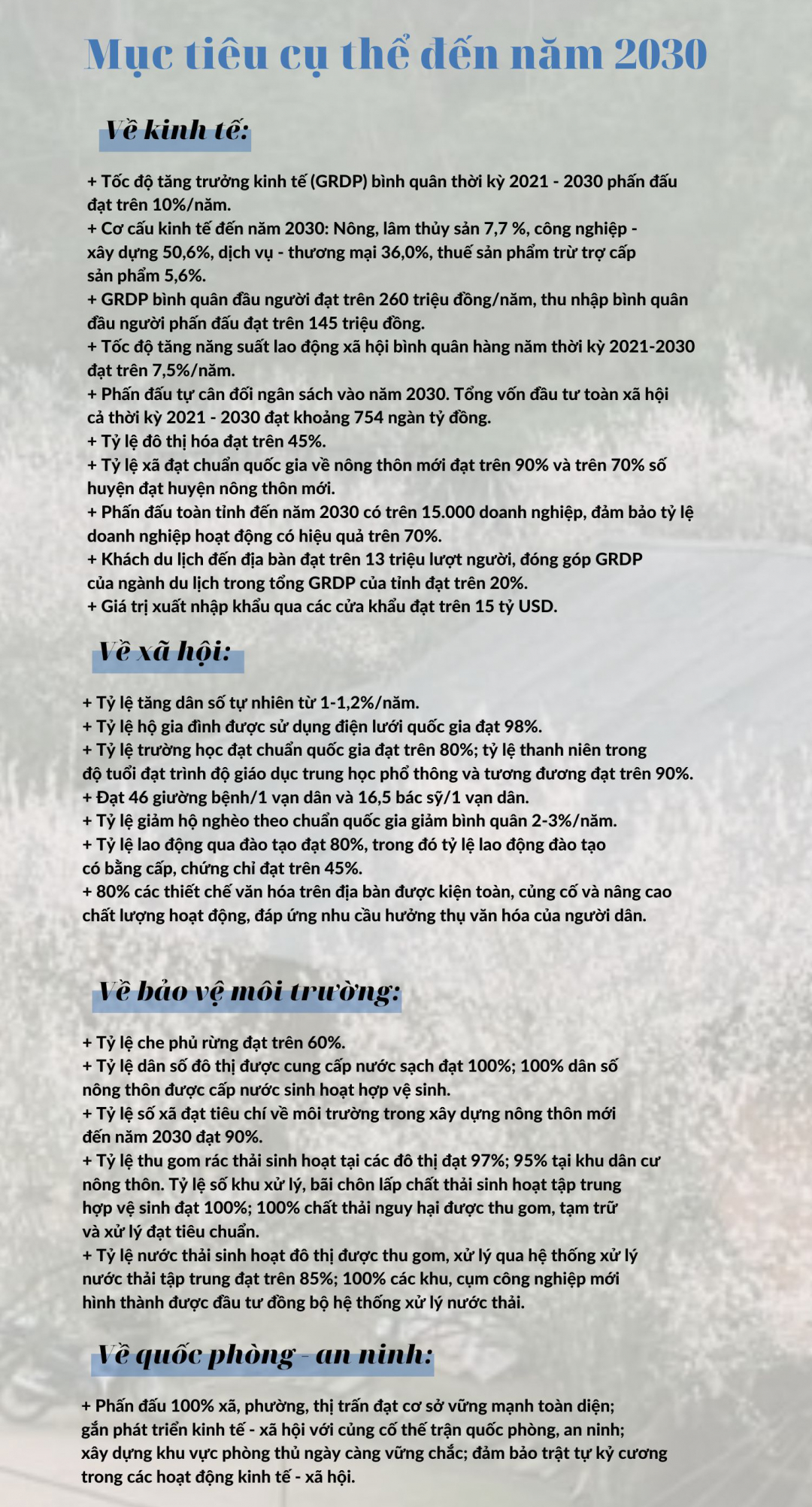 |
Lao Cai province has identified tourism development as a key, breakthrough economic sector, gradually becoming the leading economic sector and a driving force for socio-economic development; building the border economic zone into a major and leading logistics center of the country, a trade hub connecting ASEAN countries with the markets of Southwest China and Europe; developing industry towards deep processing and manufacturing, expanding the province's position and role in the national industrial production chain; focusing on transforming agriculture into commodity production, shifting the mindset from agricultural production to agricultural economic development. Trade, services, education, health, culture, social affairs, information and communication, science and technology, etc., are comprehensively developed and ranked among the most advanced in the country; the material and spiritual lives and living environment of the people are improved; cooperation and integration are expanded; and a solid national defense and security posture is built.
By making the most of the opinions of central ministries and agencies, experts, managers, scientists, businesses, and the people, Lao Cai province has built a realistic vision for the future, with a strategic perspective and groundbreaking thinking.
 |
 |
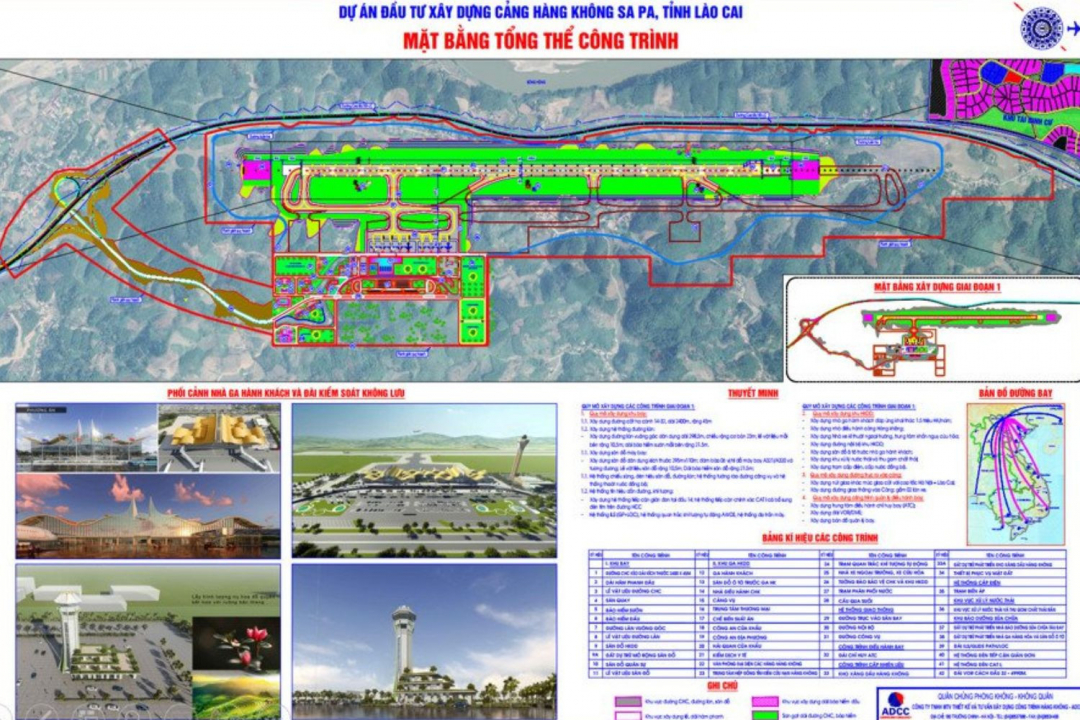
The Lao Cai Provincial Planning for the period 2021-2030, with a vision to 2050, selects three breakthrough areas : Completing a synchronous and modern socio-economic infrastructure system, focusing on key transportation projects, major urban infrastructure, border gate infrastructure, and digital infrastructure. Developing and strengthening the application of science, technology, innovation, and promoting digital transformation. Developing advantageous service sectors with high knowledge and technology content: border gate economy, tourism, education and training, and healthcare.
 |
Focus on implementing five key tasks : perfecting institutions and policies; developing human resources and labor force; improving infrastructure, with a focus on transportation and digital infrastructure; developing agriculture and rural areas and arranging and stabilizing the population; and preserving and promoting the cultural identity of the people of Lao Cai.
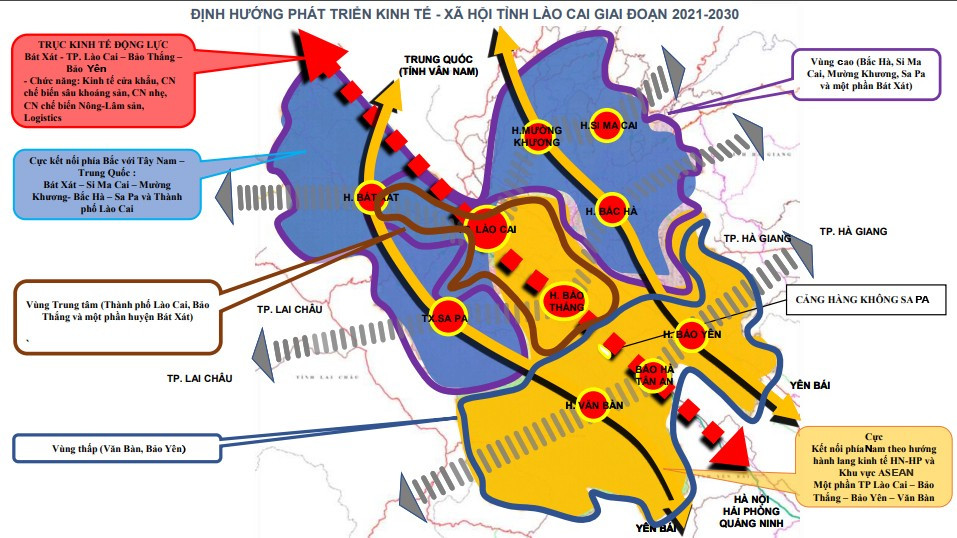
Development priorities: Based on the analysis and assessment of potential, advantages, and forecasts of development trends, the Provincial Planning has identified development priorities, including one driving axis, two development poles, three economic regions, and four pillars of economic development .
 |
A dynamic axis: Forming a dynamic economic axis along the Red River, which includes the development of urban areas: the expanded Bat Xat town, Lao Cai city, Tang Loong town, the expanded Pho Lu town (including Son Ha and Son Hai), and the new urban areas of Bao Ha - Tan An, Trinh Tuong, and Vo Lao; developing processing and manufacturing industries, deep processing of minerals, light industry, and deep processing of agricultural products; attracting investment to build logistics zones, inland ports, commercial infrastructure serving border trade, industrial parks, and industrial clusters; and developing tourism service areas, cultural and spiritual tourism, and entertainment. The dynamic economic axis along the Red River plays a role in linking the spatial development of the two development poles and three economic regions of the province, connecting inter-provincial areas and the entire country with the Southwest region of China on three connecting platforms: socio-economic infrastructure, cultural and historical sites, and businesses.
Two development poles: The northern pole includes Lao Cai city, Bat Xat district, Sa Pa town, Bac Ha district, and part of Bao Thang district: Developing border trade, commerce, urbanization, tourism, industry, and agriculture; directly connecting with Southwest China. The southern pole includes Bao Yen district and Van Ban district: Developing urbanization, industry, tourism, and forestry; connecting the province with other provinces in the Northern Midlands and Mountains, the Northern Delta, and the ASEAN region. The southern development pole, including Bao Yen, Van Ban, Bao Thang districts and the southern area of Lao Cai city: Playing a role in linking and connecting with the Noi Bai - Lao Cai expressway, the Vietnam - China international railway, and horizontal transportation routes to the eastern provinces (Ha Giang, Tuyen Quang), western provinces (Lai Chau, Dien Bien, Son La), and southern provinces (Yen Bai, Phu Tho, northern provinces, Hanoi, Hai Phong, Quang Ninh).
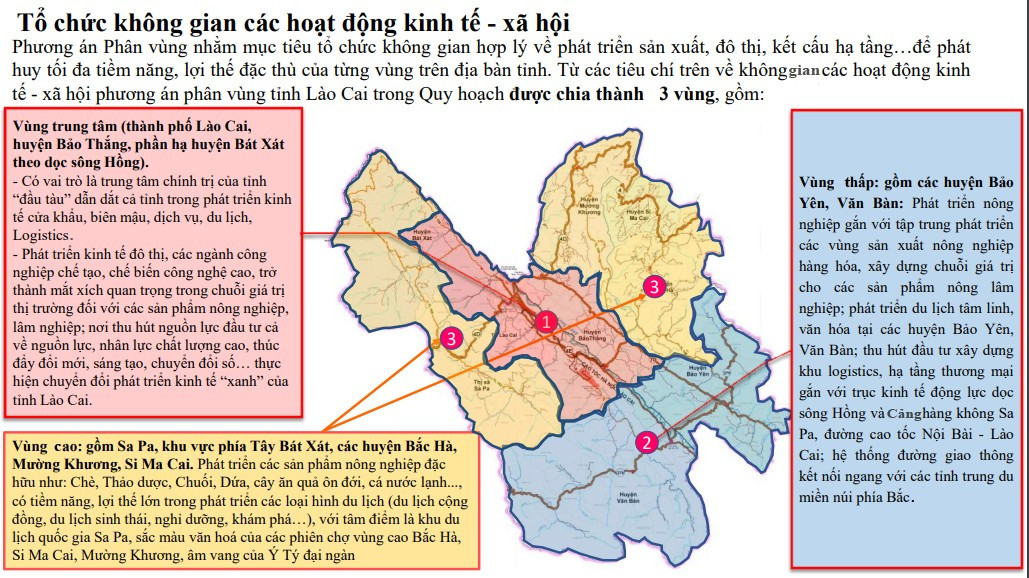
Three economic zones: The lowland zone includes Van Ban and Bao Yen districts; the highland zone includes Bac Ha, Si Ma Cai, and Muong Khuong districts, Sa Pa town, and the western part of Bat Xat district; the central zone includes Lao Cai city, Bao Thang district, and the lower part of Bat Xat district along the Red River.
Four pillars of economic development: Development of border gate economy and services; Development of processing and manufacturing industries; Development of tourism; Development of agriculture, forestry and fisheries economy.
 |
 |
 |
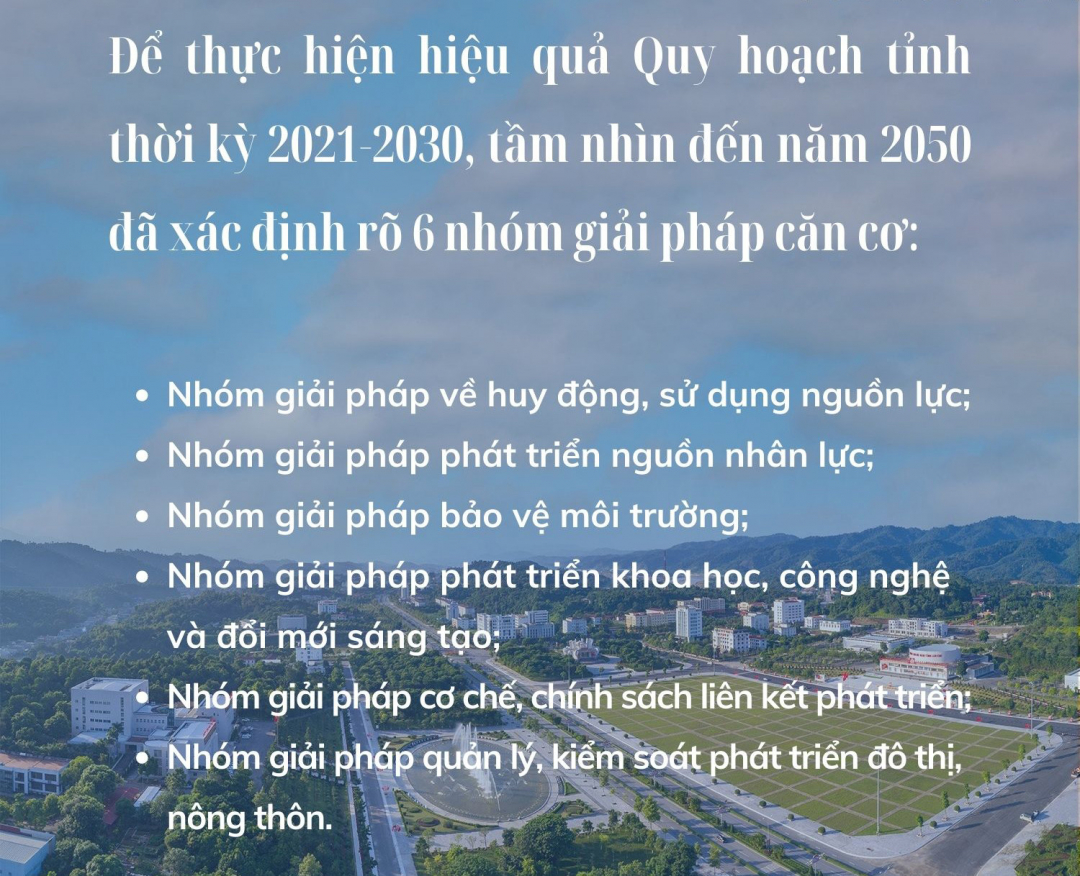
To effectively implement the Provincial Planning for the period 2021-2030, with a vision to 2050, six fundamental groups of solutions have been clearly identified. First, there is the group of solutions regarding the mobilization and utilization of resources: The capital investment needs for the period 2021-2030 are approximately 774 trillion VND, of which, the period 2021-2025 is approximately 260 trillion VND, and the period 2026-2030 is approximately 514 trillion VND. The projected capital mobilization from various sources includes: State budget approximately 80 trillion VND, ODA approximately 6 trillion VND, government bonds approximately 6 trillion VND, foreign direct investment (FDI) approximately 290 trillion VND, investment from the business sector approximately 122 trillion VND; and investment from the residential sector approximately 270 trillion VND.
In addition, a range of solutions will be implemented, including human resource development; environmental protection; scientific, technological and innovation development; mechanisms and policies for integrated development; and management and control of urban and rural development.
 |
According to Lao Cai Newspaper
Source
![[Image] National Assembly discusses the implementation of the socio-economic development plan.](https://vphoto.vietnam.vn/thumb/1200x675/vietnam/resource/IMAGE/2026/04/20/1776696707422_ndo_br_img-20260420-185419-jpg.webp)

![[Photo] General Secretary and President To Lam meets with National Assembly delegates from ethnic minorities.](https://vphoto.vietnam.vn/thumb/1200x675/vietnam/resource/IMAGE/2026/04/20/1776696701056_a1-bnd-8331-3342-jpg.webp)



























































Comment (0)