

I became acquainted with literary critic Chu Van Son in the late 1980s at Hanoi Pedagogical University, where he had just been hired as a lecturer.
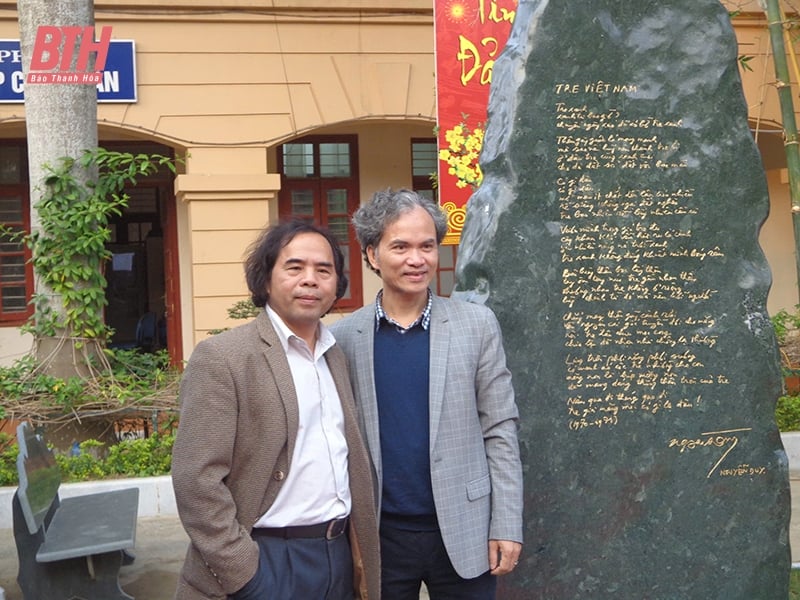
At this time, Son had a small family in Hanoi. Occasionally, he would return to Thanh Hoa to visit his elderly mother and siblings. Son had many siblings. His father passed away when Son was only a few months old. Later, his eldest sister also died young due to illness, leaving behind a son. The remaining siblings were two sisters and two brothers. One sister worked as a civil servant, and one brother served in the army and has since retired. Son's family originally came from a working-class background. Previously, almost the entire family was involved in pottery making. When I first visited Son's home, I saw that his mother was quite old. No one in Son's family had stopped making pottery anymore. Almost no one in the village or neighborhood made pottery either. Son's mother explained that with easier transportation now, people brought in Bat Trang and Chu Dau pottery, and their designs were more diverse and attractive, so Lo Chum pottery couldn't compete and gradually faded away.
Playing with Son, I learned that his paternal hometown is in Ha Nam province. In the past, Ha Nam was a poor province, located in a low-lying, flood-prone area prone to drought. Due to poverty, many people left their hometowns to seek a better life. Son's father wandered to Thanh Hoa province, settling in Lo Chum pottery village, where he found work for the kiln owners. There, he met his wife, a local resident, and they fell in love and got married. As Professor Tran Quoc Vuong jokingly put it, "Where the wife is, the culture is there too." It's no wonder that some cultural researchers consider Vietnamese culture to be the mother culture. Son was born and raised in Lo Chum; the atmosphere, the scent, the essence of Thanh Hoa's land naturally shaped him into the artist-intellectual Chu Van Son. Later, guided by imagination, intuition, or perhaps spiritual inspiration, Son sketched a portrait of his father with a ballpoint pen. It depicted a young, healthy farmer with resolute eyes. Although the drawings were just sketches from imagination, Sơn's siblings praised them, saying they looked very much like their grandfather. Sơn was a talented man. Throughout his life, he drew many portrait sketches, usually of his literary friends and beloved teachers. I, the author of this article, also had a couple of them drawn by Sơn, and I still cherish them as a precious memento of my dear friend.
I asked Son, "When you were little, did you have to do pottery?" "Yes," Son replied, "but mostly just for fun. My mother wouldn't let me; if I even tried, she'd chase me away. I was a decent student, and the youngest, so the whole family spoiled me." Son recounted, "My mother may look like that, but she was quite strict. If I came home late from school playing around, she'd whip me immediately. I was so angry with her back then. Looking back, it's because my father passed away early, leaving my mother to raise a whole brood of children. The hardship made her short-tempered..." To say this shows how much Son loves his mother.
Son's hamlet is located along the banks of the Nha Le canal, as the locals call it. The small, deep river has crystal-clear water and flows quite strongly. One afternoon, Son took me on his motorbike along the canal to the Ma River embankment. When we reached a landing that extended from the canal to the shore, Son said it was the Royal Landing. Wow, the name sounds so noble and aristocratic, yet it seemed so simple and humble. Son explained that in the old days, whenever the Le Dynasty kings returned to their ancestral homeland in Thanh Hoa province, they would travel by river. Upon reaching this landing, all the boats would anchor so that the officials and soldiers could carry the king ashore in palanquins and sedan chairs.
Walking along the Nha Le canal from Lo Chum up to where it joins the Ma River, for about a few kilometers, a vast river unfolds. Truly, the sky is wide and the river is long. Looking upstream, one can see Ham Rong Mountain, home to the legendary bridge from the years of the war against the Americans. The characteristic folk songs of the Thanh Hoa river region resonate in my mind. The upper reaches of the Ma River belong to Son La province, and further upstream, it stretches into Laos. “The Ma River is far away now, O Tay Tien…/ The Ma River roars its solitary journey.” These lines from the poem Tay Tien by poet Quang Dung suddenly come to mind. The Ma River carries within it a wealth of culture, flowing from Dien Bien to Son La, circling through Laos, and then flowing straight to Thanh Hoa before emptying into the sea. Son recounts that, as a child, he and the other children in the neighborhood often went upstream along the Ma River embankment. Just for fun, nothing in particular. Some afternoons, engrossed in playing, they would suddenly remember and run home, arriving just as dusk was falling. Once, I came home late and almost got a beating from my mother. Sitting on the high embankment, gazing at the mighty river flowing by, I wondered if the image of this vast river had awakened a vague yearning to reach distant horizons in Son's childhood?... Later, Son won first prize in the first national-level Literature competition for gifted students in 1978, then went to Hanoi to study, and later became an excellent teacher and an outstanding critic. Perhaps a part of the horizons from Son's childhood has now been conquered by him.
Sơn's family has many sisters and sisters-in-law, so they cook very well and know how to make many kinds of specialty cakes and pastries. Every time Sơn returned to Hanoi after visiting home, he would bring back many things that his mother and sisters made him bring along. There were rice cakes, sticky rice cakes, rice rolls with meat and shrimp fillings, and countless spices. Sơn's family's cakes and pastries always had a rich, fragrant flavor; you could eat until you were full but still crave more. Later, whenever I went back to Thanh Hoa for work, I couldn't find any shop that made cakes and pastries as delicious as those made by Sơn's mother and sisters.
What I remember most is the delicious sweet rice pudding that my mother used to cook. It's a dish I'm almost addicted to. Apparently, it's made from molasses, sticky rice with mung beans, and glutinous rice, with the aroma of ginger. When served, peanuts and white sesame seeds are sprinkled on top. You don't eat this pudding with a spoon; you cut it into six even pieces like starfruit blossoms with a knife and hold it in your hand. Oh, holding a piece of this thick, fragrant pudding, you can't bear to put it in your mouth right away. You chew each piece carefully, savoring every bite to fully appreciate its delightful taste.
Having accompanied Son home to Lo Chum many times, I was also well-liked by his mother and siblings. Every time Son returned to Hanoi after going back to his hometown, he would bring me a gift, sometimes saying his mother sent it, other times saying his sister sent it. It was truly heartwarming to see the kindness of his mother and sisters!
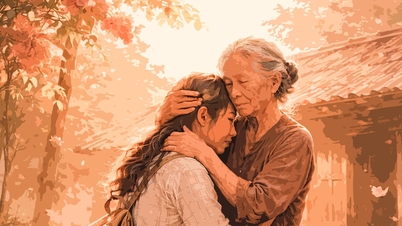
I remember once accompanying Son back to his hometown to visit his sick mother. She was over eighty years old. Her eyesight was failing, and her hearing was poor. She was reluctant to get up, mostly lying down. I sat beside her, asking her questions. She only heard bits and pieces of what I said. When I went to say goodbye, she sat up and called out to Son's sister, "Have you sent the sticky rice cakes as a gift to Uncle Gia yet?" We all laughed. My friend's sister teased, "You value Uncle Gia more than even us!"...
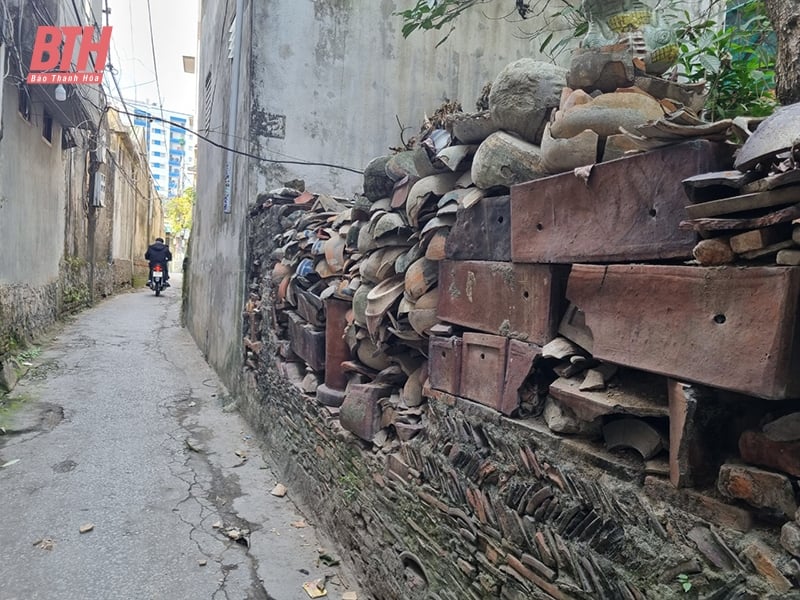
Life is unpredictable. My friend, unfortunately, fell seriously ill and passed away before my grandfather. It's truly a case of "Yellow leaves remain on the tree / Green leaves fall to the sky, who knows?" On the day my grandfather passed away, I went to light incense for him. After leaving that beloved house, I strolled alone for a long time. On the tiny paths around the village, the walls of houses and fences were built with the shattered pieces of earthenware jars and pots piled high – remnants of a golden age of the famous Thanh Hoa pottery village.
Now, whenever I return to Thanh Hoa province for work or simply to visit and have fun, I often seek out eateries that serve cakes, sweet soups, and sticky rice dishes to relive the taste of the local delicacies made by Son's mother and sister back then...
Hanoi, mid-winter, December 10, 2024
VAN GIA
Source: https://baothanhhoa.vn/nha-ban-toi-o-pho-lo-chum-237952.htm
![[Photo] General Secretary and President To Lam meets with National Assembly delegates from ethnic minorities.](https://vphoto.vietnam.vn/thumb/1200x675/vietnam/resource/IMAGE/2026/04/20/1776696701056_a1-bnd-8331-3342-jpg.webp)

![[Image] National Assembly discusses the implementation of the socio-economic development plan.](https://vphoto.vietnam.vn/thumb/1200x675/vietnam/resource/IMAGE/2026/04/20/1776696707422_ndo_br_img-20260420-185419-jpg.webp)













![[Infographics] Hai Tien Beach Tourism Festival 2026 and celebratory activities](https://vphoto.vietnam.vn/thumb/402x226/vietnam/resource/IMAGE/2026/04/20/1776687221715_infographics-le-w1200t0-di2616d199d1165828t11358l1-2026-029.webp)





![[INFOGRAPHICS] Phase 2 of the First Session of the 16th National Assembly: Considering and deciding on many important issues](https://vphoto.vietnam.vn/thumb/402x226/vietnam/resource/IMAGE/2026/04/20/1776678933182_20-4-anhquochoi2004.jpeg)









































Comment (0)