


Today, everyone knows that people need information on many aspects and fields, especially information about political and socio-economic events. A society with a high level of public awareness is a society with abundant journalistic information. In a modern society with a high level of public awareness and good democracy, it is inevitable that the budget allocated to journalistic information services must account for a large proportion of the country's total budget. Information services are essential because, in any country, information is wealth, a resource, a commodity, intellectual property, and the authority of the State. Whoever possesses information possesses power... Therefore, journalists have a role and position, and thus need to have a scientific attitude towards information.
The movement of society, the development of nations, and the information explosion are all unfolding dynamically, richly, and complexly. There is even an "information war": truth and falsehood are intertwined. Is the movement in a number of countries an upward trajectory or a collapse? In such a situation, journalists need a voice, and the public will judge their perspective. That is the belief in truth.
The most valuable and essential quality of a journalist is the ability to truthfully and eloquently reflect the vibrant realities of life, enabling readers, observers, and listeners to see and recognize the new, and to collectively cultivate its development. Currently, new elements—or more accurately, the dissemination of new elements—receive little attention. This is a difficult task for several reasons: objectively, due to the socio-economic situation; and subjectively, because journalists are limited in their awareness and knowledge, lacking understanding of life and professional skills.
Journalists need to understand that the new element is different from the new, different from the typical, and also different from the model.
The new factor must be something new that arises from revolutionary practice, from the working and productive life of the people. It is a concrete manifestation of the good nature of the social system, something unique that can be multiplied and become widespread.
New factors, while containing many positive elements, often arise during the application of laws, the implementation of policies and guidelines, and the application of economic management mechanisms. These new factors must embody innovation, abandoning the old, the clichéd, and the outdated. The demise of the old and the emergence of the new lead society forward. These are facts that cannot be ignored or left unaddressed and encouraged. Conversely, there may also be "new" factors that negatively impact society, which must be frankly criticized. Understanding this gives us journalists an added responsibility in promoting these new factors internationally. Of course, this must achieve positive results, guide public opinion, and instill in people faith in the common progress of humanity.
New factors emerge, which can be affirmed, summarized, acknowledged, even adopted as policies, and may even be replicated as a model. For example, the "contract bidding" system – a form of product contracting linked to the division of labor ("whoever is good at a certain trade does that trade") in Vinh Phu province – was later seen as a good practice in implementing the ten-point contract system. In many models, new factors also emerge, namely the dynamism of the model. The factors considered when evaluating new factors in the economic field are usually viewed from three aspects: economic significance, economic benefits, and human factors…
Discovering new factors is the responsibility of journalists, a job that demands their sensitivity. Journalists need to be able to spot new factors, the unusual in the ordinary, even seeing the good in what appears fragmented or contradictory. New factors can be discovered from reporters, readers, journalists, leaders… But regardless of the source, the result largely depends on the journalist's courage and talent. A new factor might only be a budding flower, a spark, but the journalist needs to recognize it. Readers will surely remember that in the 1960s, the press in the northern provinces played a key role in discovering and promoting exemplary factors such as the Three-One Flag, the Great Wind, and the Coastal Waves; The education sector has the Hoa Binh Socialist Youth Labor School, Bac Ly Secondary School, etc. For example, last year, the findings of our press made a significant contribution to the formation of policies and guidelines, and to understanding the requirements and content of the reform movement in all fields. Journalists must be deeply involved with the grassroots, listen attentively, analyze and consider issues, and be able to generalize problems and events based on a keen understanding of society, current events, and economic thinking.
Another issue is how to effectively introduce new factors. Some argue that new factors are often unexamined and unproven, so what should the level of publicity be? Of course, the level must depend on the socio-economic significance of the new factor. Journalists are not allowed to sugarcoat or exaggerate, nor are they allowed to distort the new. The time when people focused too much on form, only paying attention to breadth and large-scale projects is over. Today, we know how to look at the small details and cherish the new developments that are progressing in a positive direction. Therefore, journalists must speak about the new in their own way, aiming to build healthy public opinion, create conditions for the new to emerge, and fight for its survival and development.
A scientific approach to disseminating new information and new factors also lies in achieving the goal of spreading these new factors widely. Effective and widespread dissemination requires collaboration with various agencies and media outlets. The leaders at all levels of the Party and State, and those directly in charge of media agencies, act as "midwives" for the emergence and spread of new ideas. A new factor can only be recognized when leaders understand its significance, and when media agencies and journalists also have a new, consistent mindset, resolutely supporting and actively promoting it. For example, the household contract system in Vinh Phu – that was a new factor, but it took decades for it to be recognized! Today, our Party and State are undertaking the great revolution of "Streamlining the Apparatus," which is a new factor, something we are doing scientifically, thoroughly, and meticulously, and it will certainly succeed in propelling the country forward!
Providing diverse and multifaceted information, combating negativity, and proactively identifying and promoting new factors are the responsibilities of journalists in the face of the country's reform needs. This requires strong political acumen, professional competence, and a scientific approach from journalists.
Source: https://hanoimoi.vn/nha-bao-voi-nhan-to-moi-706306.html

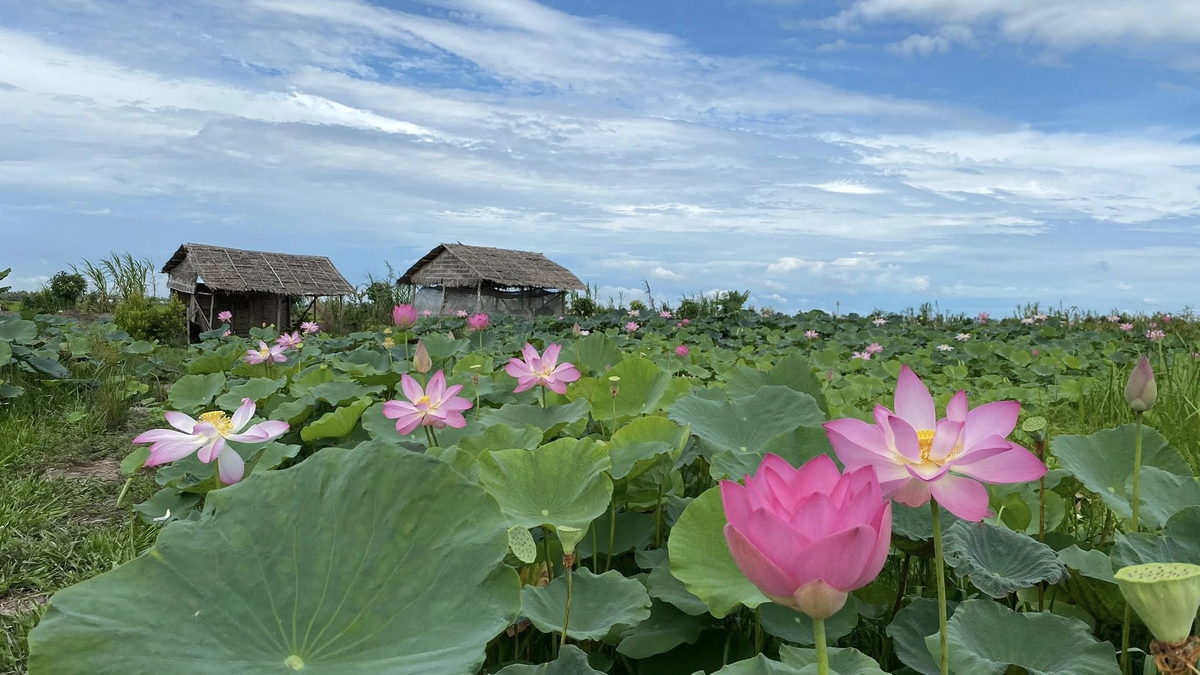



![[Photo] Young people of the Dong Thap Border Guard actively participate in "March Border Month" activities.](https://vphoto.vietnam.vn/thumb/1200x675/vietnam/resource/IMAGE/2026/03/23/1774248483508_ndo_tl_dt3-jpg.webp)

























































































Comment (0)