

Clearly, among the many things that constitute the dignity of poetry (and here we can think more broadly of literature and art), the emergence of AI has further complicated human perception of literary works. In fact, we are not only talking about the dignity of literature and art, but also about the integrity of the writer – the creative subject. The fundamental question is: How should writers deal with AI to preserve the dignity of literature and their own integrity?
 |
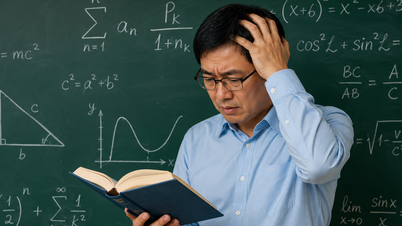
| (Illustrative image.) |
We won't discuss the benefits of AI any further, given its capabilities. Here, I want to discuss the relationship between HUMANS and AI. The nature of this relationship depends on how humans interact with AI, but we cannot ignore the impact AI has on human attitudes and how we respond to it.
The superiority of AI is gradually conquering humanity, making people dependent on it. Thus, from being masters, humans become slaves to machines. Writers and creative artists are no exception, allowing AI to interfere too much in their creative process.
AI doesn't have emotions, but what it can express mirrors many forms of human emotional expression. That is, whatever human emotions have been expressed in the past, if AI has the data, it can replicate them, even at a very high level – a highly refined version.
In a seemingly optimistic vision, human creativity and emotion are always considered possibilities, belonging to the future, while AI is a mechanism for recreating the past, where readily available data is linked and shaped. This might seem reassuring, but in reality, it poses an enormous challenge to the creative drive of writers. Living differently, thinking differently, writing differently—new emotions, new values… become a matter of survival for writers.
Previously, it was simply a matter of survival in relation to other humans – their fellow beings. Now, however, writers are forced to confront another challenge from AI (another species): if humans cannot renew their emotional cells, and actively develop new forms of life, then they will have essentially "mechanized" themselves, becoming merely a biological version of AI.
Poet Nguyen Quang Thieu once shared this sentiment, stating: “Constantly following a beaten path / Writing in the style of previous writers / Reworking others' work into your own / Only understanding a work from your own perspective and refusing to accept others' / Only recognizing others' creativity when they create in a similar way / Writing according to a certain type of commission (because there are many types of commissions)… That's truly AI, and even worse than AI” (Nguyen Quang Thieu's personal Facebook, March 17, 2026).
With these signs, the writer gradually abandoned his integrity, simultaneously producing literary works that lacked dignity. This consequence also led to the collapse of identity, personality, style, and even raised concerns about copyright.
Is art a replaceable field? Every piece of art, if it can be digitized, can be simulated by AI. An artistic structure, however sophisticated, if established as digital data, can be reproduced. That's the strict mechanism of machines. But what cannot be digitized from a work of art? There seem to be many things that cannot be digitized. Mostly, these are things that belong to the living things that humans possess.
In reality, art forms only express a part of the mental structure, aesthetic sensibility, and artistic thinking of the creative artist – or more broadly, all states of life. How can AI express the lingering silence between words, even though it can create many blank spaces in the text? How can AI express the part of life connected to the pain, sorrow, helplessness, or disintegration of a human being? Without anxiety, fear, responsibility, torment, or joy… AI is completely devoid of emotion. Existence and living are the most important issues to discuss in the relationship between humans and AI. AI is existence, humans are living.
I wholeheartedly agree with critic Dinh Thanh Huyen when she emphasizes that "living bodies and living relationships" are the fundamental elements of poetry (The Dignity of Poetry in the Age of AI). Machines are not living bodies, and certainly do not possess living relationships. For example, when we hold a human hand, all the bodily sensations—warmth, coldness, gentleness, softness, firmness, a docile hand, hesitation, indifference, close affection…—are present.
It could be said that in that handshake, the entire sense of life, both tangible and intangible, between two people, around them, and within them, is brought to the surface. This is something that machines and AI cannot yet replace, even though they can produce tens of thousands of pages related to that human handshake.
The working mechanism of AI is reproduction. This means that the product it creates will resemble the sample it receives. Of course, humans also realize that artificial intelligence can be wrong when it doesn't have a sufficiently good database to produce accurate information and products. Meanwhile, works of art created by humans aim for something different (NTT emphasizes: AI is reproduction, humans are creation). Always different from what already exists, from the creator themselves, to a greater or lesser extent, that is the survival mechanism of art.
The brain is also a part of the body, always inclined to rest, just as humans always want to rest rather than work. Therefore, when AI takes on many tasks instead of humans, those humans—those brains—immediately cling to it, seeing it as an opportunity, a crutch, to rest. This process creates a mechanism, similar to satisfying an addiction, causing humans and their brains to immediately think of AI when faced with difficult tasks.
Scientists also call it a form of dopamine – a mood-enhancing chemical that makes the brain and nervous system feel happy and euphoric, but it poses a risk if there is an excess or if one becomes dependent on these mood-boosting agents. Addiction – the need for support – arises when the brain and nervous system face challenges.
Returning to the topic of writers facing AI, do they encounter any difficulties or pressures when confronting AI? How do they behave in the face of AI? To prepare for this essay, I had the opportunity to discuss this with several young writers in Vietnam. When asked about this issue, writer Duc Anh said, "I don't see any difficulties. It's probably just a decline in readers' trust in words and writing."
Non-expert readers may easily suspect that the writing is AI-generated. Conversely, the same applies to readers who place too much faith in AI-generated content. AI is deeply integrated into computer systems, making research simpler (even Google searches today have AI behind them). At the very least, it simplifies searching for foreign language terms and categories, saving research time. This is a very positive development.
However, AI is completely inaccurate (if not outright ignorant) when it comes to literature, and this is something to be extremely wary of. AI also forces readers into its own discourses, most of which are flawed perspectives (for example, assuming that realist literature will "denounce" the nature of society), thus affecting the habit of seeking unique expressions and worldviews . Therefore, AI should only be used for basic research. Some writers consider it a positive tool to support their writing.
Some also see it as a test: “AI forces writers to answer a very fundamental question: what can I write that artificial intelligence cannot? In my opinion, AI can simulate language in a sophisticated and smooth way. But experience, memories, fleeting moments, personal impulses and emotions are things AI lacks. Therefore, I choose to view AI as a supporting tool. Writers, on the other hand, must delve deeper into life, into genuine emotions to maintain their own unique voice. If AI is considered pressure, then that pressure reminds me to write more deeply, more meticulously, more seriously, and more honestly with my own experiences” (Poet Nguyen Thi Kim Nhung).
Faced with this issue, some people flatly refuse to comment. Writer Dinh Phuong asserted: “As a writer, I create based on the land and memories I have. I don't rely on or care about AI at all. Whether I write a lot or a little doesn't matter, as long as it's my own writing. But as a literary editor, I'm forced to deal with AI. When faced with a manuscript lacking unique details and failing to capture the atmosphere of the story, I'll immediately question it. The sentence structure is also important; AI has sentence structures that are easy to recognize (but soon AI's structure will be even better). So the most important thing is still detail and the editor's intuition.”
Poet Van Phi also stated: “AI can write quickly and smoothly, but that very smoothness makes me feel as if all emotions are ‘flattened’ by anonymous, synthesized languages. Poetry is a confession, a voice of the heart; I write for the people I love, I write to release the emotions in my heart… Therefore, with poetry, I want to express my own thoughts, through my real experiences, through my spontaneous moments of inspiration.”
I think that as long as I'm able to express myself in my own voice, there's no need to rely on another tool. What would become of myself then? I'm not so extreme as to deny the remarkable advancements of AI. But in the field of creative writing, especially poetry, I personally don't want AI involved. So, I don't worry or ponder too much about it. Now, I just write whatever I can."
But having said that, does pride in being human, living as a human being, and rejecting AI truly guarantee humanity a peaceful life in the face of AI? The truth is, humans have shifted from being proactive to passive, resisting in the face of AI manipulation. The question remains: do we face any difficulties or pressures when confronting AI, and how should we respond to it?
Writer Ho Huy Son shared: “I haven't felt intimidated or afraid of the AI 'storm' yet. AI might be very useful in some other industries and fields like advertising, media, and management… But literature is a unique field, where personal emotions are elevated, creating a resonance in the soul between the writer and the reader, and more broadly, creating connections between people in society. Literature not only shows talent but also reveals the thoughts, feelings, and unique identity of the writer. This, to date, I haven't found in an AI 'author'."
The opinions of young writers about AI's inability to replace emotional experiences, individuality, and even self-respect and human pride seem to subtly reflect humanity's resistance to AI. I have a feeling that these voices rejecting AI, excluding it from artistic creation, or expressing AI's powerlessness in the face of human qualities, carry a hint of pity. Nevertheless, this touch of pity highlights the fundamental difference between humans and AI.
The concept of evolution belongs to biology, referring to the development of living organisms throughout their historical process. Now, people are saying that AI is evolving every second. Not long ago, computers were still loading; now they are reporting "thinking." The competition from a new, highly superior species is indeed a cause for concern.
Poet Truong Dang Dung wrote in his essay "On the Road to the Dignity of Poetry": "We can say generally that the history of humankind is the history of anxiety and fear. Human society develops simultaneously with new anxieties; after fears of natural origin came fears of religious origin, and now fears of social origin."
Humanity has progressed from fear of Nature, fear of God, to fear of other humans. I think now humanity will have to face yet another fear: fear of machines. But, thinking carefully, machines are also created by humans, so the core of this fear/"modern nightmare" is still the fear of other humans. The ethics of AI has become a very important issue concerning the fate of humanity.
A biological-cultural entity, a unique individual, a creative personality demanding distinctiveness, uniqueness, and human qualities… will always remain the core element in shaping and maintaining attitudes and behaviors between humans and other humans, and between humans/writers and AI/machines.
A writer's character is forged by their humanity, their talent, their self-respect, and their pride in living (not merely existing). Increasingly, people will value even the smallest emotions, the humane compassion, the feelings and sensations of a "living body" and "living relationships" in the face of AI's dominance.
The reality is, if humans stop creating, it means that knowledge, art, and human history will cease to evolve—in the sense that nothing new will emerge. AI only creates products from existing templates and data. Therefore, it seems that the mission of humanity, especially writers, remains very noble: to continue carrying the burden of creativity to sustain human life. Thinking about this, the anxiety about the pressure from AI is somewhat alleviated.
Source: https://baothainguyen.vn/van-nghe-thai-nguyen/cung-quan-tam/202603/nha-van-truoc-thach-thuc-cua-ai-1f00943/



























































Comment (0)