

The family of baby D.MA stated that two days before the baby was admitted to the hospital, they accidentally noticed that the left side of the baby's groin was significantly larger than the right, felt hard and painful to the touch, and the baby was crying a lot, so they took the baby to the hospital for examination. At the hospital, doctors examined and diagnosed a strangulated inguinal hernia, and emergency surgery was quickly performed.
Inguinal hernia in children is a condition where the intestines or other abdominal organs protrude into the groin or scrotum. The condition can have dangerous complications such as strangulation and ischemic necrosis of organs at the hernia site.
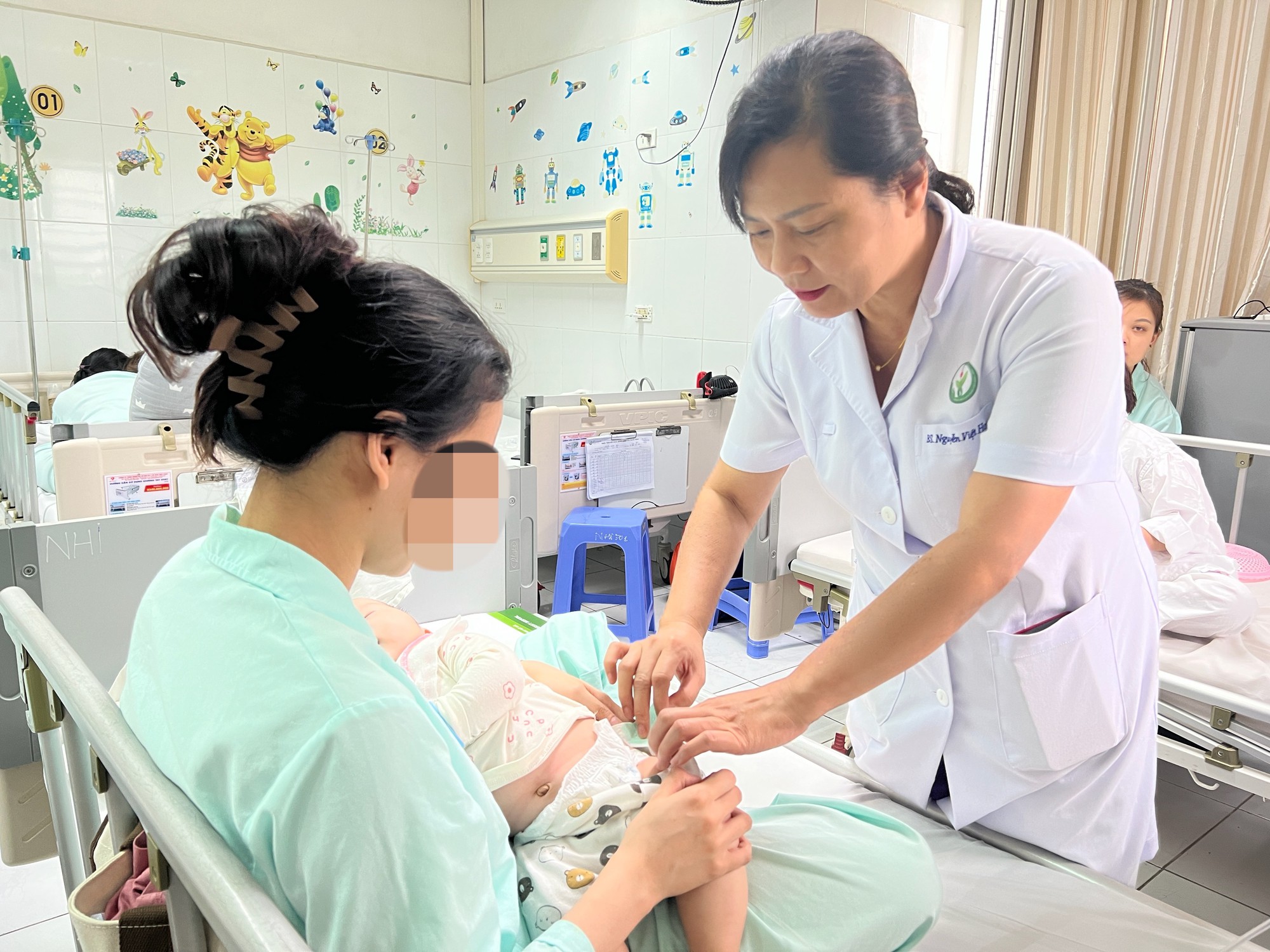
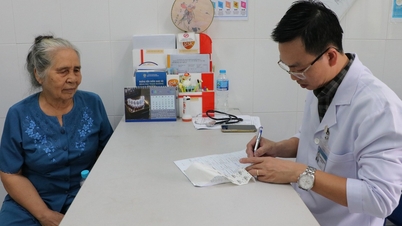
Associate Professor Dr. Nguyen Viet Hoa checks the health of a child patient after inguinal hernia surgery.
Regarding strangulated inguinal hernia in young children, Associate Professor Dr. Nguyen Viet Hoa, Head of the Department of Pediatric and Neonatal Surgery at Viet Duc Friendship Hospital, stated that inguinal hernia is a very common congenital condition in children, especially boys. In girls, it is rarer and often difficult to detect because it lacks typical symptoms. Typically, with strangulated inguinal hernia in girls, adults will notice one side of the pubic area or labia majora bulging when the child cries or strains; it may or may not shrink upon palpation, and the child may or may not experience pain. In girls, the hernia sac usually contains the ovary, while in boys it usually contains the descending intestine. Inguinal hernias can become strangulated; if treatment is delayed, the organs (intestines or ovaries) within the hernia sac may become strangulated and necrotic, requiring surgical removal.
Associate Professor Dr. Nguyen Viet Hoa shared that in the case of baby D.MA mentioned above, due to a painful, firm bulge in the pubic area, the patient was diagnosed with late-stage strangulated ovarian hernia leading to ovarian necrosis, requiring the removal of one ovary. This is not the first case requiring ovary removal or bowel resection due to strangulated inguinal hernia. In fact, the Department of Pediatric and Neonatal Surgery still encounters several cases of late-stage strangulated inguinal hernia each year, resulting in slower recovery after surgery due to infection and toxicity. Cases like baby D.MA will affect the child's life and future reproductive capacity.
Associate Professor Dr. Nguyen Viet Hoa advises families to take their children to the hospital early when they notice any unusual symptoms; early screening can help detect diseases and prevent complications.
An inguinal hernia is caused by a weakness in the abdominal wall that should have closed before birth. The bulge in the groin area may be noticeable when the child cries, coughs, or due to increased bowel movements (constipation, straining), or it may be present from birth, easily moving up and down. Approximately 90% of inguinal hernias occur in boys.
In girls, the ovary is often trapped within the hernia sac; if left untreated, the ovary may become ischemic and necrotic, leading to the need for removal of one ovary.
In boys, other conditions associated with inguinal hernia, such as undescended testicles, hydrocele, and spermatic cord cysts, should also be considered, as these are all conditions requiring surgical treatment.
Inguinal hernia in newborns is not uncommon. Approximately 2 out of every 100 full-term infants will have an inguinal hernia or other conditions related to the patent processus vaginalis. This rate is higher in premature infants. Laparoscopic surgery is an effective treatment method for inguinal hernia.
(Source: National Children's Hospital)
Source link
![[Photo] Prime Minister Pham Minh Chinh receives the Chinese Ambassador to Vietnam](https://vphoto.vietnam.vn/thumb/1200x675/vietnam/resource/IMAGE/2026/04/05/1775397481797_ndo_br_dsc-5512-jpg.webp)


























































![[INFOGRAPHICS] Exploiting children's personal images for profit can result in fines of up to 50 million VND.](https://vphoto.vietnam.vn/thumb/402x226/vietnam/resource/IMAGE/2026/04/06/1775442200854_1775442148.webp)













Comment (0)