

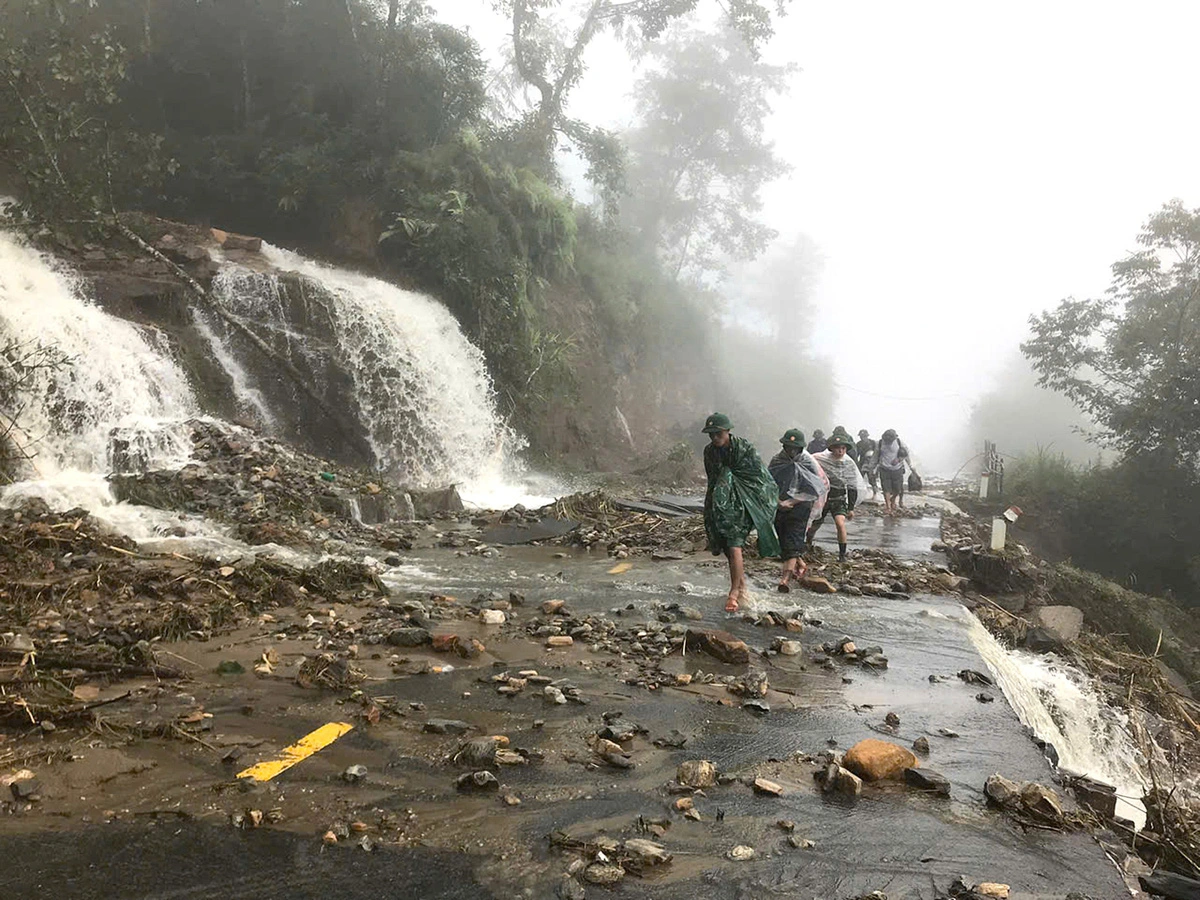
Border guards in Lao Cai province rescued dozens of households during the historic floods and landslides of September 2024 – Photo: Provided by the Lao Cai Border Guard Command.
Never before have the people of Northwest Vietnam seen the mountains and forests so furious! Typhoon Yagi swept through, bringing torrential rain, landslides, and overflowing streams. Many villages were left without safe shelter, and countless lives were saved thanks to the soldiers' selfless dedication to the people.
Ms. La Thi Dao and her husband moved in temporarily with her mother-in-law in Sin Chai village, Y Ty commune (Bat Xat district, Lao Cai province). Ms. Ly Chuy Go's house, Ms. Dao's mother-in-law, is a traditional rammed earth house of the Ha Nhi people, with a slope behind it. Whenever it rains, Ms. Go and her children have to run to a neighbor's house to sleep.
In the midst of a dangerous storm
Recalling the day her daughter Dao narrowly escaped death, Mrs. Go burst into tears, partly out of love for her daughter and partly out of fear. She recounted that on that morning (September 9, 2024), the embankment behind the house turned into a muddy mess and collapsed.
She ran to a neighbor's house for refuge, crying and calling her son, who hadn't come to stay with her that day, but to no avail. All she heard was that the rice paddies where her daughter-in-law and grandchild lived had been swept away by the flood. More than a week later, hearing that her son had been rescued by the soldiers, she cried again with joy.
The rice paddies where Ms. Dao's house is located are a few hundred meters from the Y Ty Border Guard Station. Before the border crossing was closed, Dao and her husband, Pha Gio Xa, built a temporary house to repair bicycles and sell goods to the locals.
Due to the COVID-19 pandemic and the closure of border crossings, Xa went to Tuyen Quang to work at a sturgeon farm. Ms. Dao and her 3-year-old daughter stayed behind in this temporary house.
A few days before that terrible landslide, the soldiers at the border guard station advised her to go back to her mother-in-law's house and only return when the rain stopped.
Ms. Dao is a Tay woman from Hop Thanh commune (Lao Cai city) who came here to marry into a family. Partly because she doesn't know the Ha Nhi language and finds it difficult to communicate with her mother-in-law, and partly because she's worried about the pile of newly harvested rice stored in the temporary house, she refuses to leave and stays in that house.
Major Nguyen Dat Phong – head of the Y Ty border control station – went around, advising anyone with residents to move elsewhere. Ms. Dao refused to leave, so he carefully instructed her not to sleep, to remember to charge her phone, and to call the soldiers immediately if anything happened.
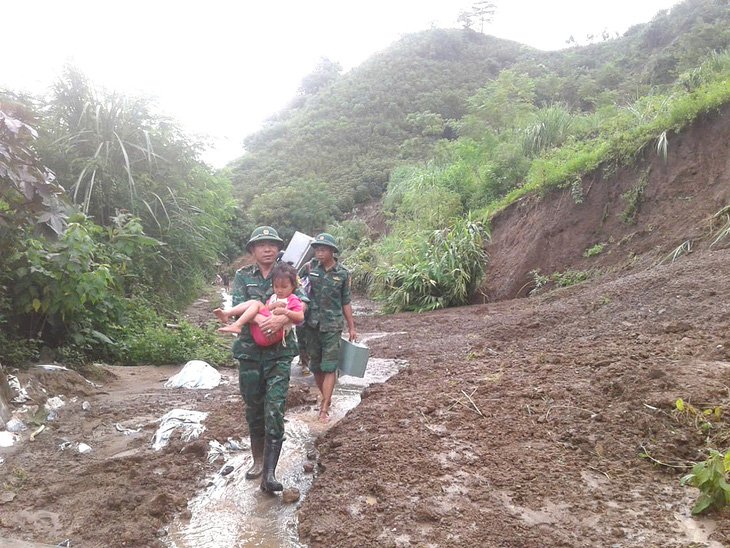
Ms. Dao and her child were rescued by border guards and brought to the station – Photo: Provided by Y Ty Border Guard Station.
Cries for help in the night of the flood
After two days of torrential rain, landslides occurred everywhere that night. Following the sounds of mountains exploding like bombs, there was the rumbling of rolling rocks, falling trees, and the roaring of floodwaters. The checkpoint staff stayed awake all night, listening to the howling wind and rolling rocks.
At just after 3 a.m., Major Phong grabbed the phone. On the other end, all he could hear was the roar of the floodwaters and the faint, panicked voice of a woman: "My house is flooded... the pillars have fallen..."
Amidst the roar of the floodwaters and cries for help, the heart-wrenching cries of children filled the air. Major Phong shouted into the phone, "Run! Go to the tent across the road!..."
The wooden-framed house, enclosed by corrugated iron sheets, had collapsed, and mud and debris had piled up all over it. Ms. Dao, clutching her child, crawled through a hole under the fallen corrugated iron wall and ran to a shack by the roadside. Mother and child trembled as they clung to each other, waiting for the soldiers to come and rescue them.
The two border guards grabbed their flashlights, hastily put on their raincoats, and rushed off into the darkness. The once-paved concrete road was now a muddy river; a single misstep would send them sinking up to their waists.
As they approached Ms. Dao's makeshift house, they could no longer proceed. The two soldiers cautiously made their way along the flooded stream, through several abandoned fields. By the time they reached the shivering mother and child, dawn had broken.
The four of them had only walked a short distance when they heard a loud explosion. When they turned around, they saw that Ms. Dao's house had been swallowed by the floodwaters.
When the mother and daughter arrived at the border guard station, they were trembling and couldn't say a word. "Knowing we'd made it through, I don't remember anything else!" Ms. Dao recounted, expressing her immense gratitude to the soldiers who had saved their lives.
From the moment they arrived at the border guard station, there was a power outage and loss of communication. The station was isolated for nearly a week, and Phong could only report to the border guard commander via military telegram: "The men at the station are safe; we have brought two civilians whose houses collapsed back to the station."
Major Phong recalled how risky it was for the two of them to go rescue the villagers. In the darkness, they couldn't see, and they didn't know when the landslides would happen. "But if we didn't go, who could they rely on? I told them before to call me. When the people call for help, we have to find a way to come and rescue them," Phong confided.
Living peacefully near the soldiers.
When Ms. Dao's husband heard that her mother's house had been destroyed by a landslide and that his wife and children were missing in their makeshift shelter, his heart was filled with anguish. He couldn't stay there, nor could he return because the roads were blocked and communication was lost. It wasn't until a week later that he received news that his mother was safe and his wife and children had been rescued by border guards and were staying at a border outpost.
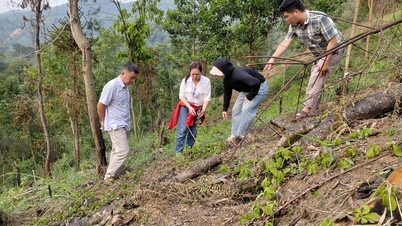
The days following the rain were followed by scorching hot days. Soldiers cut through the forest to reach the village and mobilized the villagers to help Ms. Dao clean up her house. Dozens of people, wearing boots and carrying hoes and shovels, came to dig up the mud and retrieve anything usable.
They managed to pull up the motorbike, Ms. Dao's most valuable possession. Luckily, the corrugated iron wall that had fallen on her acted as a shield, preventing her belongings from being completely swept away.
Ms. Dao managed to save over 30 sacks of rice and a dozen sacks of corn, her entire harvest for the year. She dried them right in the border guard station's yard, gathering over 20 sacks, while the rest, being too wet and sprouting, she took home to her mother-in-law to feed the chickens.
When people came to help, she paid them with... motorcycle spark plugs and spare parts (things her husband used to make), giving away whatever anyone wanted. The mother and child were cared for by the border guards for a full 10 days. After the floodwaters receded and the landslides stopped, she took her child back to live with her mother-in-law in the village, leaving her belongings at the border guard station.
In the days following the flood, she would occasionally receive joyful phone calls from the soldiers informing her to come and collect relief supplies. Sometimes it was rice and water, sometimes food, sometimes a bottle of fish sauce, and sometimes even money. She gathered enough to feed her whole family until the next harvest season.
She only hopes to reopen her shop and repair shop soon. She and her husband feel safe there because it's near the soldiers who are very kind to the people and always ready to help.
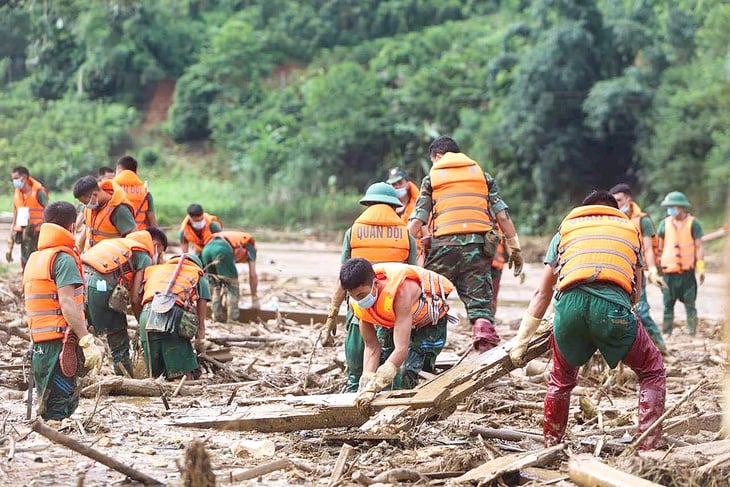
Soldiers search for the bodies of villagers in Nu Village after the devastating landslide – Photo: NGUYEN KHANH
By day we search for and rescue our compatriots, by night we stand guard while our comrades sleep.
Lieutenant Giàng A Lan (24th Border Guard Training School), along with his teammates, rescued people in Làng Nủ village. He shared that even now, he still dreams of the days when he waded through the mud searching for his fellow villagers in Làng Nủ.
Lan was once stuck halfway in the mud, and it took his teammates a long time to pull him out. His teammates either stepped on nails or were cut by shards of sheet metal, bleeding profusely. They had to suppress their grief and overcome hardships to find the bodies of their compatriots.
The most dangerous time was the unsafe night, when the ground behind the hill where the soldiers slept was prone to landslides and could collapse. They had to take turns guarding, and whenever they heard a noise like a tree breaking or rocks sliding, they would jump up and run outside.
The soldier plunged into the flood to save the people.
Private First Class Ly Van Vu (Ngoc Con Border Guard Post, Cao Bang Provincial Border Guard Command) jumped into the floodwaters and rescued 14-year-old Hoang Ngoc Han who was being swept away by the current.
On the night of August 2, 2024, northern Vietnam was experiencing a major flood. Vu and his team were on patrol when they heard cries for help. At that time, the Quây Sơn River (Trùng Khánh, Cao Bằng) was rising, and Hân, who was with her older sister, was swept away by the flood. Vu immediately jumped into the dangerous water, swam to rescue Hân, and brought her safely home.
During the heavy rains and floods following Typhoon No. 3, dozens of exemplary members of the armed forces risked their lives to rescue people affected by the storm and floods.
For example, officers from the A Mú Sung Border Guard Post (Lao Cai) cut through the forest to bring people to safety at a flood shelter. Officers from the Si Ma Cai Border Guard Post (Lao Cai) walked more than 20 kilometers, overcoming dozens of dangerous landslides to reach their unit to participate in rescue efforts…
Source: https://tuoitre.vn/nhu-sinh-ra-lan-hai-nho-bo-doi-20241221100609659.htm




























































































Comment (0)