Unicorn startups are a term referring to start-up companies valued at over $1 billion. Unicorns are mythical creatures associated with rarity. Currently, only 0.07% of all start-up companies have reached a $1 billion valuation within 10 years.
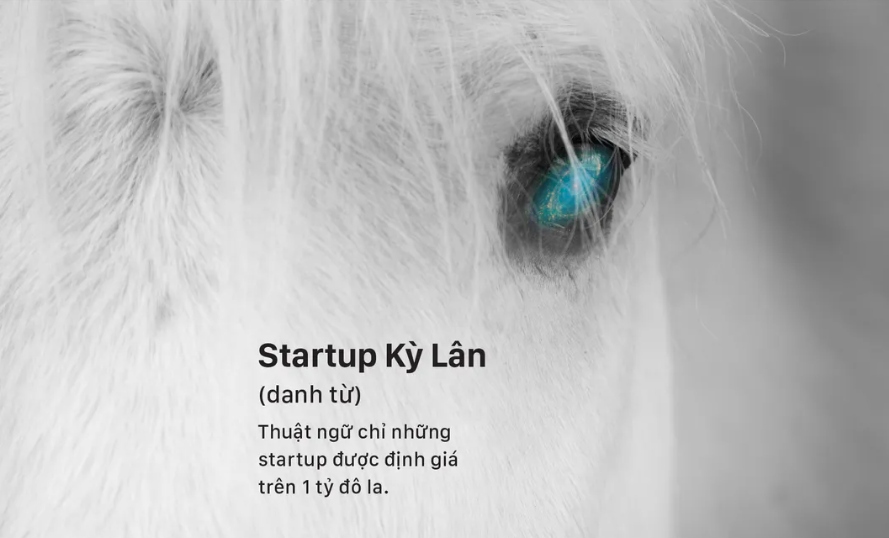
The term "unicorn startup" was first used by Aileen Lee, co-founder of the investment fund Cowboy Venture, in an article published on TechCrunch in 2013. Lee intended to use the term "unicorn" to describe the group of technology startups valued at over $1 billion and founded in the US after 2003. At the time of publication, only 39 companies had met these criteria.
Unicorn companies rise to the top quickly, and they do so by disrupting the market with groundbreaking innovations. The prestigious Forbes magazine has highlighted several valuable lessons that business leaders can learn from these unique startups.
Develop both the product and the brand simultaneously.
Unicorn companies don't create products and services and then seek markets. They start with the end user. By developing services that future customers find irresistible, unicorns create brand enthusiasts.
These businesses seek smart marketing strategies, primarily focusing on online marketing to best serve their customers. These strategies for accessing products and services have helped these unicorn companies grow rapidly. For example, mobile food delivery services have undoubtedly changed the way customers dine. This marketing approach has also created new dining experiences for customers.
People don't order through Uber Eats because they're hungry. The truth is, they want the experience of eating restaurant-quality food at home. They want their favorite dishes and potentially new culinary experiences at their fingertips. The technology behind the app acts as the product, the service vehicle, and the brand itself.

Mission-oriented



Unicorn companies like Tesla and InstaCart operate with a clearly defined mission. These businesses are very good at letting the world know what they are for.
A mission statement can be encapsulated in how a business helps solve a problem. This problem is often something that deeply concerns the target customer. It could be a social issue, such as climate change or clean energy; or it could represent a personal characteristic, such as a desire to escape the tedious daily grind. Whatever the mission statement, the leaders of unicorn companies place it at the heart of everything they do. Their mission is not simply a slogan on their website and in advertisements. Every business decision, including the design of products or services, is geared towards the company's purpose.
Respond quickly to new market developments.
Predict what might happen and engage in "what if" scenarios. Think about when you start your car and hit the road. You can avoid accidents with defensive driving techniques as you learn to anticipate the actions other drivers might take.
Unicorn company leaders do the same with market conditions. They are constantly looking for signs of impending change. These changes can be temporary or long-term, and unicorns are very good at adapting to new, unexpected developments. Unicorns are not afraid to quickly rethink their company strategy, as Airbnb did when launching ambitious expansion plans during the COVID-19 pandemic. Their teams are very interested in analyzing trends, consumer behavior, and economic and social developments to anticipate the impact on their business operations.
In other words, they are not slow to react. Unicorn companies are also always open to new ideas and seek success through experimentation. Adaptability helps them “fight” new competitors and change the way they serve customers.
It is not advisable to solicit investment in the early stages.
Forbes also quoted Dileep Rao, an investment expert and advisor to many startups that don't need to raise capital, as saying that startups shouldn't seek out investment funds too early.
Expert Dileep Rao points out that 99.9% of startups fail to raise investment. Even those that do manage to secure funding only achieve success in 20% of cases.
When startups approach venture capital too early, they often find themselves at a disadvantage. The funds may take control of the company, install their own people in CEO positions, and steer the company away from its original vision.



Conversely, if business owners can "take matters into their own hands" in the early days, they will be able to protect their control over the company as well as the profits generated by the business.
Dileep Rao points out that among 22 startup entrepreneurs with assets exceeding $1 billion, those who had not sought venture capital achieved returns twice as high as those who raised capital from the outset. For those who did not seek funding at all, this figure increased to sevenfold.

VOV.VN - The number of unicorns has increased significantly amid a surge in venture capital, making 2021 a record year for private startups to achieve unicorn status (over $1 billion).
Source



![[Photo] General Secretary and President To Lam works with the Party Committee of the Government on the work of preventing and combating storms, floods, extreme natural disasters and climate change.](https://vphoto.vietnam.vn/thumb/1200x675/vietnam/resource/IMAGE/2026/06/29/1782729441945_a1-bnd-0385-9454-jpg.webp)
![[Photo] National Assembly Chairman Tran Thanh Man attends the Conference to announce the Master Plan for Hanoi Capital City with a 100-year vision.](https://vphoto.vietnam.vn/thumb/1200x675/vietnam/resource/IMAGE/2026/06/29/1782709639728_ndo_br_1-jpg.webp)
![[Image] A look back at the capital's preparations for the century-long master plan.](https://vphoto.vietnam.vn/thumb/1200x675/vietnam/resource/IMAGE/2026/06/29/1782750453122_quy-hoach-100-nam-minh-duy-1-2118-jpg.webp)






















































![[Image] Building an elevated road through the Ma Da forest.](https://vphoto.vietnam.vn/thumb/402x226/vietnam/resource/IMAGE/2026/06/29/1782724737750_anh-man-hinh-2026-06-29-luc-16-18-43.png)