

At the training ground of the 285th Regiment, the early summer April sun cast a golden glow on the trees. The tranquility of the K9 historical site seemed to be awakened by the resounding commands. The rows of soldiers straightened, and the still somewhat uneven steps of the new recruits began to find a common rhythm after more than a month of training.
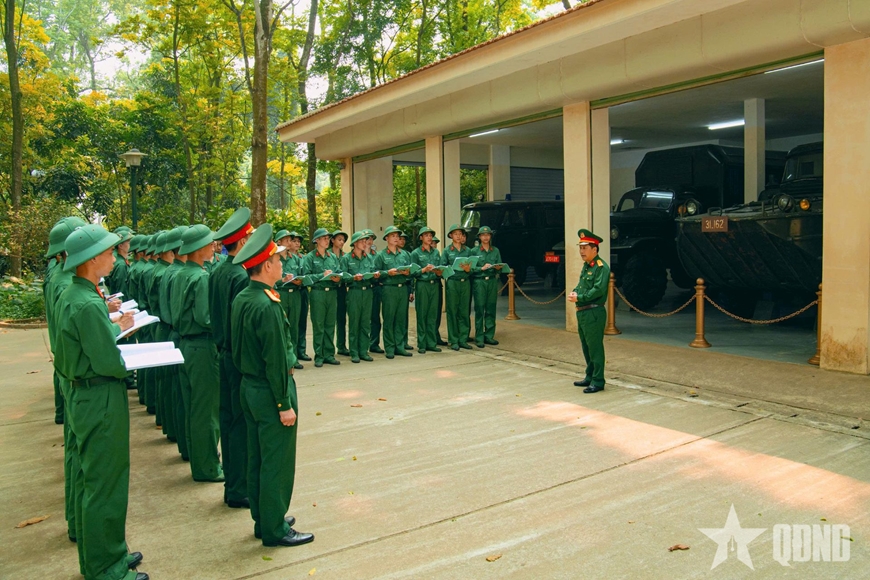 |
Colonel Tong Duc Hung shared with the new recruits about the traditions of Regiment 285 and the K9 historical site. |
Colonel Tong Duc Hung, Political Commissar of Regiment 285, shared that educating soldiers about the historical significance of the K9 historical site is always a priority for the unit, helping each soldier clearly understand the honor and pride of being a guard soldier beside President Ho Chi Minh's Mausoleum, thereby determining their responsibility and striving to improve themselves from the very beginning.
In a place so closely associated with President Ho Chi Minh, training seems to take place with a different mindset. For the guards at the Mausoleum, regulations are not just rules, but also symbols of professionalism, excellence, and absolute loyalty.
Sweat streamed down their sun-tanned faces, soaking their backs and shoulders, but their eyes remained steadfastly fixed forward. Every hand movement, every step on the scorching asphalt was honed to near-perfect precision, aiming for "unity, rhythm, and power."
 |
New recruits at the training center, 285th Regiment. |
Private Tran Huy Hiep, Squad 21, Platoon 6 (Training Center, Regiment 285), shared: “Being trained at the K9 historical site, I feel very honored and proud. Every time we hear about the history and traditions of this place, we feel more motivated to strive to train and overcome difficulties. For me, the most difficult thing when practicing marching is maintaining the correct height, distance, and arm angle. To improve our technique and make the movements more precise, outside of training hours, we still take advantage of extra time to practice so that our hands and feet coordinate smoothly.”
From this training ground, the journey of the soldiers of the Ho Chi Minh Mausoleum Command will continue.
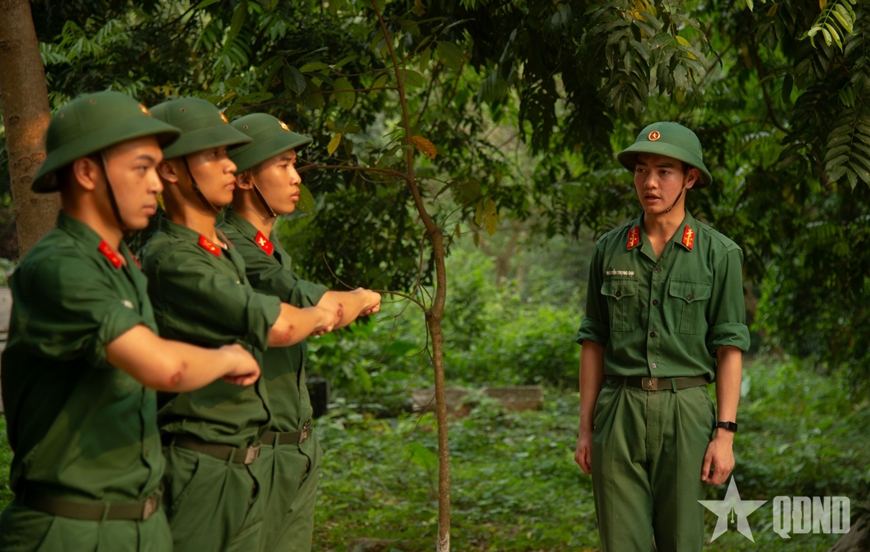 |
| The soldiers took advantage of their breaks to train. |
We met Lieutenant Tran Manh Quang, Deputy Commander of Detachment 2, Honor Guard Team, Regiment 275 - the force directly responsible for the flag-raising and flag-lowering ceremonies and 24/7 honor guard duty at the Ho Chi Minh Mausoleum. From March 2026, he has been assigned to train new recruits at the K9 historical site.
Lieutenant Tran Manh Quang confided: “As a member of the Honor Guard, performing the flag-raising and lowering ceremony daily at the Ho Chi Minh Mausoleum, I always feel honored, proud, and moved. Before each mission, we consciously prepare thoroughly, from neat uniforms to proper demeanor, to demonstrate the solemnity, seriousness, and the regular, powerful image of the Vietnam People's Army.”
After three months of training at the Training Center of Regiment 285, approximately 30% of the qualified soldiers were selected to continue advanced training, aiming to become soldiers of the Honor Guard. Through each selection round, the soldiers were rigorously evaluated on their character, awareness, health, and military conduct, including height, build, gait, and even shoe size, to ensure near-perfect uniformity. From there, they entered a period of intense training with long hours of drill exercises, perfecting their footwork, posture, and ability to maintain attention in all weather conditions.
From the training grounds of the 285th Training Center at the K9 historical site, the unsteady steps of the soldiers today will gradually become firm and disciplined, ready for their duty as honor guards at President Ho Chi Minh's Mausoleum. Despite the difficulties and hardships, each soldier burns with pride: contributing to guarding the peaceful rest of President Ho Chi Minh is a sacred and noble duty of the youth.
| Unit 285 is a unit directly under the Command of the Ho Chi Minh Mausoleum, with the function of managing and ensuring security and safety of the K9 historical site and its architectural and technical structures; organizing the reception and guidance of people and international visitors to the K9 historical site; organizing military, political , professional and technical training, combat training and combat readiness; and managing forest resources. |
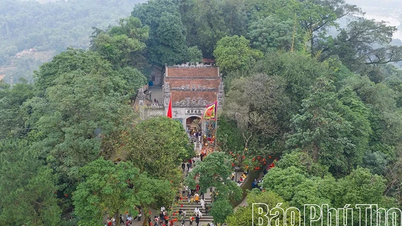
The K9 historical site is associated with many significant milestones in the life and career of President Ho Chi Minh. From 1957, he chose this location as the base of the Central Committee. During the period 1960-1969, he worked with the Politburo and the Central Committee of the Party, making many important decisions regarding the resistance war against the US and for national liberation, while also receiving delegations of international friends and comrades visiting Vietnam. After his death, this was chosen as the place to preserve and protect his remains with absolute safety during the fierce years of war (1969-1975). On July 18, 1975, President Ho Chi Minh's remains were brought to rest at the Ho Chi Minh Mausoleum in Ba Dinh. Since then, the K9 historical site has become a reserve base, as well as a destination for delegations to visit, study, and receive traditional education. |
Source: https://www.qdnd.vn/quoc-phong-an-ninh/xay-dung-quan-doi/nhung-buoc-chan-dau-tien-ben-bac-1034605
![[Photo] The General Secretary, President and his wife meet with Vietnamese-Chinese friendship leaders.](https://vphoto.vietnam.vn/thumb/1200x675/vietnam/resource/IMAGE/2026/04/15/1776264829725_vna-potal-tong-bi-thu-chu-tich-nuoc-to-lam-gap-mat-nhan-sy-huu-nghi-viet-nam-trung-quoc-8703641-3130-jpg.webp)
![[Photo] My Son at night: A thousand-year-old heritage site amidst the Milky Way](https://vphoto.vietnam.vn/thumb/1200x675/vietnam/resource/IMAGE/2026/04/15/1776261039184_ndo_br_chon6-jpg.webp)
![[Photo] National Assembly Chairman Tran Thanh Man arrives in Türkiye to attend IPU-152](https://vphoto.vietnam.vn/thumb/1200x675/vietnam/resource/IMAGE/2026/04/15/1776261003665_tnk10-jpg.webp)
![[Photo] National Assembly Chairman Tran Thanh Man attends the opening session of IPU-152](https://vphoto.vietnam.vn/thumb/1200x675/vietnam/resource/IMAGE/2026/04/16/1776277863731_ctqh5-jpg.webp)
![[Photo] Mrs. Ngo Phuong Ly meets and exchanges views with Mrs. Peng Li Yuan](https://vphoto.vietnam.vn/thumb/1200x675/vietnam/resource/IMAGE/2026/04/16/1776277858080_phu-nhan-1-jpg.webp)





































Comment (0)