


To date, the province has recorded many ancient trees, including 25 trees recognized as Vietnamese Heritage Trees. These trees are widely distributed across localities such as Tri Ton, Thoai Son, O Lam, An Chau communes and Long Xuyen, Thoi Son wards, as well as Phu Quoc Special Economic Zone.
An Giang 's heritage trees, each over 100 years old, are not merely a part of the natural landscape. They are also "living witnesses," silently recording the vicissitudes of time, accompanying the process of land reclamation, village establishment, and community development.
Each tree trunk, each canopy, and the surrounding space seem to preserve unique cultural values of the region, memories of a difficult time of land reclamation, and of the generations of people who have come, stayed, and been attached to this land.
It is noteworthy that many heritage trees do not stand alone but are closely associated with cultural and religious structures such as communal houses, temples, and shrines. In these sacred spaces, the trees not only provide shade but also contribute to the formation of a heritage complex with profound spiritual value.
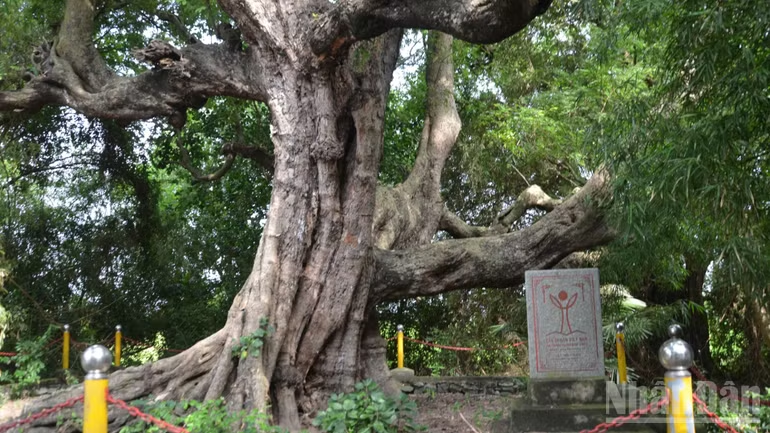
Like the over 200-year-old Dipterocarpus tree at Thoai Son communal temple in Thoi Son commune, it stands as a silent testament from the time when this land was sparsely populated until it became a prosperous village and residential area. The tree's shade has provided coolness for many generations who come to the temple to worship and admire its greenery.
The tree grows on the slopes of Mount Sap - a rocky mountainous area - so the local people often feared when the tree's trunk withered and its leaves died. Smiles returned under the shade of the ancient tree when tree experts rescued it, bringing it back to life.
Previously, people used to drill holes in the tree trunks to extract oil for use, but later, realizing the harm it caused, they sealed the holes and instructed their children and future generations to work together to protect the trees.
At Phu Nhuan ancient communal house, a centuries-old structure, stands a massive Dipterocarpus tree in front of the grounds, its trunk reaching high and casting shade over the rural landscape of An Chau commune. Recognized as a heritage site, the tree grows near a busy roadside, yet few dare to vandalize it, for they see it as a symbol of time, its trunk carrying the joys and sorrows of generations.
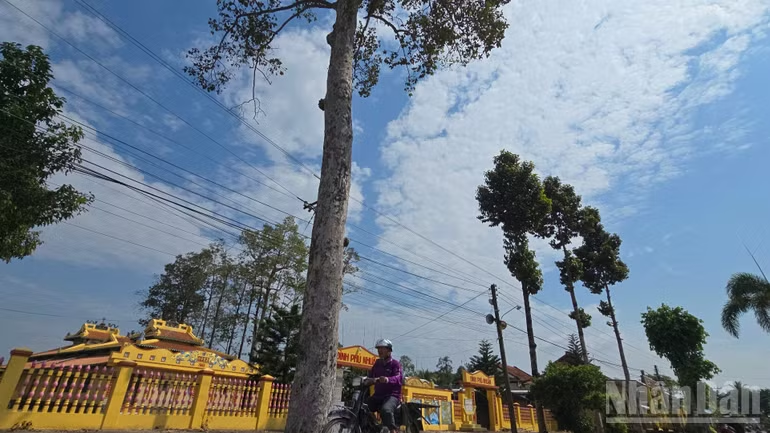
Mr. Nguyen Van Luong, Head of the Phu Nhuan communal house's worship committee, shared: "The Dipterocarpus tree is a symbol of the enduring existence of the village. It not only holds cultural value but also serves as proof of the community's resilience. The people are very proud to protect and care for the tree together." This affirms that heritage trees belong not only to nature but also to the community's consciousness.
In a corner of Svay Ta Hon pagoda (O Lam commune), two lychee trees, over 300 years old, grow side-by-side. Despite their age, they remain lush and green through the years. The two trees have large trunks and abundant branches and leaves, providing a cool breeze during the hot, dry season.
The temple and the local people work together to care for the trees. For the people of this region, the two heritage lychee trees are not just biological entities but also bridges through time, representing an ideology connecting the future and the past of this land.
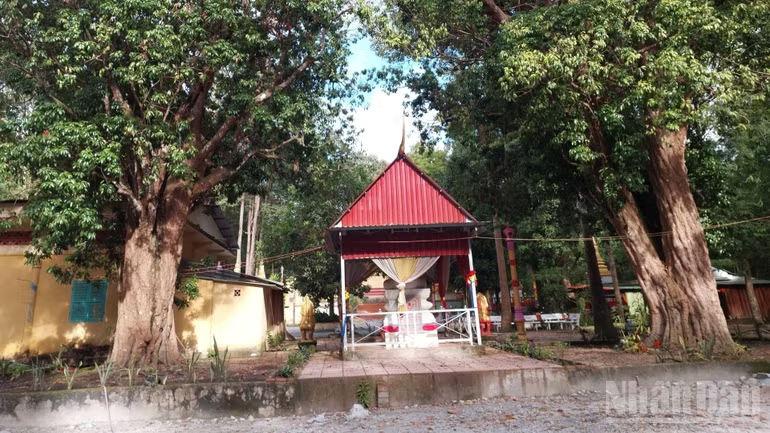
Beyond their spiritual significance, heritage trees are intimately connected to the daily lives of the people. Under the canopy of these ancient trees, generations have gathered, socialized, and shared stories about their village and its history.
During the war years, the ancient Dipterocarpus and Shorea trees in the Sap-Thoai Son mountain region became shelters, protecting the people from bombs and bullets. When peace was restored, the people returned to care for and protect the trees as a way of preserving an indelible part of their memories.
In Cho Vam commune, the ancient Lagerstroemia trees near Bang Lang temple were once believed by locals to have medicinal properties. Many people came to harvest the bark to take home for use as medicine.
However, after being educated and explained the situation by forest rangers, the people changed their perception and stopped exploiting the trees, instead focusing on protecting them. This small story shows that when the true value of heritage trees is understood, the community will voluntarily become the most active and sustainable protectors of these trees.
Besides their cultural and spiritual value, heritage trees also play an important role in improving the ecological environment, regulating the climate, and creating landscapes. Many locations with heritage trees have become attractive tourist destinations, contributing to the development of ecotourism and spiritual tourism, while also creating livelihoods for local people.
However, the conservation of heritage trees in An Giang still faces many challenges. Most of the trees are old, susceptible to pests and diseases, and vulnerable to harsh weather conditions. Their care requires advanced techniques and significant funding, while resources remain limited.
Given this reality, establishing a clear legal framework, along with a province-wide plan for managing ancient trees, is absolutely essential. Simultaneously, it is necessary to promote social participation and mobilize the involvement of businesses and the community in conservation efforts. Most importantly, it is crucial to raise public awareness, especially among the younger generation, so that everyone understands their responsibility to preserve these precious "green treasures."
Heritage trees are not only natural assets but also the spiritual heritage of the people of An Giang. As long as their canopies remain green, the memories of a land rich in tradition are preserved. And when the community works together to protect them, these "ancient trees" will continue to thrive, their rustling breath carried by the wind, silently telling stories of the region's past, present, and future.
Heritage trees include:
O Lam commune: 2 lychee trees; Tri Ton commune: 1 sour tamarind tree; Cho Vam commune: 3 water crape myrtle trees; Thoi Son ward: 1 honey locust tree;
Twelve Dipterocarpus trees are distributed in the communes of Co To, An Cu, An Chau, Binh Hoa, Thoai Son, and Long Xuyen ward.
The six heritage trees in the Phu Quoc Special Economic Zone include: two Terminalia trees, two Kơ Nia trees, and two Kien Kien trees.
Source: https://nhandan.vn/nhung-cay-co-thu-doc-dao-o-an-giang-post953390.html

![[Photo] Prime Minister Pham Minh Chinh receives the Chinese Ambassador to Vietnam](https://vphoto.vietnam.vn/thumb/1200x675/vietnam/resource/IMAGE/2026/04/05/1775397481797_ndo_br_dsc-5512-jpg.webp)






![[Photo] Prime Minister Pham Minh Chinh receives the Chinese Ambassador to Vietnam](https://vphoto.vietnam.vn/thumb/402x226/vietnam/resource/IMAGE/2026/04/05/1775397481797_ndo_br_dsc-5512-jpg.webp)



















































Comment (0)