

During my travels, I have visited many places, each leaving a lasting impression and unforgettable memories.
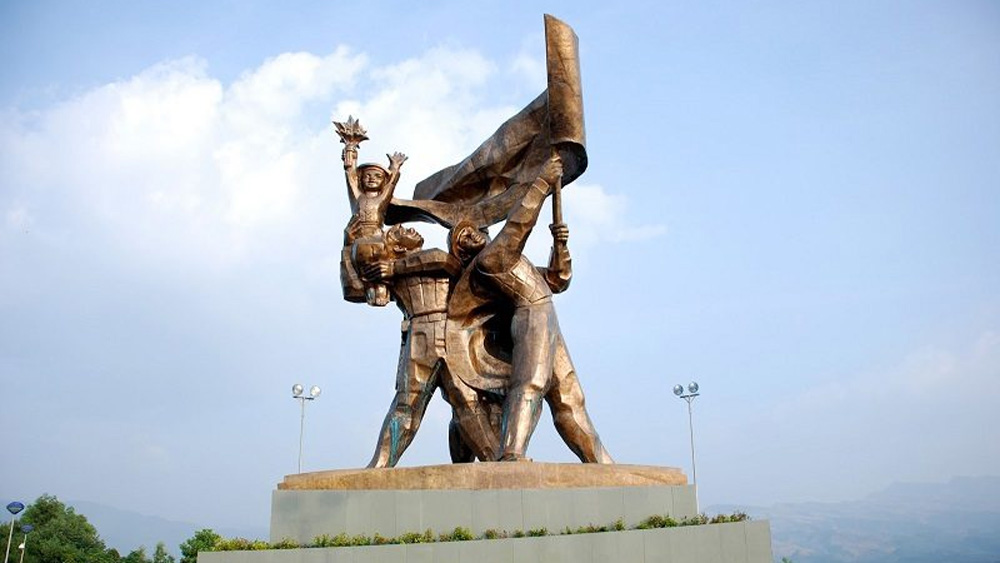 |
| Dien Bien Phu Monument |
Like the time I went to Truong Son Cemetery, and got lost on unfamiliar roads. I also visited Dong Loc Crossroads, where young women in their twenties fell. There, the graves adorned with white flowers, mirrors, and combs left on the tombs of those who visited, evoked a profound emotion. I kept going, telling myself that one day I would reach Dien Bien Phu, a place with surely not many green trees or scenic spots. But leaving my footprints on the journey, witnessing historical events, is something truly unique.
The story goes: France built Dien Bien Phu into a strong fortified complex to attract and wear down our main forces, while simultaneously controlling the entire Northwest region of Vietnam and Upper Laos. At its peak, France deployed up to 16,200 troops and numerous modern weapons and equipment at 49 strongholds, divided into 3 sectors. They considered Dien Bien Phu an "impregnable" fortress. The Politburo 's resolution and President Ho Chi Minh's appeal were enthusiastically and wholeheartedly supported by the entire nation, with everyone devoting their efforts to the campaign. Besides the 55,000 main troops, over 100,000 people, including civilian laborers, youth volunteers, and other forces, participated in the campaign, all focused on the Dien Bien Phu Campaign.
According to documents and records, in 210 days, from November 1953 to May 1954, more than 261,000 civilian laborers, including 18,200 cadres, team members, and volunteer youth, directly participated in building 89 km of new roads and repairing over 500 km of existing roads. The military and people of the localities mobilized 22,000 bicycles, 11,800 boats, 1,800 bamboo rafts, 756 rudimentary carts, 914 pack horses and ox carts, and a fleet of 628 trucks... transporting 30,759 tons of food, supplies, weapons, and military equipment to support the campaign. As a result, the names of places like Hill A1, Him Lam, Hong Cum, and Muong Phang became familiar.
Throughout the length and breadth of the country, the beauty of its landscapes and its people create stories. It is a blessing for those who leave their footprints on the lands of their homeland. With Dien Bien Phu, a place not everyone can visit, the sheer emotion upon arrival is overwhelming. It's not just the beautiful scenery, but the historical significance of the place itself, which, even after nearly 70 years, represents a miracle: the victory at Dien Bien Phu, leading to the Geneva Accords of 1954.
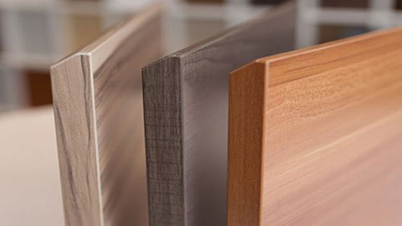
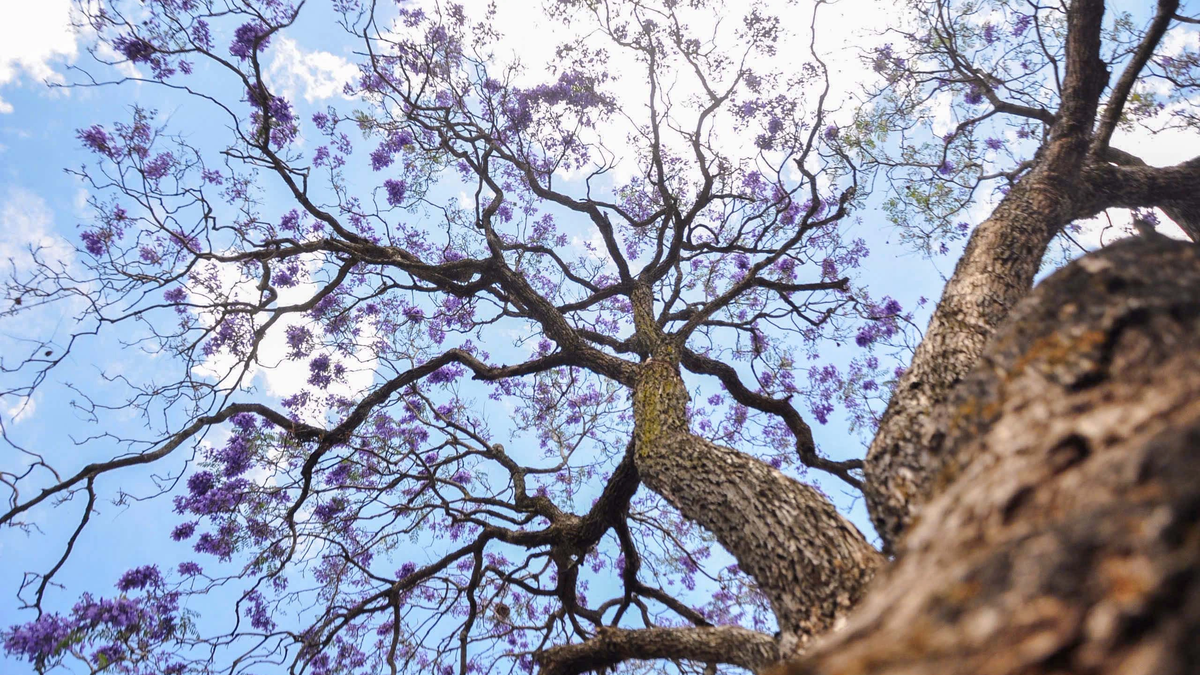
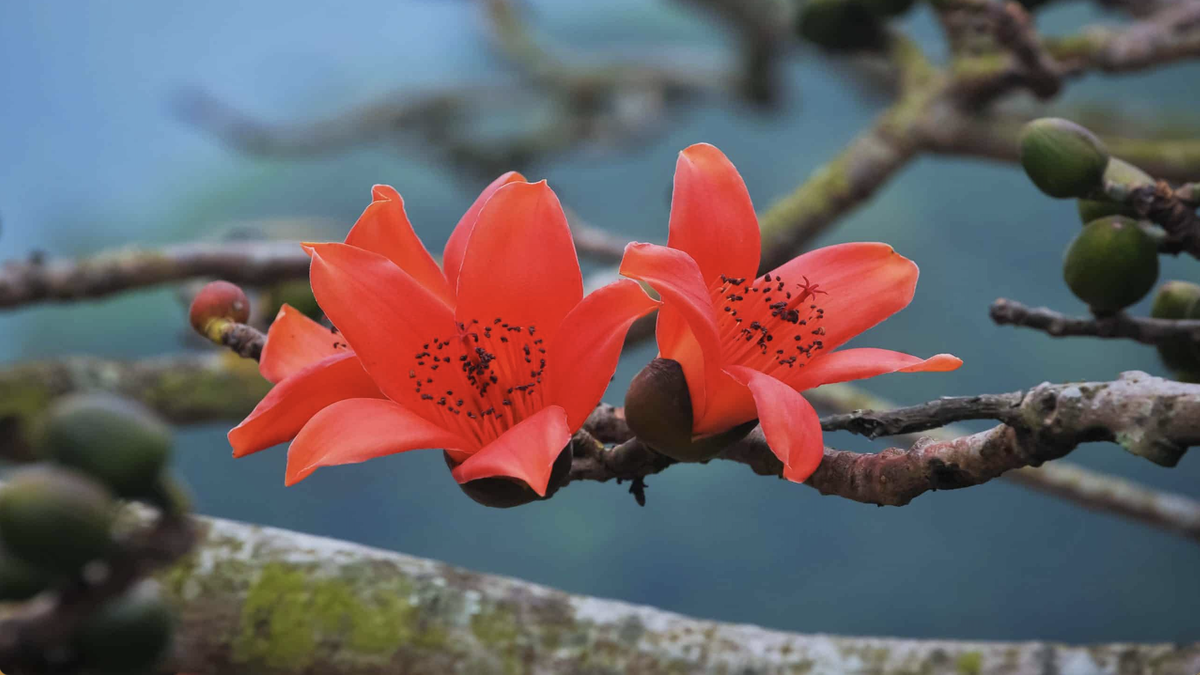
We set off in the early spring, traveling through Moc Chau on mountain slopes where peach blossoms bloomed, and below, fields of yellow mustard flowers created an irresistible beauty. The journey continued to Dien Bien, crossing Pha Din Pass, one of the four great mountain passes, the others being O Quy Ho, Khau Pha, and Ma Pi Leng. It was also my first time crossing Pha Din Pass, where in February, the kapok trees began to bloom, creating a poetic landscape. The pass is 32 km long, and its summit reaches an altitude of 1,648 m. All roads leading to Dien Bien Phu are steep and winding, with mountains upon mountains. The pass has now been widened, and at its summit there are many shops selling regional specialties, especially wooden goods and cutting boards made from ironwood. Traversing those towering mountains and dense forests, Pha Din Pass played a crucial role as it lay on the vital supply route for military supplies, weapons, ammunition, and food for the army.
We arrived in Dien Bien Phu City and spent the night at a hotel on Muong Thanh Street. Checking the GPS, we saw that Hill A1 was not far away, so we decided to meet the next morning. The morning began; Dien Bien Phu was cold at 14 degrees Celsius this season. The roads were not crowded with vehicles, and the trees along the streets had shed their leaves, awaiting new green shoots. The journey to reach Hill A1 was a journey that had taken many years. Hill A1 stretches in a northwest-southeast direction, comprising two peaks: the northwest peak is over 490 meters high, and the southeast peak is over 493 meters high. A1 is the designation given to the hill by the Vietnamese army. After many extremely fierce battles that took place here, at 4:00 AM on May 7, 1954, the Vietnamese army captured Hill A1.
The path to the hilltop was gently sloping, surrounded by bare-branched dipterocarpus trees. Many people from different regions, women in traditional ao dai dresses and men in military uniforms, followed the path to the summit. In the distance, near a grass-covered bunker, an old soldier sat thoughtfully, surrounded by the smoke of his cigarette.
Now a historical site, Hill A1 has a comfortable path leading up to it, bordered with grass and flowers. The old bunkers have been renovated mainly for visitors, and the remains of a tank, one of two French tanks, are on display. Below, right in the exhibition area, are exhibits of the weapons that the Vietnam People's Army brought to Dien Bien Phu to participate in the battle.
Hill A1, with its red soil, was a place where the tour guide told stories, and many young people gathered around to listen. The hill was breezy and spacious, surrounded by ancient trees, perhaps some of which were planted later and have grown to keep pace with the passage of time.
We visited the bunker of General De Castries – born in 1902 in Paris (France) with the very long name Christian Mari Ferdinand DelaCroix De Castries. At 5:30 PM on May 7, 1954, the entire staff, including General De Castries and his subordinates, were captured alive in his command bunker. After the 1954 Geneva Accords, De Castries was returned to the French army. He left the military in 1959, and more than 30 years later, on July 29, 1991, De Castries passed away. The final moments of Commander De Castries are vividly portrayed during the 170-day siege of Dien Bien Phu, a rather tragic event. In the central command bunker, the officers felt bitter about their defeat. De Castries' face was pale under his red beret as he was led out of the trenches, a cigarette in his mouth, his eyes blinded by the sunlight. Afterward, the French general was escorted into a Jeep.
The bunker is located in the center of the Dien Bien Phu basin. It served as the workplace of General De Castries and the Command Headquarters of the Dien Bien Phu fortified complex. The bunker is 20 meters long and 8 meters wide, divided into four compartments. It was the working and resting place of General De Castries and the Command Headquarters of the Dien Bien Phu fortified complex. The bunker has been restored with sturdy cement walls and a corrugated iron roof. Historically, it was surrounded by barbed wire and guarded by four tanks at each corner.
At the end of our trip, we visited the Dien Bien Phu Monument located on Hill D1. The Dien Bien Phu Victory Monument is the tallest, largest, and heaviest bronze statue complex in Vietnam to date. The statue, 12.6 meters tall, was cast from 217 tons of bronze, stands on a 3.6-meter-high pedestal, and consists of 12 sections, some weighing 40 tons. This is the work of sculptor Nguyen Hai. Here, there is the largest large-scale relief sculpture in Southeast Asia, with an average height of 7.5 meters and a width of 58 meters, assembled from 217 slabs of Thanh Hoa blue stone, weighing nearly 400 tons. The main path leading to the monument is a ceremonial axis with 320 steps. On either side of the axis are 56 markers made of Thanh Hoa blue stone, symbolizing the 56 days and nights of "carving tunnels, sleeping in bunkers, enduring rain, and eating dried rice rations."
We left Dien Bien Phu, and the road back to Pha Din Pass, through Son La and Moc Chau, was shrouded in thick fog in many places. On Pha Din Pass, the kapok trees were still in full bloom with their vibrant red flowers.
Source link

![[Photo] Conference announcing the Politburo's Decision on organizational and personnel matters](https://vphoto.vietnam.vn/thumb/1200x675/vietnam/resource/IMAGE/2026/04/01/1775017881825_bnd-2410-1472-jpg.webp)








































































Comment (0)