

This is not simply a technical or organizational adjustment, but reflects modern, effective management thinking on the path to a new era for the country.
Two-tiered government model in elections
This election takes place at a time when the country has just gone through 40 years of reform with historically significant achievements. 2026 is also the first year of implementing the Resolution of the 14th National Congress of the Party - a "pivotal" term that opens the door for the country to enter an era of national strength and prosperity.
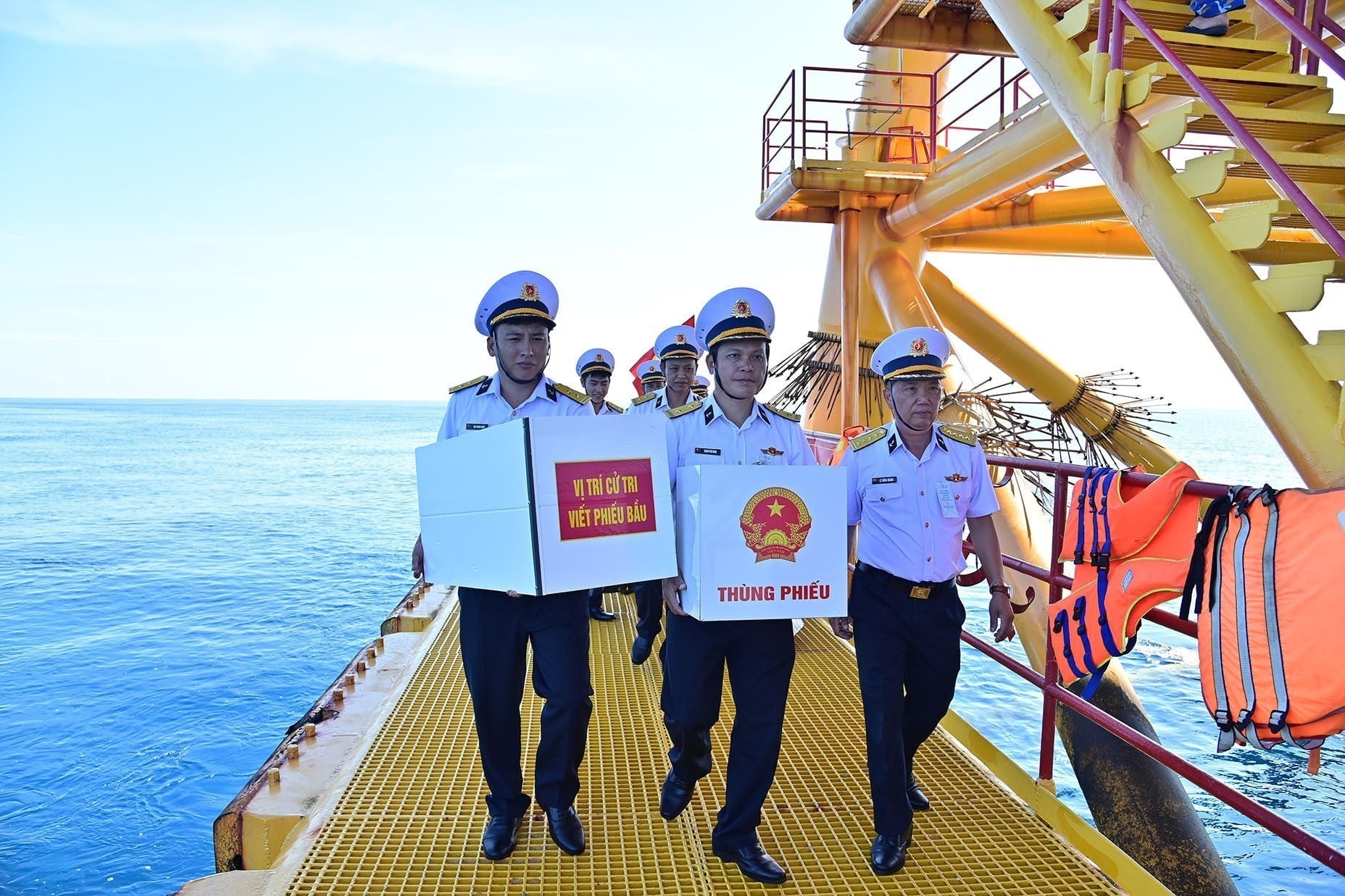
On the morning of March 1st, the early voting team of the Naval Region 2 arrived at the Ba Ke cluster to organize early voting for voters on the Hai An 68 ship and the DK1/9 platform. In the photo: The voting team carrying ballot boxes and supplies to the DK1/9 platform.
PHOTO: VNA
The most profound and fundamental new feature of this election is the first-ever implementation of a two-tiered local government structure. This streamlines administrative processes, enhances the effectiveness and efficiency of management, and facilitates centralized and unified election direction and operation. This also necessitates a review and adjustment of electoral unit divisions, delegate structures, and the organizational structure serving the election.
At the National Conference on the Implementation of the Election of Deputies to the 16th National Assembly and Deputies to People's Councils at all levels for the 2026-2031 term on November 15, 2025, General Secretary To Lam emphasized: "The success of the election will create an important starting point for building and consolidating the state apparatus for the new term, creating a solid political and social foundation to successfully implement the Resolution of the 14th National Congress of the Party. This is also an opportunity for us to affirm the leadership capacity of the Party, the effectiveness of state management, and the efficiency of the political system in the context of having just completed the streamlining of the organizational structure, merging administrative units, and reorganizing local governments according to the two-tier model."
On March 1st, in an interview with Thanh Nien Newspaper, Mr. Pham Dinh Toan, Permanent Deputy Head of the National Assembly Office and Deputy Chief of the National Election Council Office, stated that regarding the division of electoral units, localities base their decisions on population size, geographical characteristics, transportation conditions, and population distribution to determine the number of units and the number of representatives to be elected. Some areas have adjusted polling locations to suit new boundaries, but all calculations prioritize convenience and safety for voters, especially in large areas with dispersed populations.
Regarding the structure of delegates, the structure of the 16th National Assembly delegates was adjusted to increase the number of delegates from the central level and full-time delegates; reduce the number of provincial and city leaders who also head the National Assembly delegation, and at the same time, increase the proportion of delegates from research institutes, universities, businesses, and production and business associations.
This helps to enhance professionalism, legislative quality, supervision, and decision-making on important national issues, demonstrating innovation and strengthening the accountability of representatives to their constituents. It forms the core of a more effective National Assembly, closer to the people and responsive to the demands of the new situation. Regarding the People's Councils, the basic structure and composition remain stable. The determination of the structure is carried out rigorously, based on democratic consultation and high consensus. Voters' rights to vote, supervision, recommendations, and feedback are still guaranteed according to law.
"In the context of a streamlined administrative apparatus, the demands for the quality of representatives' performance and the effectiveness of supervision are increasingly enhanced; the application of information technology and online interaction channels also facilitates increased openness, transparency, and accountability," said Mr. Pham Dinh Toan.
Breakthrough in administrative efficiency
The second new feature of this election is the reduction in the time required for each step in the election process. According to Resolution No. 199/2025/QH15 of the National Assembly, the election date is set for March 15th, approximately two months earlier than in previous elections.
This shortens the time between the National Party Congress and the first session of the new National Assembly and People's Councils, allowing for timely consolidation of high-level personnel. It ensures that the assignment of new Party committee members is consistent, comprehensive, stable, continuous, and interconnected among key officials in Party, State, Government, Fatherland Front , and socio-political organizations. Simultaneously, the new Party committees at all levels can promptly implement the resolutions of the 14th National Party Congress and other Party congresses at all levels.
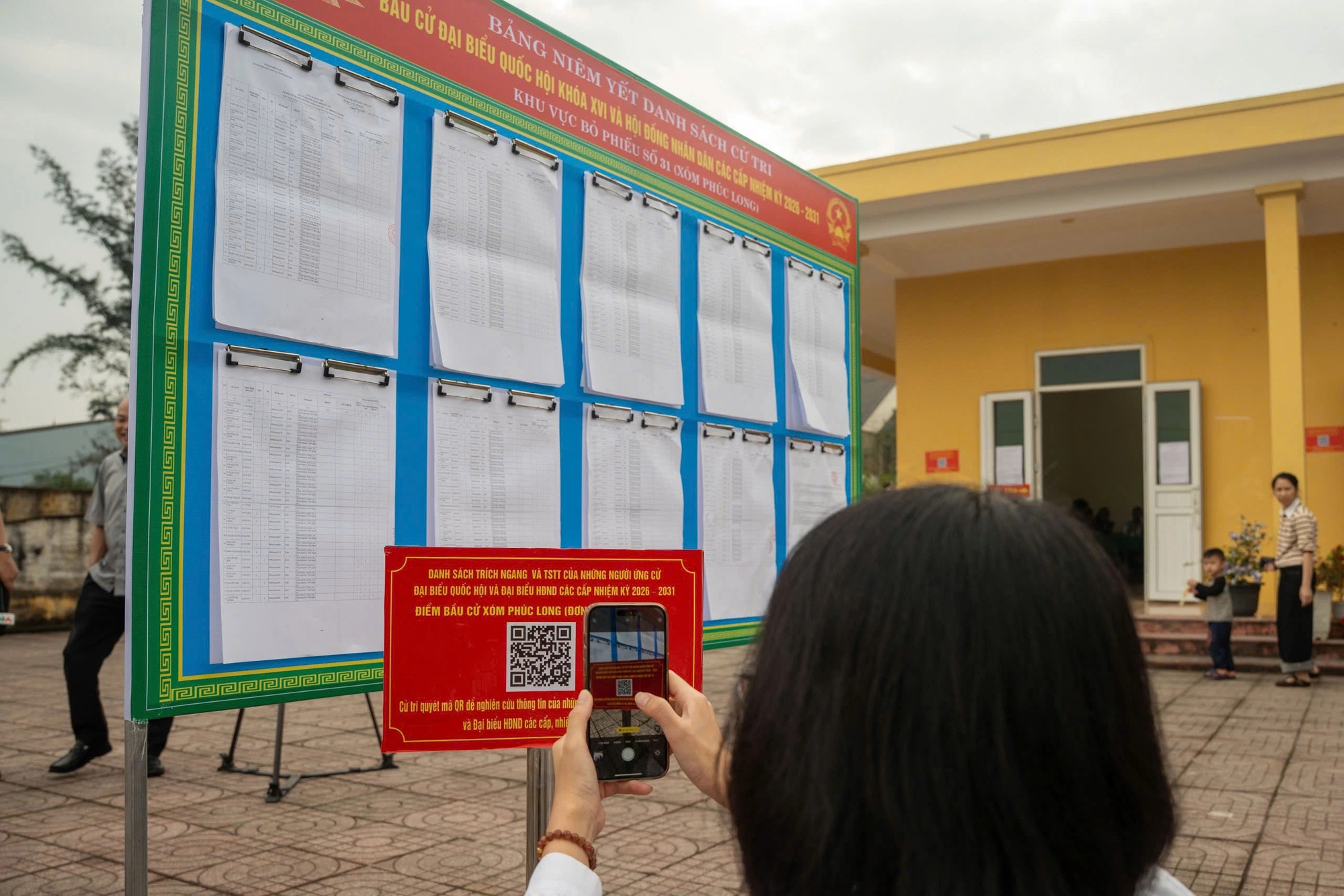
Voters scan the QR code to look up and learn information about the candidates.
PHOTO: GIA HAN
The total time from the deadline for submitting candidacy applications to election day has been shortened from 70 days to 42 days. The timelines for consultations, announcement of candidate lists, and handling complaints and denunciations have also been adjusted accordingly, ensuring consistency, compliance with regulations, and suitability to practical realities.
Mr. Pham Dinh Toan affirmed that shortening the time for some steps in the election process does not mean omitting procedures or reducing the quality of the election, but rather places higher demands on responsibility and organizational capacity, especially in areas related to personnel matters, consultation, candidate dossiers, voter list compilation, and the compilation and reporting of election results and related data.
The driving force behind modern elections.
Operating a two-tiered government model in elections and shortening the time required for each step in the election process is both a driving force and an essential requirement of the third change and innovation: digital transformation and the application of information technology in certain tasks.
Accordingly, the creation and management of voter lists are carried out through the exploitation and use of the National Population Database and the VNeID application. On February 26, speaking at the nationwide online conference on election implementation, Deputy Minister of Public Security Nguyen Van Long stated that the Ministry has issued regulations on exploiting the National Population Database and VNeID to create voter lists and print voter cards; and is coordinating training for localities nationwide on election work.
To date, 3,320 out of 3,321 commune-level units have applied the software to the voter registration process. These units have allocated voters to polling stations on the software system for over 78.5 million eligible voters, achieving a rate of 99.48%. The Ministry of Public Security is also closely coordinating with the National Assembly Office to connect the election information portal with the electronic identification and authentication system, integrating login via VNeID accounts starting from December 17, 2025.
Simultaneously, the election information portal has been connected to the National Population Database, allowing candidates to automatically access information to fill out the declaration form. Instead of election officials having to manually record information door-to-door as before, using data from the Ministry of Public Security ensures that the voter list is updated accurately in real time, guaranteeing the right to vote for all citizens in the fairest and most transparent way. In addition, localities have proactively used social media platforms to quickly, vividly, and widely disseminate election propaganda content to voters.
It is clear that the three innovations of this election are closely related and inseparable. Shortening the election process is only truly feasible with the strong support of digital transformation and the application of technology. The two-tiered local government model helps to streamline the administrative structure, facilitating the deployment of technological applications and the smooth communication of election directives, while also creating conditions for concentrating resources on digital transformation.
Speaking with a reporter from Thanh Nien newspaper, Mr. Pham Dinh Toan acknowledged: "In the initial phase of operating the new model, the workload is large, requiring high standards and quality, while the time for implementing the process is shortened. This demands determination, close coordination, and thorough, systematic, and scientific preparation from an early stage among relevant agencies. The application of information technology also requires enhancing the digital capacity of election officials at all levels. In response to this, the National Assembly promptly established the National Election Council, issued plans and guiding documents; central and local agencies intensified training and prepared the best possible conditions for the election. The overarching goal is to organize a democratic, open, transparent, lawful, safe, and economical election."
The nationwide election day is not only a broad democratic activity for voters across the country to choose outstanding and worthy representatives of the people's will and aspirations, but also an opportunity for voters nationwide to experience a modern and transparent election process.
Preparations for early elections in the Spratly Islands Special Administrative Region are complete.
On March 1st, the People's Committee of Khanh Hoa province announced that preparations for early elections in the Truong Sa Special Zone have been completed, awaiting the day voters can cast their ballots. The Truong Sa Special Zone has 21 polling stations, with elections scheduled to begin on March 8th. To date, all polling units have completed the posting of voter lists and lists of candidates for the National Assembly and People's Councils at all levels in accordance with regulations. Propaganda, preparation of facilities, and security plans have been implemented thoroughly and seriously. The leaders of the Truong Sa Special Zone People's Committee stated that they have established an Election Committee with 11 members, along with 6 election boards and 21 polling stations with a total of 189 members.
Earlier, on February 24th, Ships 464 and 471, belonging to Brigade 146 (Naval Region 4), departed from Cam Ranh Naval Port for the Truong Sa Special Zone to deploy early election efforts. The two ships carried a working group, along with ballot boxes, ballots, voter cards, and lists of candidates for the National Assembly and People's Councils at all levels for the 2026-2031 term, to support the election process on the islands.
Hien Luong
The Hon Khoai and Hon Chuoi island clusters of Ca Mau province will vote on March 13th.
The Ca Mau Provincial Department of Internal Affairs announced that voters on the Hon Khoai and Hon Chuoi island clusters will cast their ballots early on March 13th to suit the unique conditions of these remote islands. Preparations at the two island locations have been carried out comprehensively, from reviewing voter lists and preparing facilities and polling areas to ensuring communication, logistics, medical services, and security measures. Officers and soldiers on duty on the islands are both directly assisting with the election process and educating and guiding workers to fully exercise their rights and fulfill their civic duties.
Similarly, on March 1st, news from the An Giang Provincial Election Committee indicated that the province has 6 polling areas authorized by the National Election Council to hold elections for the 16th National Assembly and People's Councils at all levels for the 2026-2031 term earlier than the national election day. Accordingly, the Tho Chau special zone will hold its election on March 8th, earlier than the national election day.
Seven days earlier than stipulated. Tho Chau is located more than 200 km from the mainland, and transportation is mainly by boat and heavily dependent on weather conditions at sea. Given this reality, to ensure timely compilation of election results, the An Giang Provincial Election Committee submitted a request to the National Election Council for consideration and permission to hold early elections in the Tho Chau Special Zone. There are 36 candidates running in the Tho Chau Special Zone; the voter lists for the 5 polling areas have been publicly posted with 1,972 registered voters.
Polling station No. 60 – a separate polling station for officers and soldiers of Brigade 127, Command of Region 5 of the Navy in Phu Quoc Special Zone – held its vote on March 12th, three days earlier than the nationwide general election date, due to the specific duties of the officers and soldiers. The ships are constantly on the move to manage and protect maritime sovereignty and islands in offshore waters, making it difficult for them to participate in voting on the official election day.
Tran Ngoc - Gia Bach
The Hoang Sa Special Zone and the highlands are ready for the big event.
The People's Committee of the Hoang Sa Special Zone (Da Nang City) has proactively implemented election work in accordance with its assigned functions and duties. To date, the unit has completed the posting of the official list and brief biographies of candidates for the City People's Council in electoral unit No. 3 at the headquarters of the Hoang Sa Special Zone People's Committee. Speaking with a Thanh Nien reporter, Ms. Tran Thi Kim Hoa, Director of the Department of Internal Affairs and Chairwoman of the Hoang Sa Special Zone People's Committee, said that the Hoang Sa Special Zone belongs to National Assembly electoral unit No. 2 (including the Hoang Sa Special Zone; An Hai, Son Tra, Cam Le, and Hoa Xuan wards; and Hoa Vang, Hoa Tien, and Ba Na communes) and Da Nang City People's Council electoral unit No. 3 (including the Hoang Sa Special Zone and An Hai and Son Tra wards). The special zone has meticulously prepared for the election, from reviewing the voter list and preparing facilities and equipment at polling stations to information and propaganda work.
In Quang Tri province, the Provincial Election Committee announced that the National Election Council has approved the request to allow three polling stations in Truong Son commune to hold elections seven days earlier than the national election day. Specifically, polling stations No. 13 (Doc May village), No. 16 (Hoi Ray village), and No. 17 (Nuoc Dang village) will hold elections for representatives to the 16th National Assembly and representatives to the People's Councils at all levels for the 2026-2031 term on March 8th, earlier than the national election day.
One week earlier than the general regulations. The proposal to hold early elections stems from the specific circumstances of Truong Son commune, as it is a remote area with difficult transportation. In particular, residents of Doc May village have to walk through the forest for 6-9 hours to reach the commune center. Meanwhile, people in Hoi Ray and Nuoc Dang villages have to travel by motorboat for 2-3 hours to reach the commune center.
Mr. Nguyen Dang Quang, Deputy Secretary of the Provincial Party Committee, Chairman of the Provincial People's Council, and Chairman of the Provincial Election Committee of Quang Tri province, said that the locality will develop appropriate plans to ensure the voting rights of people in remote areas, while organizing the forces to carry out the task in a reasonable and compliant manner.
Manh Cuong - Thanh Loc
Source: https://thanhnien.vn/nhung-doi-moi-mang-tinh-lich-su-185260301223523914.htm


![[Photo] National Assembly Chairman Tran Thanh Man attends the policy seminar to promote Vietnam-Türkiye cooperation.](https://vphoto.vietnam.vn/thumb/1200x675/vietnam/resource/IMAGE/2026/04/16/1776351415367_vna-potal-chu-tich-quoc-hoi-tran-thanh-man-du-toa-dam-chinh-sach-thuc-day-hop-tac-viet-nam-tho-nhi-ky-8705791-jpg.webp)


















![[Image] Bridges and roads connecting the eastern part of Ho Chi Minh City](https://vphoto.vietnam.vn/thumb/1200x675/vietnam/resource/IMAGE/2026/04/16/1776328595108_ndo_br_bh-vt5-jpg.webp)

































![[Infographic] Details of the Hanoi-Quang Ninh High-Speed Railway Project](https://vphoto.vietnam.vn/thumb/402x226/vietnam/resource/IMAGE/2026/04/16/1776338188424_anh-man-hinh-2026-04-16-luc-18-16-10.png)
![[Photo] National Assembly Chairman Tran Thanh Man meets with the Speaker of the Georgian Parliament](https://vphoto.vietnam.vn/thumb/402x226/vietnam/resource/IMAGE/2026/04/16/1776338494029_anh-man-hinh-2026-04-16-luc-18-21-21.png)















Comment (0)