Other members of the Mac family in Ha Tien
Around Binh San Mountain, besides the tombs of Mac Cuu's descendants, there are other Mac family tombs. These include the tomb of Mac Bang De and his wife Vien Tu Nuong on the other side of Binh San Mountain, near the tomb of Mac Mi Co. Both tombstones were erected in the year Quy Ty (1713, 1773, and 1833). Both tombstones bear the inscription "Erected by Thi Xuan and Thi Nguyet, daughters of the filial daughter of Dong Linh village, Loi Chau." This indicates that Mac Bang De also belonged to the Mac family of Dong Linh village, the lineage of Mac Cuu.
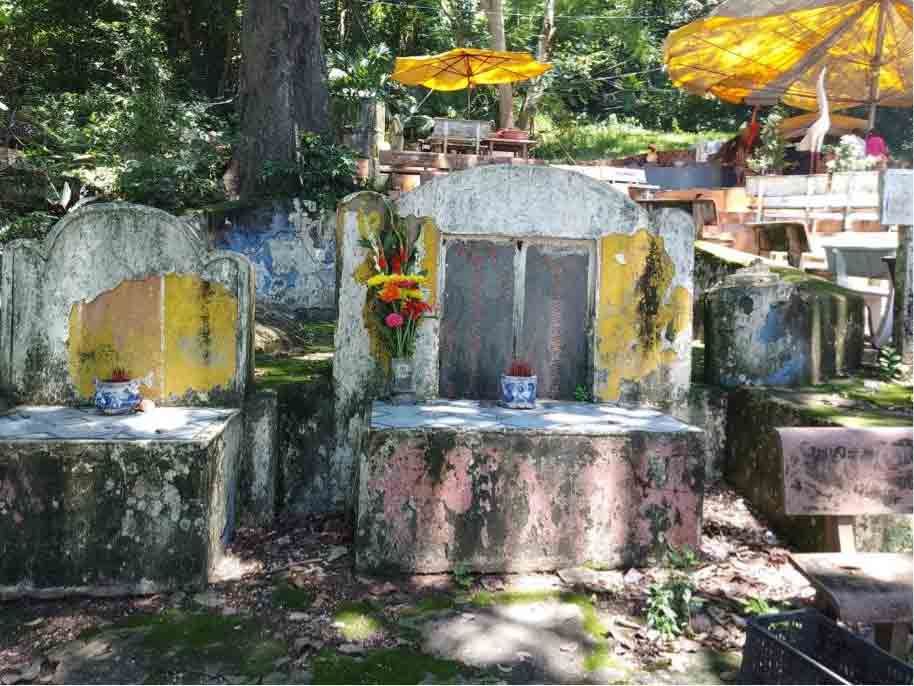
The tomb of Mac Bang De and his wife is located in Binh San.
According to the Mac family genealogy , after Mac Cuu established himself in Ha Tien, his mother, Sai Thi, also came by sea to live with her son. It is possible that other members of the family also came to settle there. Mac Bang De was one of them.
The tombstone of Mac Bang De does not yet bear the character "Mac" but has the radical "Ap" (meaning village/hamlet).
(鄚). But after Mạc Thiên Tứ came to power, some other members of the family were also allowed to use the character Mạc with the radical Ấp. Vũ Thế Dinh's Mạc family genealogy and Trịnh Hoài Đức 's Gia Định Thành Thông Chí record the names of several members in Hà Tiên with the Mạc surname containing the radical Ấp, such as Mạc Sùng, Mạc Khoan, Mạc Tú, and Mạc Long. Trịnh Hoài Đức also clearly states that Mạc Sùng and Mạc Khoan were "Mạc clan members"—that is, people from Mạc Thiên Tứ's family. However, we have not yet determined their relationship to Mạc Thiên Tứ in the family tree.
The envoys belonged to the Mac dynasty.
Among these individuals, Mac Long left the most significant traces. Vu The Dinh stated that Mac Long (Mac Van Long) was an envoy sent by Mac Thien Tu to Guangdong to answer Governor-General Ly Thi Nghieu's question about the origins of the Hoa Do people (Burmese). In the Qing Dynasty's official documents (similar to the Nguyen Dynasty's imperial archives), one of the two envoys, the correspondent Mac Nguyen Cao, went to Guangdong in 1767. In a letter from 1770, Mac Thien Tu also mentioned the envoy Mac Van Long who had just returned from Guangdong.
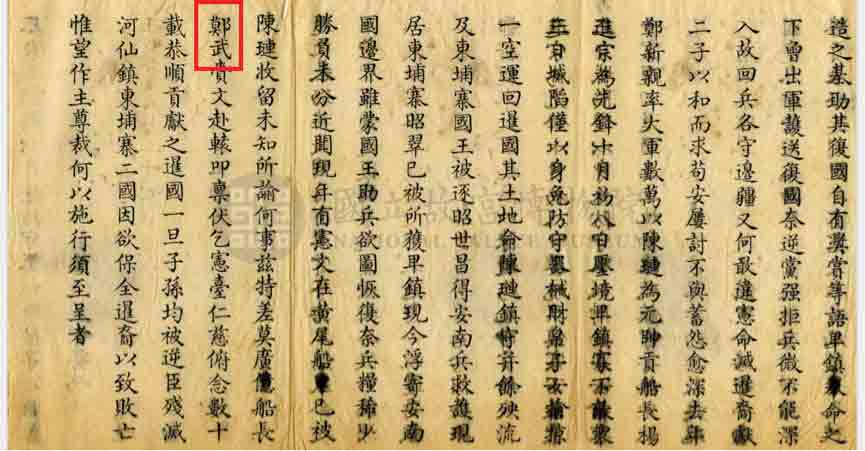
A copy of Mac Thien Tu's letter bears the inscription Mac Vu with the radical "Ap" (meaning village/hamlet).
The delegation led by Mac Van Long marked the third literary exchange between Ha Tien and Guangdong literati. The "Lo Khe Poetry Collection" by the poet Duong Chan Thanh (1701 - ?) from Nam Hai district, Guangdong province, contains a poem titled "Happy to meet the envoy of Ha Tien, Mac Van Duong, and immediately composed a poem as a gift" (Rejoicing at meeting the envoy of Ha Tien, Mac Van Duong, and immediately composed a poem as a gift). The character "Mac" in Mac Van Duong's name also contains the radical "Ap". The poem reads:



Phu Tra Dong Chi Hai Thien Dieu
The royal envoy arrives to serve the royal court.
Literature and education have declined over time, becoming vulgar.
The lute plays a joyful tune, continuing the melody.
Tran Huy Di Phu Hoan Trung Luan
The art of selling the art of the Mysterious Void, written under the brush.
Heartbroken, cold and unlucky in youth.
The sound of the forest echoes, reaching towards the clouds.
(Riding a raft towards the east, the sea and sky stretch far into the distance)
The envoys came to pay their respects in accordance with the imperial court's decree.
Literary education has long been a part of our customs.
Today, the literary community is delighted to receive such kind words.
The comments about Di Phu are indeed accurate.

His talent surpasses even Huyền Hư, as evidenced by his writing style.
It inspires awe and admiration in the young man.
In the literary circle (the gathering place), the sound of poetry resounds to the heavens.
Dương Chấn Thanh also wrote another poem titled "Sending Trần Phượng Nghi to the Hà Tiên garrison in An Nam" (Farewell to Trần Phượng Nghi on his way to the Hà Tiên garrison in An Nam). Trần Phượng Nghi was probably Trần Đại Dương, the acting district chief of Thuận Đức district. He was sent to Hà Tiên by Lý Thị Nghiêu, the Governor-General of Liangguang, to investigate the situation after Mạc Long's delegation had gone to Guangdong.
In April 2024, while clearing weeds in the Mui Nai area (Ha Tien), local residents discovered an ancient tomb. It was the tomb of Lady Le Thi Than Duc, a concubine from Lo Giang (Fujian). The tombstone was erected by her two sons, Mac Van Long and Mac Van Khanh, in January of the Year of the Pig (1749). The character "Mac" in the inscription contains the radical "Ap," indicating they were also "Mac clan members." Considering Mac Van Long's activities, the Year of the Pig was likely 1749.
From diplomatic documents between Ha Tien and Guangdong, we learn about another member of the Mac family, Mac Vu. At the end of 1771, Mac Vu was sent to Guangdong to report on the fall of Ha Tien. When transcribing Mac Thien Tu's documents, the Qing dynasty scribes omitted the "Ap" radical from Mac Vu's Mac family name. However, they left out the character "Mac" with the "Ap" radical. This confirms that Mac Vu was also a member of Mac Thien Tu's family. Descendants of the Mac family with the "Ap" radical, but not directly related to Mac Thien Tu, still live in Ha Tien today.
Source: https://thanhnien.vn/hau-due-mac-cuu-qua-nhung-tu-lieu-moi-phat-hien-nhung-hau-due-ho-mac-khac-185250302225701958.htm
![[Photo] General Secretary and President To Lam working with the Technical and Professional Center, Ministry of Public Security](https://vphoto.vietnam.vn/thumb/1200x675/vietnam/resource/IMAGE/2026/07/06/1783318005842_a1-bnd-1129-2263-jpg.webp)