


Glorious memories
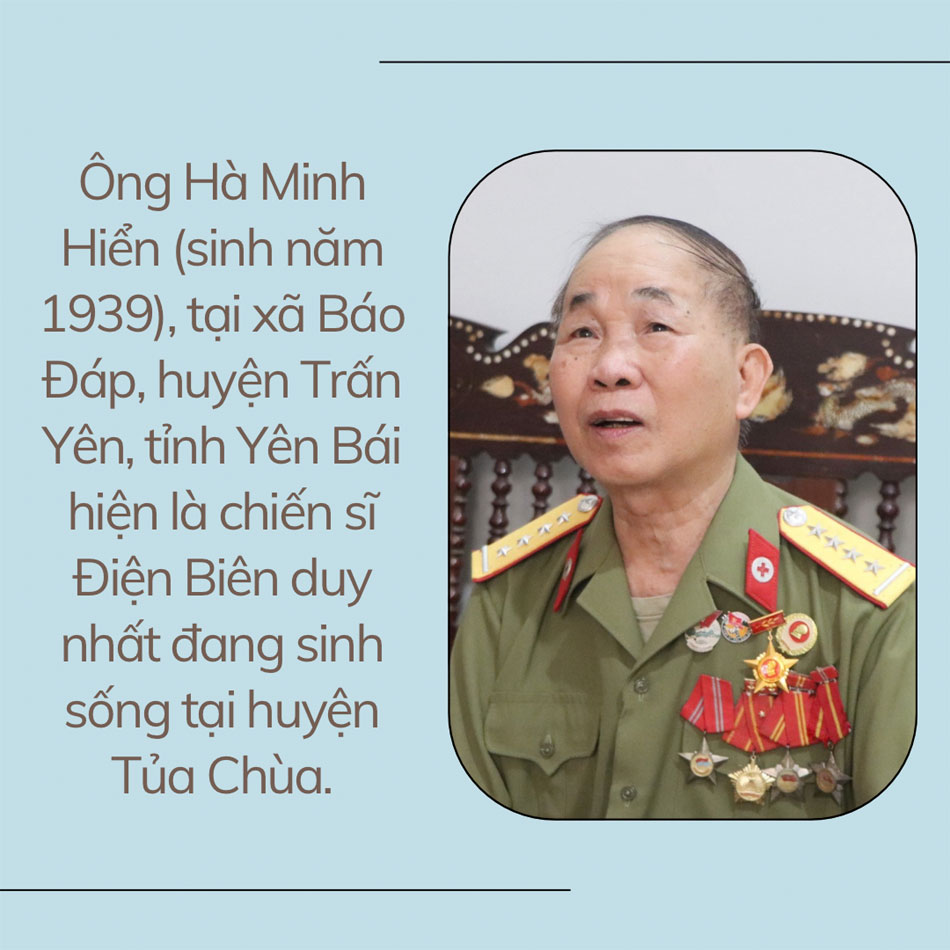
These days, Mr. Ha Minh Hien, a resident of Dong Tam neighborhood, Tua Chua town (Tua Chua district), is filled with an indescribable sense of pride. Memories of his participation in the Dien Bien Phu Campaign keep flooding back. Fortunately, during my work trip, I had the opportunity to meet and hear Mr. Hien recount the heroic, arduous, and united period of our army and people.
Seventy-one years ago, Mr. Hien, then just 14 years old, answered the call of his country and left his hometown to join the resistance war to save the nation. The young cadet enlisted in October 1953 and was assigned to Company 23, Battalion 955, Regiment 159, Northwest Military Region, participating in the Dien Bien Phu campaign. Wearing his military uniform adorned with many medals, and sipping a warm cup of tea, Mr. Hien thoughtfully recounted: "I remember on January 25, 1954, when all the soldiers on the front were ready to fire, we received an order to postpone the attack. The strategy shifted from 'attack quickly, win quickly' to 'attack surely, advance surely.' During the Dien Bien Phu campaign, we were stationed right next to the Him Lam stronghold. This is the battle I remember most." On March 13, 1954, our troops launched an attack on Him Lam, a strong resistance center consisting of three strongholds located on three adjacent hills along Highway 41. In that battle, some comrades I had met that morning were killed upon returning home at noon. At that time, all I knew was that seeing each other again meant I was still alive.
Despite three waves of attacks on the Dien Bien Phu stronghold, resulting in many losses and sacrifices, thanks to the brilliant military leadership of General Vo Nguyen Giap and the determination and unity of the entire army and people, after 56 days and nights of arduous fighting, on May 7, 1954, our army and people completely destroyed the Dien Bien Phu fortified complex.
Recalling the past with a heavy heart, and remembering the historical witnesses of that period who are no longer alive to witness the changes in this historic land, Mr. Hien's eyes welled up with tears as he said: "To achieve victory, so many of my comrades and fellow soldiers bravely sacrificed their lives and lie buried on this land… That is why the image of the 'Determined to Fight - Determined to Win' flag flying atop General De Castries' bunker, the moment hundreds of French soldiers emerged raising white flags in surrender, is something I will never forget."
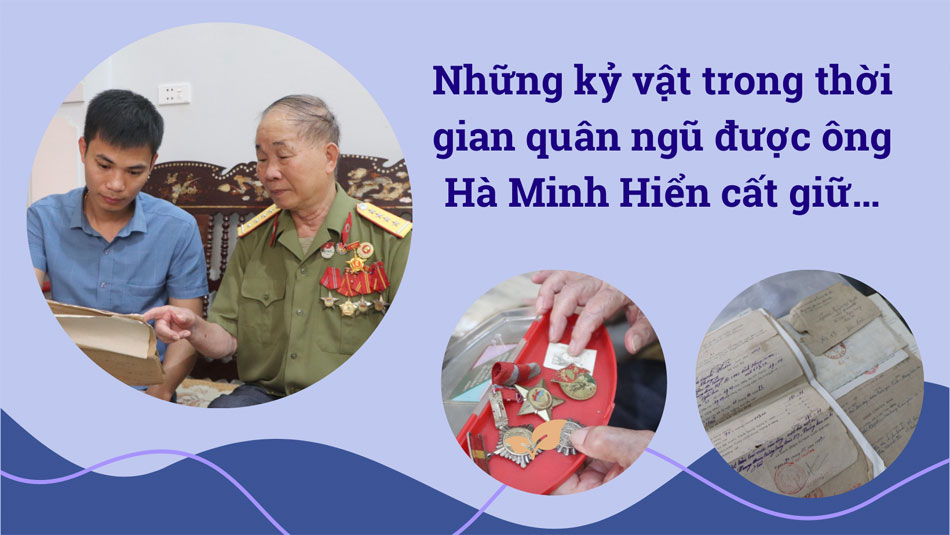
"Treat wounded soldiers like family."
During the Dien Bien Phu campaign, Mr. Hien both directly fought on the battlefield and assisted the military medical forces in treating the wounded. In his memory, the war was fierce, and many soldiers were wounded; on some days, the number of wounded brought to military medical stations reached thousands. With so many patients, the military medical force at that time consisted of only a few dozen people. During the 56 days and nights of the campaign, the military medical personnel hardly ever got a full night's sleep, only occasionally daring to sit down for a short nap to relieve fatigue before continuing their work of treating patients. To share the heavy workload of the military medical team, Mr. Hien joined the civilian labor force in assisting with the care of the wounded.
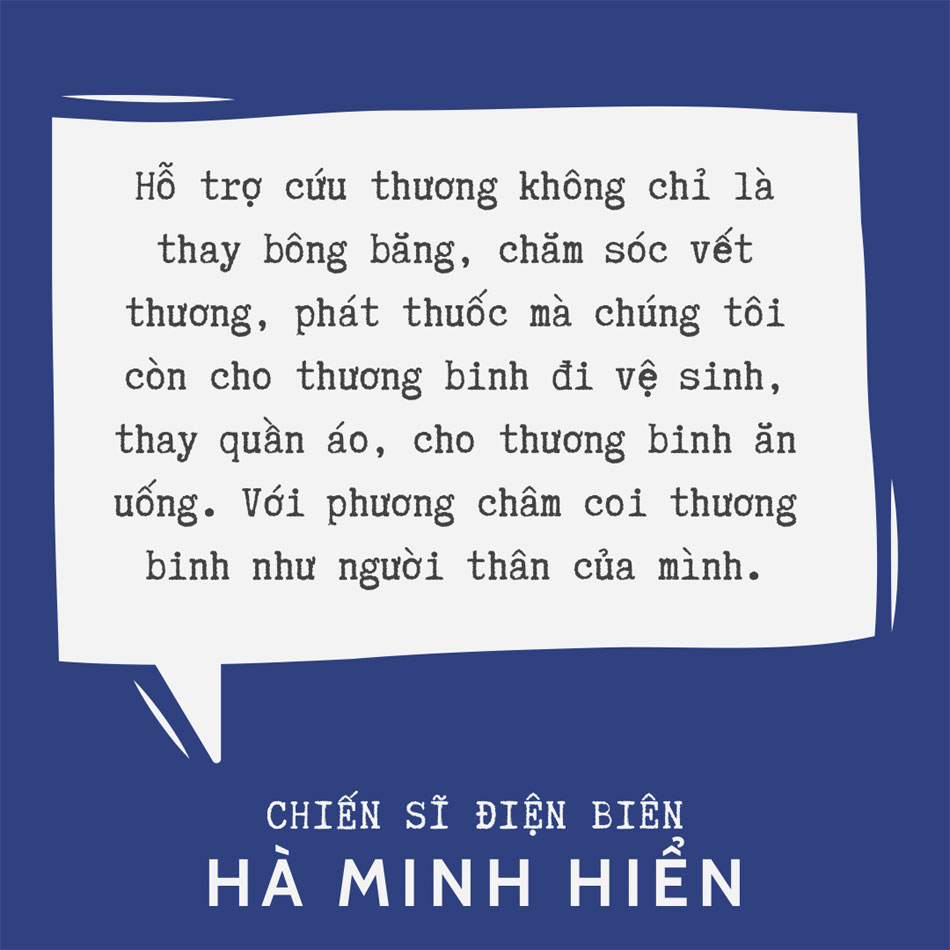
“During the Dien Bien Phu Campaign, the medical teams had trenches and shelters to serve in treating the wounded, divided into three areas: the critically wounded, the moderately wounded, and the lightly wounded. Wounded soldiers usually arrived at the medical team at 1-2 a.m. to prevent light from escaping and revealing the location; we all quickly assisted the medical personnel in checking, selecting, and cleaning the wounds of the wounded so they could be quickly transferred to the trenches for treatment. In assisting with the care of the wounded, I personally fed them spoonfuls of thin porridge to help them fight hunger and dehydration, and quickly recover their health; I stayed by their side in the trenches to encourage them, and sometimes even had to be a support for those with injuries or difficulty breathing… With the desire to help more wounded soldiers, I regularly learned from military doctors about the experience of caring for and treating lightly wounded soldiers. Afterwards, I personally changed bandages, cleaned wounds, and stopped bleeding for my injured comrades,” Mr. Hien recalled.

No longer confined to the pages of books, historical documentaries, or literary works, the victory at Dien Bien Phu now exists only in the memories of the soldiers who fought there. In the home of Dien Bien Phu veteran Ha Minh Hien, the verses of "Hail to the Dien Bien Phu soldiers" by poet To Huu resonate, echoing the heroic memories of those who fought in a time of fierce battles.
"Hail to the soldiers of Dien Bien Phu!"
Heroic soldier
Iron furnace
For fifty-six days and nights, we dug tunnels through the mountains and slept in bunkers.
incessant rain, rice balls
Blood mixed with mud
"With unwavering courage, unyielding determination!"
During the Dien Bien Phu campaign, the military medical corps treated over 10,000 wounded soldiers and nearly 4,500 sick soldiers. With the support of soldiers and civilian workers, thousands of lightly wounded and sick soldiers were treated and recovered within 10 days, returning to their combat units and making a significant contribution to restoring the fighting strength of units across the entire front.
Source














































































Comment (0)