In Co Chat village, Ninh Giang commune, the silk reeling craft once flourished. Almost every household in the village had cocoon trays, spinning wheels, and silk baskets; the sounds of spinning and weaving became familiar sounds of rural life. The craft not only provided income but also represented memories, identity, and pride for many generations of people here.
However, facing fierce competition from industrial silk production, the Co Chat craft village has encountered many difficulties in recent years. Fluctuating raw material prices, an unstable market, and the labor-intensive nature of handcrafted products have resulted in low profits. Many households that were once dedicated to the craft have had to switch to other jobs to ensure their livelihoods. Currently, only over 30 households in the village maintain the silk reeling and spinning craft, with women being the primary workforce.
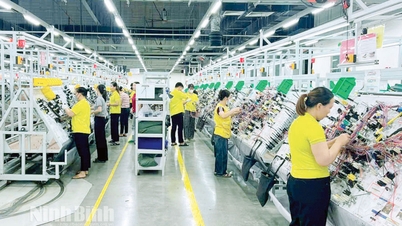
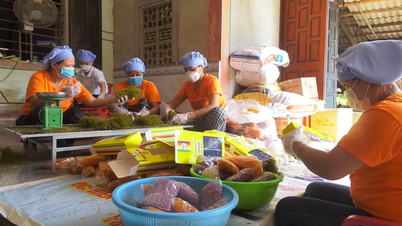
In the small workshop of Mrs. Doan Thi Hue's family, lustrous silk threads are regularly spun into yarn. Mrs. Hue has been involved in this craft for over 20 years. From the days of entirely manual labor, heavily reliant on human effort, her family's workshop has gradually applied modern machinery and technology to the production process. As a result, labor productivity has increased, the quality of the silk yarn is more stable, and it better meets market demands.
Ms. Doan Thi Hue from Co Chat village shared: “Previously, manual work was very hard, and we couldn't spin much silk in a day. Now, with the help of machinery, the work is less strenuous, and on average, the facility spins about 30-40 kg of silk per day. Most importantly, we are still preserving the craft of our ancestors and creating more jobs for local laborers.”
Currently, her family's silk spinning facility provides regular employment for 7 local workers. The majority are middle-aged women who can balance their work with caring for their families. For them, silk spinning is not simply a means of earning a living, but also a continuation of a traditional craft deeply ingrained in rural life.
What is noticeable in Co Chat today is that while many young workers choose to leave their hometowns to find jobs in industrial zones, the women quietly cling to their traditional crafts. It is they who are "keeping the flame alive" for the village craft with their admirable perseverance and dedication.

According to Ms. Doan Thi Diu, Chairwoman of the Women's Association of Ninh Giang commune, the locality currently has two typical traditional crafts: weaving in Dich Diep village and silk reeling in Co Chat village. These crafts not only have economic value but are also linked to the history, culture, and identity of the local community.
"In the context of the craft village facing many difficulties, women remain an important force in maintaining production. The Women's Association of the commune always focuses on promoting and encouraging members to preserve their crafts, support each other in production, and connect resources so that women have more opportunities to develop their family economy," Ms. Dịu said.
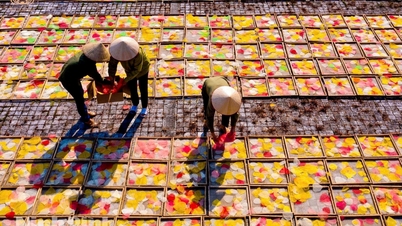
Not only in the silk weaving industry, but also in the Bao Dap silk flower village, Hong Quang ward, the role of women is clearly evident in every stage of production. At the Duy Huong silk flower workshop, the working atmosphere is harmonious. On long tables, each petal, stamen, and leaf is cut, bent, assembled, and shaped by the skillful hands of the artisans.
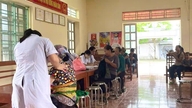
Ms. Nguyen Thi Mai Huong, owner of Duy Huong silk flower workshop, said that her unit has been involved in the craft for about 15 years. The silk flower making craft in Bao Dap has been passed down through many generations, from family-scale production to more professional establishments. Currently, the workshop specializes in producing various types of silk flowers for the domestic and export markets, creating jobs for nearly 10 local workers with an average income of 7-10 million VND per person per month.

“Making silk flowers cannot be rushed. From choosing materials and coordinating colors to shaping, everything requires careful attention. Women have the advantage of being skillful, meticulous, and hardworking, so they are very suitable for the profession. We hope to both develop production and preserve the unique characteristics of the craft village,” Ms. Mai Huong shared.
Today, traditional craft villages no longer rely solely on traditional methods of production but have evolved, improving product designs, seeking new orders, and expanding their markets. In many places, women are the ones directly driving this transformation.
However, the journey of preserving traditional crafts still faces many challenges. For a craft village to develop sustainably, it needs the support of the government, women's associations, and programs providing capital, vocational training, trade promotion, and brand building. This is also the direction that women's associations at all levels in the province are focusing on to enhance the economic empowerment of women, especially rural women and women involved in production in craft villages.
In the first quarter of 2026, the Provincial Women's Union advised the Provincial People's Committee to issue Plan No. 67/KH-UBND dated March 2, 2026, on implementing the Government 's "Support for Women's Entrepreneurship Project giai đoạn 2026 - 2035", with a total budget of over 70 billion VND. Of this amount, 50 billion VND was allocated to the Social Policy Bank for women to borrow for starting businesses.
In addition, the Women's Union at all levels continues to implement the Project "Supporting cooperatives managed by women, creating jobs for female workers until 2030". Currently, the Women's Union at all levels is managing and operating over 9,488 billion VND for 133,960 members through coordination with the Social Policy Bank, the Agricultural and Rural Development Bank, TYM organization and other capital sources.
The Women's Union at all levels coordinated the organization of vocational training, counseling, and job placement for 750 female workers; and improved the quality of operations of 221 cooperatives and associations managed by women. In addition, the movement of women helping each other develop economically continued to spread with the mobilization of officials and members to provide interest-free loans to each other.

Ms. Vu Thi Ha, Vice President of the Provincial Women's Union, believes that empowering women economically is not just about providing capital, but also about helping women become more confident in production, business, management, and participation in socio-economic development at the local level.



“Women in craft villages are skilled, experienced, hardworking, and creative. What is needed is to create more opportunities for them to access capital, science and technology, digital transformation, product promotion, and market linkages. When women have the opportunity to develop economically, they not only improve their status within their families and communities but also contribute to preserving the traditional values of their homeland,” emphasized Ms. Vu Thi Ha.
Amidst market fluctuations, traditional craft villages may change their methods, designs, and production scale; but as long as there are women deeply committed to the craft, and persistent hands working with silk reels and silk flowers, the flame of traditional crafts will continue to be preserved, passed on, and spread.
However, for them to truly feel secure and committed to developing the craft village, support from all levels of government, organizations, associations, and the business community is essential; especially in providing capital, skills training, applying science and technology, digital transformation, product promotion, and expanding markets. When women in craft villages are given more opportunities, resources, and confidence, they not only enrich their families and hometowns but also contribute to preserving traditional cultural values and local identity.
Source: https://baoninhbinh.org.vn/phu-nu-giu-lua-lang-nghe-truyen-thong-260614172903224.html