

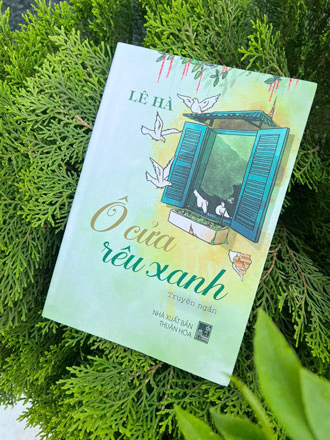
 |
| Short story collection "The Green Mossy Window" , Thuan Hoa Publishing House, March 2023. |
I've been reading Le Ha for about two years now, starting with her lush, loving essays about life, plants, and flowers, then moving on to her short stories, imbued with a passionate womanly sadness, sparkling with the light of happiness at the end of the road. I was suddenly struck by how profound her writing voice was, reflecting the depth of life's experiences. It's as if this female writer has gathered the sorrows and sufferings of the world into her works in a bitter yet subtly evocative way. Sometimes, when I read Ha, I sense a certain clarity in each slice of fate, in each perspective on destiny.
After several collaborative books, it wasn't until early April that Le Ha released her first collection of short stories, "The Mossy Window" (Thuan Hoa Publishing House). The collection comprises 23 works by this female writer, who is at the peak of her literary talent. Le Ha offers readers a peaceful realm of memories. Although the windows she opens are filled with reflections on life, fate, destiny, and human nature, they are always brimming with poignant affection, vibrant with the sounds of life, and blossoming with fresh green shoots.
Formerly a journalist, then a freelance writer, and now battling a terrible disease, literature is a spiritual medicine for Le Ha, giving this young woman renewed faith in life. This girl from Hue, with her smooth, flowing yet simple and unpretentious writing style, guides readers through many stories as if the reader were the character, or at least had seen or heard them before. In the short story that serves as the title of the collection, Le Ha tells the story of an elderly couple yearning for their children, their hearts aching with longing. Amidst the overwhelming memories of their aging, the old woman meticulously cooks a pot of dried fish so that her children, when they visit, will have something to take home. Was the fish stew overcooked with chili peppers, or was it the yearning for grandchildren in this twilight age that brought the old woman's tears? No delicacy can fill the void of longing in the elderly.
Six years ago, facing the brink of life and death, Le Ha chose to fight cancer to the end. Only after her condition gradually stabilized did this girl from Hue share her story with friends. Ha has always had a burning desire to live, to accept and adapt to her fate. Le Ha chose literature to express her feelings. Literature also chose Ha to spread the values of life. To live like the birds that still sing sweetly every morning. To live like the flowers that, through sun, rain, and storms, still offer vibrant colors to life. To live like the earth that never betrays people. To live like the grass, battered but still lush and green on the hillsides. And to live as if she understood the philosophy that there is no peace without overcoming hardships, without tasting bitterness and sorrow, without being tainted by pain and suffering. Only then will peace be a truly radiant peace.
Le Ha chose a narrative voice that was like a gentle whisper to the reader. Sitting together, brewing a cup of tea, opening each window—some windows filled with the melodious chirping of birds—those vibrant sounds turned out to be a form of healing for An, the girl in the story "Sparrows on the Tiled Roof," after a storm of misfortune in her life. Or like Thao in "Leisurely Wandering in the Meadow," it was the smell of the earth that made her choose to return to her mother, to her homeland, to find love always waiting for her. Only people leave their homeland, but the homeland never abandons its people. The earthy smell of the soil is an indelible memory for any child of the countryside. The city, with its green lights and dazzling splendor, but in reality, those concrete and steel structures never give us the taste of home. And as long as we remember the smell of the earth, our homeland remains in our hearts. Only those who truly love their homeland can deeply understand the longing for its taste and seek it out.
Le Ha offers a healing experience for her readers, because I believe that the young people of this era are caught up in the pressures of making a living, caught in a whirlwind of suffocating pressures. Indeed, the lightheartedness of life in Le Ha's short stories is what makes people remember this female writer so fondly. Le Ha doesn't choose a style of writing that is overly detailed, sharp-edged, or full of convoluted situations. Instead, she opts for a narrative style that flows smoothly, leisurely, and with a gentle rhythm. By the last page, I felt as if I were sitting with Le Ha in a house full of windows; each window she opened revealed a story this woman from Hue whispered to me. Slowly, just enough to listen, just enough to enjoy, just enough to feel affection, and just enough to remember. Remembering to breathe softly amidst the turmoil of life. The lighter the breath, the more leisurely one lives.
Le Ha published this collection of short stories after grappling with major surgery, chemotherapy, and the haunting prospect of an unexpected death. Yet, readers will find no gloomy atmosphere, no somber setting, or negative plot points. Instead, they will find a vast expanse of refreshing green in the 23 short stories, spanning nearly 200 pages. I believe this reflects an extraordinary and enduring spirit of optimism. I think Le Ha deeply loves life. And I also believe that when readers have the good fortune to encounter Le Ha's words, they will also feel compassion for this small but courageous girl from Hue. Compassion as one truly loves another.
Le Ha, whose real name is Le Thi Ngoc Ha, was formerly a reporter for the Vietnam Law Newspaper and is now a freelance writer. She has won several awards from Thanh Nien Newspaper, Tuoi Tre Newspaper, and the Propaganda Department of the Thua Thien Hue Provincial Party Committee. She is currently finalizing her collection of essays , "The Scent of Smoke in the Kitchen" and "Sunlight Through the Eaves." |
TONG PHUOC BAO
Source link

![[Photo] “Red Journey” 2026: Vietnamese Youth Continue Building the Bridge of Friendship Between Vietnam and China](https://vphoto.vietnam.vn/thumb/1200x675/vietnam/resource/IMAGE/2026/04/20/1776629730866_4055880775670638308-9618-4200-jpg.webp)
































































Comment (0)