

Specifically for Hanoi , the capital city continues to affirm its pioneering role in implementing the motto "leaving no one behind," with the result that by the end of 2024 there will be no more poor households; in 2025, the number of near-poor households will decrease sharply...

Social security policies are becoming more comprehensive.
In implementing the Resolution of the 13th National Congress of the Party, during the period 2021-2025, the system of policies on poverty reduction, social assistance, employment, social insurance, and health insurance continues to be improved in a comprehensive, inclusive direction, with the people at the center.
At the national level, the National Target Program for Sustainable Poverty Reduction for the period 2021-2025 has been implemented synchronously with many fundamental solutions, from livelihood support, job creation, vocational training, preferential credit to access to basic social services such as health, education , housing, clean water, and information. This multidimensional approach to poverty reduction has helped to more fully reflect people's living standards, while overcoming the mindset of poverty reduction solely based on income.
Amidst complex global economic fluctuations, unpredictable natural disasters and epidemics, especially the prolonged impacts of the Covid-19 pandemic, social security policies continue to play a crucial role as a "pillar," helping people stabilize their lives, restore production, and gradually improve their lives.
The government not only focuses on immediate support but also emphasizes long-term solutions to prevent re-poverty and the emergence of new poverty. As a result, poverty reduction nationwide has achieved significant progress: While the multidimensional poverty rate was 4.4% in 2021, it has decreased to approximately 1.3% by 2025, averaging a reduction of about 0.6% per year.
Millions of poor and near-poor households have received support in accessing preferential credit, vocational training, and job placement, gradually improving their income and quality of life. Notably, many localities have not only rapidly reduced the number of poor households but also created sustainable changes, significantly limiting the recurrence of poverty.
According to a report by the Ministry of Agriculture and Environment, by the end of 2025, the whole country will have achieved and exceeded the annual poverty reduction targets set by the National Assembly and the Government, surpassing 2 out of 5 targets (the poverty rate according to the multidimensional poverty standard and the poverty rate in (formerly) poor districts); achieving 2 out of 5 targets (the poverty rate among ethnic minorities; and the rate of particularly difficult communes in coastal and island areas escaping poverty and extreme hardship), while 1 out of 5 targets lacks sufficient basis for assessment due to the transition to a two-tiered local government model.
The National Target Program for Sustainable Poverty Reduction has invested in the construction of 2,616 new infrastructure projects and the maintenance and repair of 2,340 projects in poor districts and particularly disadvantaged communes in coastal and island areas. Among these are 1,465 transportation projects, 265 irrigation projects, 472 education projects, 41 health projects, and 96 clean water projects. These efforts have helped 19 out of 54 particularly disadvantaged communes in coastal and island areas achieve new rural standards, exceeding the assigned target of 30% (reaching 35.18%); while significantly improving living conditions, supporting production, trade, goods circulation, and providing basic social services.
The program has also implemented 10,587 poverty reduction models and projects (9,816 agricultural models, 771 non-agricultural models), attracting 205,585 households to participate (including 110,098 poor households, 63,659 near-poor households, and 31,828 newly escaped-from-poverty households). These models not only create sustainable livelihoods and increase income but also promote the shift in economic and labor structure in poor localities, from small-scale production to concentrated production linked to value chains. Of these, 6,174 projects supporting agricultural production helped 99,594 households improve farming methods, apply high technology, and enhance productivity and product quality.
Hanoi - a shining example of sustainable poverty reduction.
The capital city of Hanoi has made a significant contribution to the overall national achievements. Although Hanoi has more developed socio-economic conditions compared to many other localities, there are still disadvantaged areas. The effective implementation of sustainable poverty reduction policies has created clear and tangible changes.
Dong Chiem village (formerly An Phu commune, now My Duc commune) was once considered the "lowest of low-lying areas" in the capital city. Its low-lying terrain and frequent flooding made agricultural production difficult, and the lives of the people remained low for many years. However, things have changed significantly since then.
According to Village Head Nguyen Dinh Lieu, statistics from the beginning of 2020 show that the village still has about 80 poor households. To support people in escaping poverty sustainably, in recent years, Hanoi city and My Duc district (formerly) have paid great attention to investing in infrastructure development, creating conditions for people to develop economically and socially.
"We received investment to build a village cultural center with an area of over 200 square meters within a 1,000 square meter plot of land, costing over 2 billion VND. The village has 25 roads, 12 of which have been paved with concrete, and investment is currently underway for the remaining 13, facilitating convenient travel for the people," Mr. Lieu happily stated.
Simultaneously, policies supporting production, preferential loans, vocational training, and job creation were implemented. People proactively sought new livelihoods such as developing agriculture, engaging in small-scale trading, providing services, and working in urban areas. By the end of 2024, after reviewing all 560 households, Dong Chiem officially had no more poor households and has maintained this result to this day. Statistics up to the end of 2025 show that the average per capita income in the village reached 68 million VND, and the material and spiritual lives of the people continued to improve.
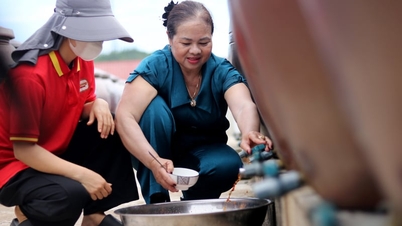
The case of Ms. Dinh Thi Lam, who had been a poor household for many years, is a clear example. Her husband passed away early, her family faced economic difficulties, and her house was dilapidated. However, thanks to housing support policies and the collective efforts of the community, she now has a spacious new house and is gradually stabilizing her life.
The changes in Dong Chiem are not an isolated case, but a vivid glimpse into the overall picture of sustainable poverty reduction in Hanoi.
According to statistics, at the end of 2021, Hanoi still had 3,612 poor households, accounting for 0.16% of the total number of households. By the end of 2022, this number had decreased to 2,134 households (0.095%); and by the end of 2023, it had further decreased to 690 households (0.03%). By the end of 2024, Hanoi will officially have no poor households according to the city's poverty standard.
In particular, with the implementation of the two-tiered local government model from July 1, 2025, 100% of the city's 126 communes and wards will have no more poor households, including 43 communes and wards with no poor or near-poor households. By September 2025, localities will continue to support the reduction of an additional 103 near-poor households, contributing to improving the lives of people, especially in rural areas.
This result was achieved primarily thanks to Hanoi's proactive approach in establishing its own poverty standard, approximately 30% higher than the national standard, demonstrating a determination not only to "eradicate poverty" in terms of statistics but also to genuinely improve the living standards of its people.
Resolution No. 17/2021/NQ-HĐND of the City People's Council on specific policies for sustainable poverty reduction in the period 2022-2025 has created an important legal framework with many policies to directly support people such as monthly allowances, health insurance support, tuition fees, and encouraging people to voluntarily register to escape poverty or near-poverty.
In addition, Resolution No. 09/2021/NQ-HĐND on social assistance continues to be effectively implemented, supporting projects that diversify livelihoods, enhance production capacity, and create sustainable jobs for the people. The city also issued Decision No. 801/QĐ-UBND dated February 19, 2025, setting the goal of not creating any new poor households and reducing 2,519 near-poor households in 2025...
The practical implementation of the Party's 13th National Congress Resolution shows that social security is not only a "safety net" but also a driving force for sustainable development. Poverty reduction, linked with improving the quality of education, healthcare, housing, and employment, helps people have the opportunity to rise up using their own resources.
In Hanoi, eliminating poverty by the end of 2025 is a significant milestone, but it's not the end point. The city continues to strive for improved social welfare, reducing poverty to a higher standard, and ensuring that all citizens benefit from the fruits of development.
Based on the results from the whole country and Hanoi, it can be affirmed that when the right policies are implemented, the approach is flexible and creative, and the spirit of "leaving no one behind" becomes a vibrant reality in social life, it contributes to strengthening the people's trust in the Party's leadership and creates a solid foundation for rapid and sustainable development in the next phase.
Source: https://hanoimoi.vn/nhung-thanh-tuu-dang-tu-hao-khong-ai-bi-bo-lai-phia-sau-trong-tien-trinh-phat-trien-729203.html






































































![[Photo] Hue: Admire the 2.4 trillion VND sea bridge, the longest in Central Vietnam.](https://vphoto.vietnam.vn/thumb/402x226/vietnam/resource/IMAGE/2026/05/24/1779614018347_anh-man-hinh-2026-05-24-luc-16-13-29.png)

























Comment (0)