There's a habit that has become a part of my life for many years and that I still can't give up: reading the People's Army Newspaper (QĐND) every day.
Throughout my journalistic career, even after retirement, I have always considered the People's Army Newspaper (QĐND) my closest, most trusted, and most reliable friend. I love this newspaper because it not only contains current events, national defense, and security information, but also embodies the historical values, traditions, and profound sentiments of the military and people of the entire country. Through each page, I gain a deeper understanding of the nation's history, the noble image of Uncle Ho's soldiers, and those who have fallen to protect every inch of our borderland and the sacred sovereignty of our seas and islands. The People's Army Newspaper also serves as a bridge connecting the military with the people, the voice of the Vietnamese armed forces and people, contributing to spreading good things and fostering faith and love for our homeland.
 |
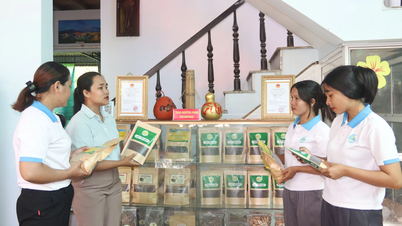
| The People's Army Newspaper reaches the officers and soldiers of the Lung Cu Border Guard Post and the local people. |
For me personally, the People's Army Newspaper (QĐND) is also a special "school of journalism." From the news articles, reports, features, and insightful political essays in the newspaper, I learned how to identify topics, how to observe, how to write, and above all, the responsibility of a writer towards life. Before 1990, Vi Xuyen district (Ha Tuyen province) was a hotbed of conflict in the fight to protect the northern border of the Fatherland. At that time, I was a radio technician at the district's radio station. Those years gave me the opportunity to meet many journalists from the People's Army Newspaper who came to work in the area and to accompany them on field trips. The simple encounters on the border battlefield, the arduous assignments with the Army journalists, and the pages of the People's Army Newspaper I read every day ignited in me a passion for writing. I began to practice writing, boldly sending my first news articles to the newspaper. Each time my writing was commented on and edited, I learned something new. The dedicated guidance of the military journalists helped me gradually grow, from a contributor to a reporter for Ha Tuyen Newspaper and then Ha Giang Newspaper.


From then on, I became more confident in writing about the armed forces: from training, combat readiness, assisting civilians in rescue operations, to patrols protecting borders and boundary markers; from the engineering soldiers silently clearing bombs and mines, searching for the remains of fallen soldiers, to the sea voyages braving the waves to Truong Sa and the DK1 platform. The journalists of the People's Army Newspaper taught me through their profession that: To create a good journalistic work, a journalist must know how to observe, listen, be persistent, and be moved by life. That is also a valuable lesson, a driving force that has nurtured my passion for journalism for many years.
In the heart of the border mountains, there are bitterly cold winter days, with fog blanketing the slopes. In that tranquil space, the sight of officers and soldiers passing around copies of the People's Army Newspaper is incredibly moving. Those pages seem to warm the camaraderie among comrades and fellow soldiers; they warm the hearts of those on the border of the Fatherland; and they give strength to the soldiers on their patrols, protecting the land and sky. In 1994, after four years as a reporter for the Ha Tuyen Newspaper and then the Ha Giang Newspaper, I went to work at the Lung Lan Border Guard Post. This was the most remote and difficult post of the Ha Giang Border Guard (now part of Tuyen Quang province). At that time, there were no roads; to reach the post, one had to walk all day from the center of Meo Vac district. Therefore, newspapers arrived very slowly. Some issues took two or three weeks, even a month, to reach the officers and soldiers. That afternoon, the military postal service delivered a backpack full of newspapers to the post, mostly the People's Army Newspaper. The whole unit felt like it was celebrating. Their eager eyes flipped through the pages of the newspaper, devouring the information they had been waiting for days. That year, many border posts didn't have electricity, relying only on oil lamps or candles. That evening, the post commander "generously" allowed two candles to be lit so the soldiers could read the newspaper. That image remains vivid in my memory to this day: the flickering candlelight amidst the border mountains, the soldiers huddled together reading the People's Army Newspaper. It wasn't just reading the newspaper; it was also a way for them to connect with their country, with their compatriots, and with the rhythm of life unfolding throughout the nation.
Having spent many years on field trips to border and island units, especially during my four voyages to Truong Sa and the DK1 platform, I have grown even more impressed by the journalists of the People's Army Newspaper. Amidst rough seas, high waves, strong winds, and scorching sun, even naval officers and soldiers accustomed to the sea find it arduous. Yet, the journalists of the People's Army Newspaper tirelessly work, staying on ships and islands, capturing the most authentic moments of life in these challenging environments. They immerse themselves in the lives of the officers and soldiers, sharing their hardships and quietly conveying these stories to readers nationwide. Thanks to them, the image of the Ho Chi Minh Army, the image of the border and the sea and islands of the Fatherland, has become closer to the hearts of the people.
I am particularly impressed by the continuous innovation of the People's Army Newspaper. From feature articles, investigative reports, and insightful commentary to sharp political essays and analyses, all demonstrate the political acumen, social responsibility, and high professional competence of the newspaper's staff. Some journalists I was fortunate enough to meet in person, while others I only knew through articles bearing their names. But all of them left a lasting impression of respect and gratitude in me. They are like diligent bees bringing sweet nectar to life, silently contributing to the prestige and standing of the People's Army Newspaper today.

On the occasion of the 101st anniversary of Vietnam's Revolutionary Press Day (June 21, 1925 / June 21, 2026), I would like to send my best wishes and sincere congratulations to the officers, reporters, editors, staff, and soldiers of the People's Army Newspaper and all those working in the military press. May you always maintain your passionate spirit, continue to innovate and create, overcome all difficulties and challenges, and produce more valuable journalistic works, contributing to the further development of Vietnam's revolutionary press.
Source: https://www.qdnd.vn/van-hoa/doi-song/nhung-trang-bao-thap-lua-dam-me-1044769
![[Photo] General Secretary and President To Lam attends the Central Public Security Party Committee Conference](https://vphoto.vietnam.vn/thumb/1200x675/vietnam/resource/IMAGE/2026/06/24/1782302063612_a1-bnd-9302-9166-jpg.webp)
![[Photo] Opening Ceremony of the 13th National Congress of the Ho Chi Minh Communist Youth Union](https://vphoto.vietnam.vn/thumb/1200x675/vietnam/resource/IMAGE/2026/06/24/1782286753905_ndo_br_1-8510-jpg.webp)
![[Photo] The 13th National Congress of the Youth Union conducts personnel work.](https://vphoto.vietnam.vn/thumb/1200x675/vietnam/resource/IMAGE/2026/06/24/1782299943080_ndo_br_1-6868-jpg.webp)