.png)
Every exam season, society places its faith in a seemingly simple principle: all candidates should have equal opportunities when entering the examination room. However, in many countries, this principle has been repeatedly challenged by large-scale cheating scandals, leading to lengthy investigations, trials, and crises of confidence in the education system.
From exam cheating rings in India and college admissions scandals in the US to high-tech cheating in online exams, exam scandals demonstrate that the fight to protect the fairness of exams is becoming increasingly difficult. When competitive pressure is too great, cheating can become a lucrative "industry."
The earthquake named NEET in India.
NEET (National Employment Information System) is a mandatory entrance exam for medical schools across India, attracting over 2 million candidates each year. For many families, it is considered the most important gateway to a prestigious and high-paying profession in society.
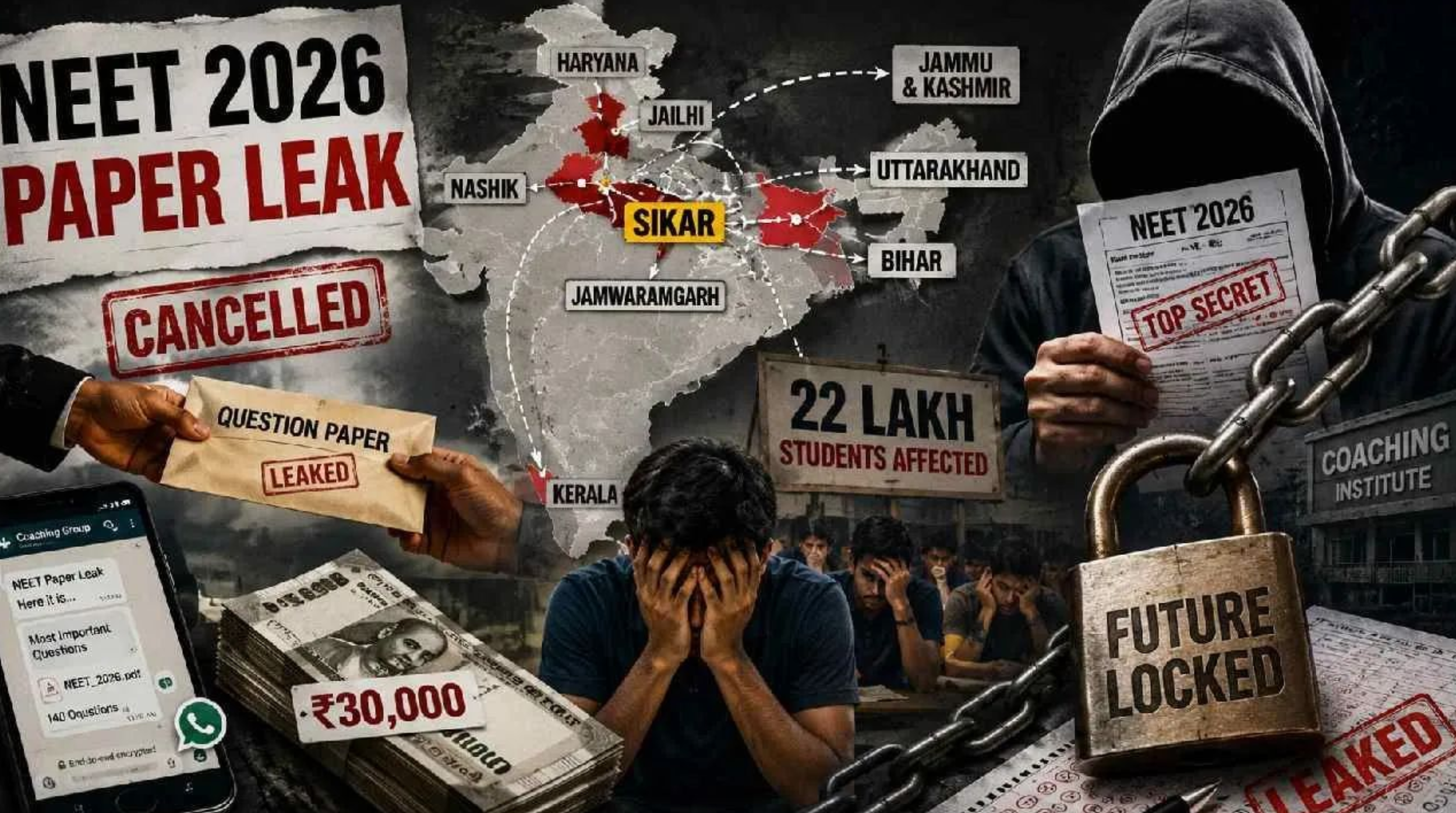
On May 3rd, approximately 2.2-2.3 million students participated in the national exam. However, just a few days later, social media and student forums were flooded with accusations that a "predicted exam paper" leaked before the exam contained content that unusually matched the official exam paper.
On May 12th, the National Examinations Authority of India (NTA) decided to cancel all results of the previously held NEET-UG 2026 exam and announced a re-examination.
According to Indian media, the Central Bureau of Investigation (CBI) investigation has led to a series of arrests across various states. Investigators say they are clarifying the roles of brokers, groups specializing in selling exam materials, and the possibility of collusion from within the examination system.
The incident sparked a wave of strong protests across India. Numerous student organizations and opposition parties organized demonstrations, arguing that the scandal had severely damaged the trust of millions of test-takers in the national examination system.
To this day, preparations for the re-examination scheduled for June 21st are still underway under unprecedented security conditions. The National Examinations Authority of India has implemented a series of new measures such as multi-layered monitoring, camera footage storage, security checks at examination sites, and complete isolation of the question-setting team until the exam concludes.
Many experts believe that the NEET case is just the tip of the iceberg. International media have previously reported on the existence of organized cheating rings in Indian entrance and recruitment exams, with fees potentially reaching tens of thousands of dollars per candidate.



The college admissions scandal rocks America.
While India faced exam leak rings, the United States witnessed one of the most notorious college admissions fraud cases in the history of higher education.
In 2019, the US Department of Justice released the results of its investigation into "Varsity Blues," which exposed a network of intermediaries that helped children from wealthy families gain admission to top universities such as Yale, Stanford, Georgetown, and the University of Southern California through fraudulent means.

Parents have spent tens of thousands to millions of dollars to manipulate SAT (Standardized Test of Competency) and ACT (Standardized Admissions Test for high school students applying to American universities) scores, or create fake profiles to make their children appear as top candidates for direct admission.
The case caused a stir because among those prosecuted were many businesspeople, lawyers, and Hollywood celebrities. It sparked a wide-ranging debate about inequality in access to higher education and whether money is distorting the principle of fair competition.
Unlike traditional exam leaks, Varsity Blues demonstrates that cheating can occur within the admissions process itself, where those with financial means seek to buy advantages for their children.
When technology creates new challenges
The development of digital technology is ushering in a new phase in the fight against exam cheating.

As many international exams shifted to online formats during and after the Covid-19 pandemic, this opened the door to more sophisticated forms of cheating.
A 2025 Reuters investigation revealed that the U.S. Law School Admissions Council (LSAC) decided to halt remote LSAT testing in China after discovering increasingly sophisticated cheating networks. These services allegedly used remote access software, hidden cameras, and various technological tricks to interfere with test-takers' exams.
According to Reuters , some advertising networks can help test-takers achieve near-perfect scores for fees as high as $8,000. Exam security experts warn that this situation is not limited to one country but risks spreading as exams become increasingly digitized.



The war has no end.
Looking back at major exam cheating scandals around the world, it's clear that the root cause often stems from increasingly fierce competitive pressure.
In India, millions of students compete for a very limited number of school places and jobs. In the US, pressure to get into prestigious universities creates a need to seek an advantage at all costs. In the online environment, technology has become a new tool for cheating.
To address this, many countries have strengthened security measures such as biometric identification, AI-powered monitoring, multi-factor authentication, and exam encryption. However, experts argue that technology is only part of the solution. The more important factor lies in building a culture of honesty in learning and maintaining public trust in the fairness of the education system.
According to education experts, a fair examination not only helps select the most deserving individuals, but more importantly, it protects society's belief that effort, knowledge, and honesty remain the most sustainable paths to success.
Source: https://daibieunhandan.vn/nhung-vu-gian-lan-thi-cu-chan-dong-the-gioi-10420193.html


![[Photo] Strengthening character and expertise: Intense training for artillery soldiers.](https://vphoto.vietnam.vn/thumb/1200x675/vietnam/resource/IMAGE/2026/06/30/1782815602541_lu-368-1875-4571-jpg.webp)