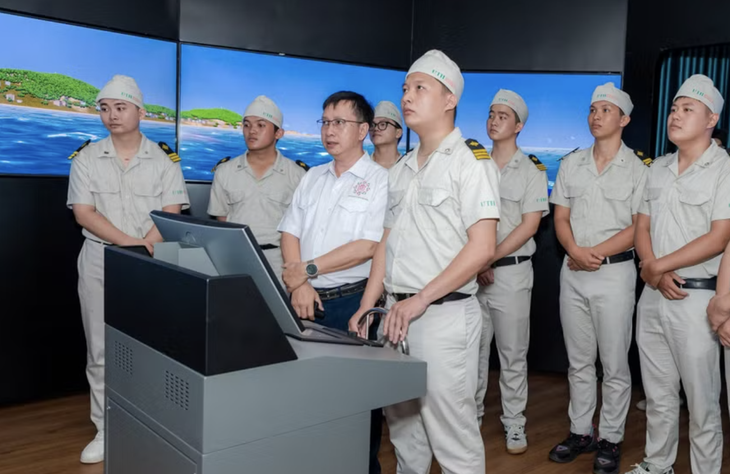
Students at Ho Chi Minh City University of Transport practice on a ship control model. The demand for human resources in the maritime industry is currently very high. - Photo: UTH
According to Dr. Nguyen Thi Hong, Vice Rector of Ho Chi Minh City University of Transport, Vietnam is accelerating the development of its maritime economy , leading to a rapid increase in the demand for human resources in the maritime sector, including shipping, logistics, port operations, sea transport, and shipbuilding.
However, the gap between training and the practical requirements of businesses remains a major challenge.
There is no shortage of jobs in the maritime industry.
Vietnam has over 3,260 km of coastline and an increasingly modern port system, creating many advantages for the development of the maritime economy. Besides maritime officers and ship engineers, businesses also have a great need for personnel in logistics management, port management, supply chain management, and the application of digital technology and artificial intelligence in operations.
Along with the shift in global supply chains, the shipbuilding industry is also receiving more international orders. The trend towards developing green ships, reducing emissions, and meeting international standards is creating a great demand for high-quality human resources.
According to Mr. Pham Nguyen Dang Khoa, Director of the Seafarer Center at Au Lac Joint Stock Company, the market is still lacking officers and seafarers who meet international standards.
"Graduates in maritime, logistics, or port operations have many job opportunities if they meet the professional and language requirements. Salaries in this field are competitive, especially on international shipping routes. In addition to salary, employees also benefit from insurance, advanced training, and opportunities to work in a multinational environment," Mr. Khoa stated.


Mr. Tran Quang Hung, General Director of Hai Duong Petroleum Maritime Joint Stock Company, commented that the company currently has no shortage of jobs, but rather a shortage of people who can start working immediately.
According to Mr. Hung, when schools invest in simulation systems, increase practical training time, and strengthen ties with businesses, students will bridge the gap between the classroom and practice, while businesses will also significantly reduce retraining time.
Attractive salaries, but still a shortage of talent.
According to seafarer recruitment agencies, the maritime industry remains a high-paying sector. Experienced sailors or mechanics can earn around $1,300-$1,500 per month; deck officers and engine officers earn $2,500-$4,000 per month; and chief officers and second engineers earn around $4,000-$5,000 per month.
For captains, chief engineers, or managing officers on international vessels, the typical income ranges from $6,000 to $8,000 per month. In addition to salary, crew members also receive funding from the company for accommodation, insurance, allowances, and time off after each voyage.
However, the high income comes with the demanding nature of the job, including shift work, being away from family for months at a time, a harsh environment, and high requirements for foreign languages and professional certifications. This is also why the industry still lacks high-quality human resources.
Businesses participate in training from an early stage.
According to Vice Rector Nguyen Thi Hong, although many training institutions are facing difficulties in recruiting students for maritime-related fields, the university's marine economic ecosystem programs still maintain their appeal thanks to high recruitment demand from businesses.
The training facilities offer many fields serving the maritime economy, such as ship control and management, marine engine operation, port management and logistics, maritime economics, shipbuilding engineering, marine economics and law, and maritime policy.
According to Ms. Duong Thi Kim Phuong, Director of the Admissions Counseling Center at Ho Chi Minh City University of Transport, the university has expanded its cooperation with many shipping companies, logistics businesses, and port operators both domestically and internationally to implement business semesters, internships, and recruitment programs even while students are still studying.


"Many businesses participate in the training process and recruit students right before graduation, helping to shorten the gap between training and employment," Ms. Phuong said.
To improve the quality of practical training, the school has recently put into operation a Bridge and Navigation Simulator Room with a modern simulation system, helping students practice ship maneuvering skills under various operating conditions before starting work in a real-world setting.
The expansion of the school's training space in Phuoc Thang area (Ho Chi Minh City) is also aimed at forming a training ecosystem linked to businesses, applied research, and production practices, contributing to providing high-quality human resources for Vietnam's sustainable marine economic development strategy.
Source: https://tuoitre.vn/thu-nhap-rat-hap-dan-nhung-nganh-bien-van-thieu-nhan-luc-100260629075543712.htm