

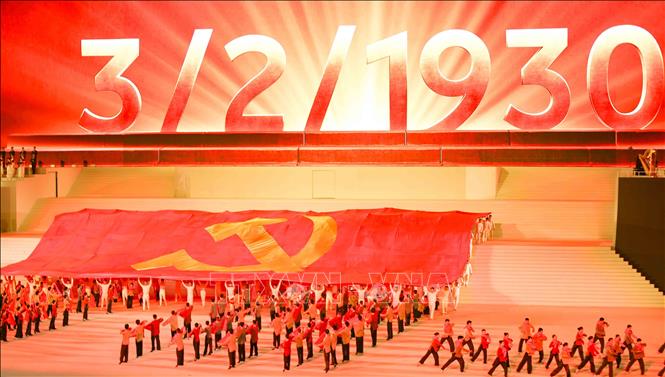
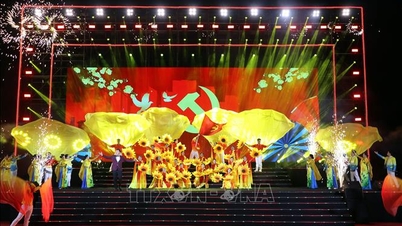
On the evening of January 23, 2026, at My Dinh National Stadium ( Hanoi ), the Hanoi City Party Committee, People's Council, and Vietnam Fatherland Front Committee organized a special art program "Under the Glorious Banner of the Party" to celebrate the success of the 14th National Congress of the Party. Photo: VNA
Looking back over those 96 years, in the eyes of many politicians, scholars, and international experts, what has made the Party so vibrant and capable of enduring leadership is its ability to connect the Party's will with the people's aspirations, transforming political trust into a driving force for development. On that foundation, the 14th National Congress of the Communist Party of Vietnam not only marks a continuation but also ignites the flame of unwavering faith in victory for a new stage of Vietnam's development.
Francesco Maringiò, Head of the Foreign Relations Department of the Italian Communist Party, stated that since assuming leadership of the country, and especially during the 40 years of implementing the Doi Moi (Renovation) policy, the Vietnamese Communist Party has demonstrated exceptional ability in combining ideological steadfastness, creative policies, and flexibility in practice. According to him, this combination has enabled the Party not only to maintain its leadership role but also to strengthen its close relationship with the people – a key factor ensuring the sustainability of any development strategy.
International scholars have particularly highlighted the turning point of the 6th National Congress of the Communist Party of Vietnam in 1986 – the moment that initiated the Doi Moi (Renovation) process. This is considered a prime example of the Vietnamese Communist Party's capacity for self-renewal: daring to confront reality, courageously overcoming the limitations of the old model to choose a development path more suitable to the country's needs and the trends of the times.
From a poor, backward country suffering many consequences after the war, Vietnam has gradually recovered and developed its socio -economic system, expanded its foreign relations, and proactively integrated into the region and the world. Many observers share the view that the ability to adapt flexibly while remaining true to its strategic goals has helped the Communist Party of Vietnam maintain its leadership role throughout challenging periods.
According to French Senator Emeritus Hélène Luc, under the leadership of the Communist Party of Vietnam, Vietnam has risen to become one of the world's top 40 economies. She emphasized that this achievement is not only significant economically, but also clearly reflects the Party's political acumen, strategic vision, and ability to govern the country under extremely complex historical conditions.
From a foreign policy perspective, this capability is clearly demonstrated through Vietnam's transformation: from a country under siege and embargo, it has become a reliable and responsible partner of the international community. Vietnam has established diplomatic relations with most countries, actively participates in multilateral mechanisms, and makes increasingly significant contributions to efforts promoting regional peace, stability, and cooperation.
Many foreign scholars note that the independent, self-reliant, multilateral, and diversified foreign policy is one of the outstanding hallmarks of the 96 years of leadership of the Communist Party of Vietnam, helping the country maintain strategic balance in the context of increasingly fierce competition among major powers.
One aspect highly valued by international researchers is the continuity and succession in the leadership of the Communist Party of Vietnam. Dr. Ruvislei González Saez, a senior researcher at the Cuban Center for International Policy Studies, noted that the model of collective leadership and generational succession, based on principles laid by President Ho Chi Minh, has helped Vietnam maintain political stability for many decades.
The fact that General Secretary To Lam was re-elected at the 14th National Congress was seen by Ruvislei González Saez as proof of stability and consistency in leadership – a particularly important factor in a volatile international context. This stability provides a solid foundation for Vietnam to implement its long-term development goals.
Russian and Egyptian scholars also argue that, throughout its history, the Communist Party of Vietnam has faced numerous major turning points, but has always maintained a consistent "red thread" of placing people at the center of development. Associate Professor of International Relations at the Russian Diplomatic Academy, Petr Tsvetov, affirms that this consistency has created the unique identity of Vietnam's development model.
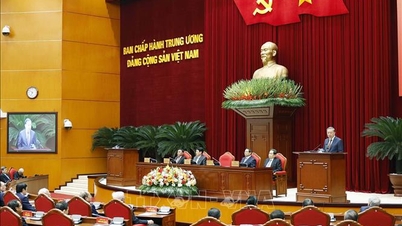
In the course of those 96 years, the 14th National Congress of the Communist Party of Vietnam was a crucial milestone, marking a transition between stages of development. Many international scholars consider this event a summary of the achievements of the era of unification, reform, and integration, while also opening up directions for a new era of development – a period in which Vietnam aims to become a high-income developed country.
According to Dr. Nguyen Hong Son, President of the Union of Vietnamese People in Japan, the Party's clear definition of a new growth model, focusing on quality, innovation, science and technology, digital economy, green economy, and circular economy, demonstrates a development mindset aligned with global trends while ensuring strategic autonomy.
According to international observers, the noteworthy aspect of the 14th National Congress lies not only in its development goals, but also in its determination to shift strongly from policy to action, from strategic vision to concrete results.
Gilbert Tenèze, head of the French-Vietnamese Friendship Association in the Eure-et-Loir province, believes that the reforms being implemented in Vietnam demonstrate consistency between policy and action, contributing to strengthening confidence in the long-term development direction. The results and directions affirmed at the 14th National Congress reflect the image of a nation deeply rooted in tradition, while simultaneously driven by inspiring development projects, with a leadership team that listens and adopts a practical approach to national issues.
Veeramalla Anjaiah, a senior researcher at the Center for Southeast Asian Studies (CSEAS) based in Jakarta, Indonesia, emphasized that the 14th National Congress of the Communist Party of Vietnam strongly ignited the political determination of the entire Party and the will of the entire people, while clearly establishing the development path for the next five years. Entering a new phase of development, Vietnam faces significant challenges from geopolitical competition, climate change, technological transformation, and the unpredictable fluctuations of the global economy.
However, according to the general consensus of many international experts, the 96-year journey has equipped the Communist Party of Vietnam with important "capitals": political acumen, governance experience, and the ability to mobilize social consensus. As General Secretary To Lam affirmed in his article "Forward! Complete Victory Will Surely Be Ours!", when political determination is concretized through decisive action, the belief in ultimate victory will continue to be the spiritual driving force leading the country forward.
Vu Ha (VNA)

























































Comment (0)