

When input costs increase significantly, ensuring project progress and quality while maintaining business efficiency requires units to adapt flexibly and expect long-term solutions.
Maintain the construction pace.
In many transportation projects, fuel costs account for a large proportion of the total cost, especially for items that use a lot of machinery such as excavation, earthmoving, and material transportation. When gasoline and diesel prices increase (by about 60%), the cost of construction materials and transportation also increases, creating a chain reaction that causes the actual total investment to far exceed the initial estimate.
Prices of key construction materials increased sharply in the first quarter of 2026. Specifically, the price of construction steel increased by approximately 350,000 - 600,000 VND/ton, currently fluctuating around 16.2 million VND/ton. The price of construction stone increased by 10-15%, commonly ranging from 280,000 - 650,000 VND/ m³ . The prices of construction sand, coal, and cement also increased by 10-30% compared to the beginning of the year... Meanwhile, the mechanism for compensating for price fluctuations in some projects is still slow and has not kept pace with market developments.
Nang Ban Mai Investment Group Joint Stock Company is currently constructing several key projects in the province, such as the coastal road and the Tuy Duong resettlement area. Mr. Pham Van Nhat, Head of the Technical Department of the company, stated: "Most of the construction vehicles use diesel fuel, leading to increased costs. However, since the contracts were signed from the beginning, adjusting prices is very difficult. For long-term projects, the constant fluctuations in fuel prices make financial planning very challenging. The company is forced to accept reduced profits to maintain progress and avoid the risk of breaching the contract."
According to a representative of Thanh Trung Joint Stock Company, although some contracts include provisions for price adjustments, the actual adjustment depends on the price index published by the State. Market prices fluctuate rapidly and rise much higher than the index, making it difficult for businesses to balance costs.
Faced with cost pressures, construction companies have proactively implemented various solutions to reduce fuel consumption and optimize construction processes. These include rearranging production shifts and limiting machinery operation outside of peak hours, which have been widely adopted. Units have also intensified equipment maintenance to reduce fuel waste, strictly controlling consumption rates for each project; and proactively securing a reasonable supply of fuel to ensure uninterrupted construction operations.
 |
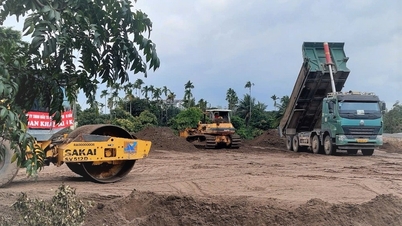
| The contractor is ensuring progress on the handed-over road surface of the coastal road. Photo: H. Pham |
Policy impetus is needed.
Given the reality of continuously fluctuating and rising fuel prices, many businesses believe that internal solutions such as cost reduction and operational optimization only partially alleviate the pressure, while the overall problem still requires support from macroeconomic mechanisms and policies.
During his field trip to Dak Lak, Deputy Prime Minister Ho Quoc Dung directly listened to the difficulties faced by investors and contractors. Representing the investor of Component Project 2, Mr. Pham Van Trinh, Deputy Director of the Railway Project Management Board ( Ministry of Construction ), expressed his hope that the Government and relevant ministries and agencies would soon implement timely solutions to regulate and facilitate fuel supply, and establish mechanisms to stabilize fuel prices to support contractors and ensure key projects are completed on schedule.
Deputy Prime Minister Ho Quoc Dung affirmed that the Government always understands and is committed to supporting businesses in overcoming difficulties. He also reminded investors and construction units to uphold a high sense of responsibility, ensuring that fuel-related issues do not cause delays or negatively impact construction on the site. The ultimate goal is to ensure the project is completed on schedule.
In addition, Prime Minister Pham Minh Chinh recently signed and issued Official Dispatch No. 25/CD-TTg, requesting the strengthening of measures to manage and stabilize the prices of fuel, raw materials, and construction materials; and at the same time, remove obstacles and accelerate the construction progress of key transportation projects.
Accordingly, ministries, sectors, and localities need to closely monitor market developments and promptly announce the prices of materials, labor, construction machinery, and construction price indices as a basis for adjusting estimates and contracts. Mechanisms for price compensation, unit price adjustments, and project extensions in cases of force majeure are also emphasized to ensure the legitimate rights of contractors and avoid situations of slow or interrupted construction.
Despite facing numerous challenges, construction businesses still prioritize ensuring project progress, especially for key transportation projects that are of great significance to socio-economic development and regional connectivity. This is not only an economic requirement but also a political responsibility, contributing to the realization of the country's strategic infrastructure development goals.
Le Bang - Huy Pham
Source: https://baodaklak.vn/kinh-te/202603/no-luc-bao-dam-tien-do-cong-trinh-10d7ca4/











































































Comment (0)