


Staff and employees of Phu Tho Water Supply Joint Stock Company operate modern equipment systems to produce clean water and provide safe water supply.
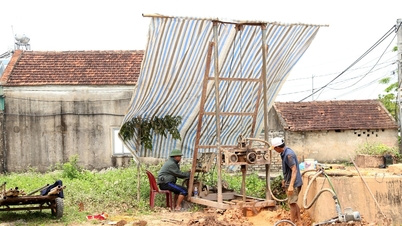
Currently, the supply of domestic water to rural areas in the province mainly comes from small-scale, centralized water supply systems. According to statistics from the Department of Agriculture and Rural Development, the province has 144 centralized rural domestic water supply systems in operation, including 98 gravity-fed systems and 46 pumped systems. Of these, 21 systems are managed by enterprises, 28 by commune People's Committees and cooperatives, and 95 by communities. As of the end of 2023, the percentage of households using safe water in the province reached 98.7%.
As the lead agency responsible for implementing safe water supply and improving the efficiency and sustainable use of centralized rural clean water supply facilities in the province, the Department of Agriculture and Rural Development has issued a document requesting district-level People's Committees, enterprises, and units managing and operating rural domestic water supply facilities to organize the implementation of safe water supply and prevent water loss and revenue loss in the area according to the plan of the Provincial People's Committee.
According to Mr. Tran Quoc Binh, Deputy Director of the Department of Agriculture and Rural Development, the Department has requested the People's Committees at the district level to strengthen the direction of specialized departments to regularly inspect and urge units managing and operating centralized water supply facilities to develop plans for safe water supply, prevent water loss and revenue loss for the water supply systems under their management; allocate funds for repairs and maintenance to ensure the effective operation of the facilities... For enterprises and units managing and exploiting surface water extraction facilities with a scale of over 100 m3/day, they must install monitoring equipment to supervise the flow rate and water quality during exploitation. At the same time, they must coordinate with relevant units to ensure the safety of water supply facilities and effectively implement the decisions approving the scope of the sanitary protection zone for water intake areas...
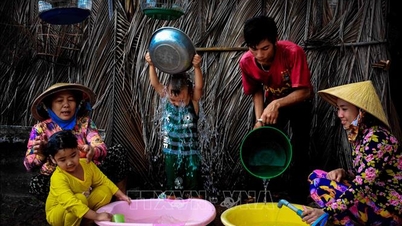
Over the past period, the province has mobilized resources from the local budget, rural water and sanitation funds, and social contributions to implement policies and invest in the construction of centralized clean water facilities, increasing the percentage of people with access to clean water. Departments, agencies, and localities have intensified propaganda and raised awareness among people about using safe, hygienic, and economical water, while also supporting poor households and disadvantaged families in accessing preferential loans to build, upgrade, and repair clean water and hygienic water facilities.
Comrade Nguyen Hai Son - Deputy Head of the Agriculture and Rural Development Department of Cam Khe district, said: “In October 2023, the centralized clean water supply project in Tung Khe commune, with a designed capacity to provide clean water to 6,000 households in 4 communes: Tam Son, Van Ban, Tung Khe, and Cap Dan, invested by the Irrigation Sub-Department, was completed and put into use. This has resolved the shortage of clean water for daily life of the local people, raising the percentage of people in the district using clean and hygienic water to 98.7%.”
According to the plan for implementing the National Strategy for Rural Water Supply and Sanitation until 2030, with a vision to 2045, the province strives to ensure that by 2030, 50% of the rural population has access to clean water meeting quality standards, with a minimum quantity of 60 liters/person/day, and this figure increases to 80% by 2045. To achieve this goal, the province will continue to implement comprehensive solutions, focusing on developing rural water supply and sanitation infrastructure that suits the customs and specific conditions of each region and locality; promoting social mobilization and attracting all resources to participate in the investment, construction, management, and operation of clean water supply facilities to ensure efficiency and sustainability.


![[Photo] Prime Minister Pham Minh Chinh receives the Chinese Ambassador to Vietnam](https://vphoto.vietnam.vn/thumb/1200x675/vietnam/resource/IMAGE/2026/04/05/1775397481797_ndo_br_dsc-5512-jpg.webp)
















































![[INFOGRAPHICS] Exploiting children's personal images for profit can result in fines of up to 50 million VND.](https://vphoto.vietnam.vn/thumb/402x226/vietnam/resource/IMAGE/2026/04/06/1775442200854_1775442148.webp)













Comment (0)