

The complex of historical relics, spanning over 2.85 hectares, is preserved in a space rich in traditional cultural imprint, including the Nguyen Du Church, the Nguyen Du Ancient House, and many valuable artifacts related to his life and works...
This space connects the past and the present, deeply imprinting the moral and humanistic values that the great poet Nguyen Du left for the national culture. With attractive experiential activities, especially for the younger generation, the historical site is becoming an indispensable destination for those who want to learn more about the career and character of one of the greatest figures in the history of Vietnamese literature.
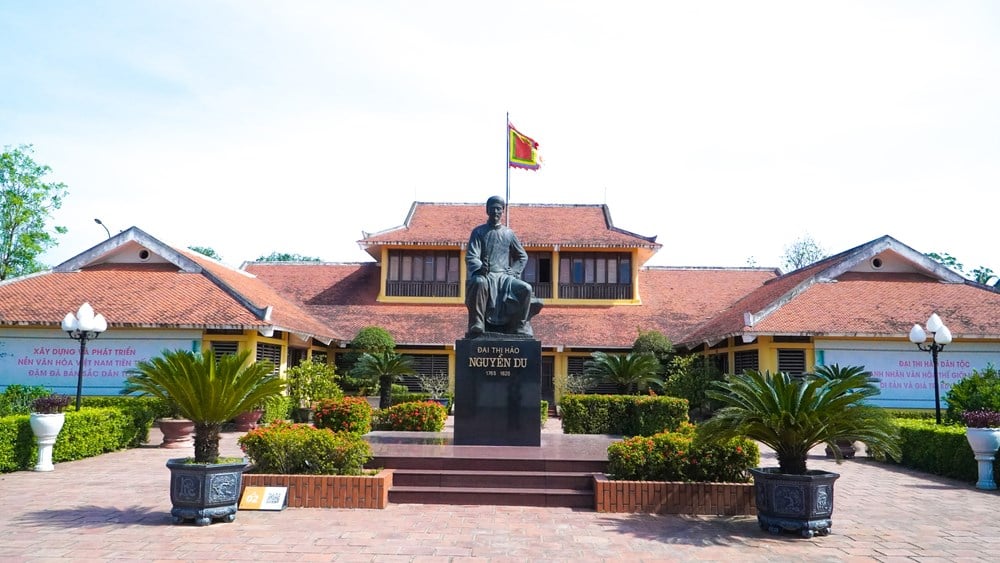
A vibrant cultural heritage, a blend of tradition and modernity.
The Nguyen Du historical site, located in Tien Dien commune, Ha Tinh province, is planned within a core area of over 2.85 hectares, part of a larger landscape of nearly 300 hectares, preserving the spatial structure of the ancient Tien Dien village. The wooden houses, temples, tombs, and museum are arranged along a traditional axis, blending harmoniously with the gardens, brick courtyards, lotus wells, and the characteristic ancient trees of the North Central region in the late 18th century.
Prominent within the complex is the Nguyen Du Church, built in 1825 in the shape of the Chinese character "丁" (ding), with a yin-yang tiled roof and elegant wooden structure. Despite undergoing several renovations and relocations, the building still retains its spirit of reverence for this outstanding son of the nation.
Next door stands the Nguyen Du Ancient House, a simple three-room house where the great poet used to return to rest after long journeys. The building serves as a repository of memories, preserving the essence of his daily life.
Within the complex of historical relics, the two-story exhibition hall, covering an area of over 400m², is the most modern architecturally designed building. Here, nearly 1,000 artifacts, manuscripts, and documents about the life and works of Nguyen Du, from The Tale of Kieu and the Funeral Oration for Ten Categories of Beings to his travel notes, are preserved. The exhibition space is designed to be open and easily accessible, allowing visitors, especially students, to gain a deeper understanding of his personality and literary career.
Not far from the historical site, the tomb of the Great Poet is located in the Dong Cung field, covering more than 3,200 square meters, facing west according to ancient tradition. Its simple, tranquil architecture reflects his character of "a great soul in a simple appearance." The surrounding tombs of his ancestors create a solemn and complete memorial space, where the past and present blend, transforming the traces of the Nguyen Tien Dien family into a national cultural heritage.
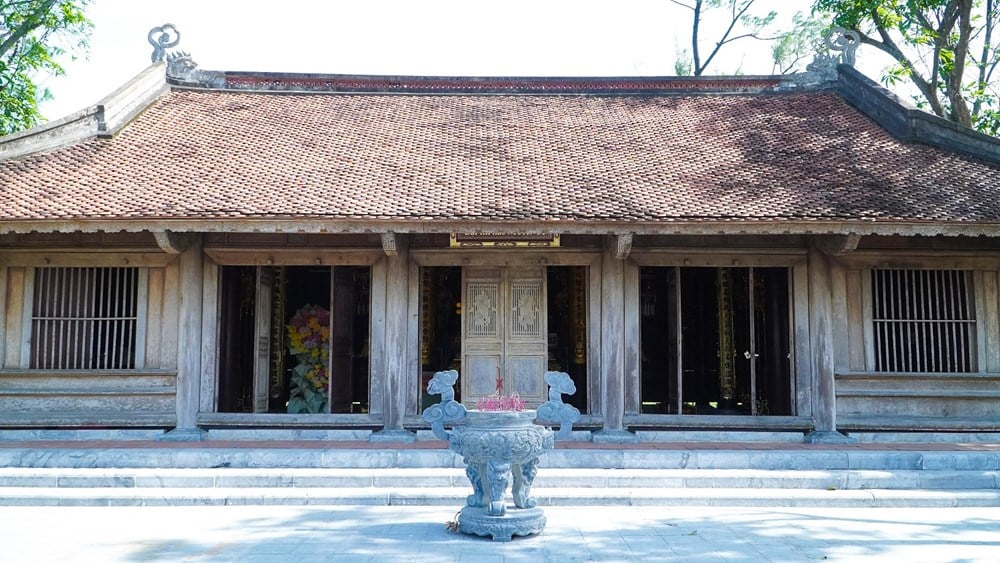
Connecting people with heritage
As Ha Tinh province prepared to celebrate the 260th anniversary of the birth of the great poet Nguyen Du, the historical site welcomed many groups of visitors, especially schools in the area.
Ms. Le Nhu Ai, Principal of Xuan Thanh Kindergarten (Tien Dien commune), said that the school organized a visit for students to help them remember the image of the great poet of the nation. Prior to that, the school also organized a calligraphy competition for students and teachers.
The Nguyen Du historical site not only preserves traditional architecture but also safeguards the spirit, character, and cultural personality of a family that has brought glory to Vietnamese literature. Every building, every brick, every roof tile in the site tells a story about the immortal legacy of the great poet.
Ms. Tran Thi Vinh, head of the Nguyen Du Relic Management Board, shared: "Over the years, the Management Board has innovated its methods of preserving and introducing the heritage, in which the human element plays a crucial role. The team of tour guides is a 'living bridge' between the heritage and the public."
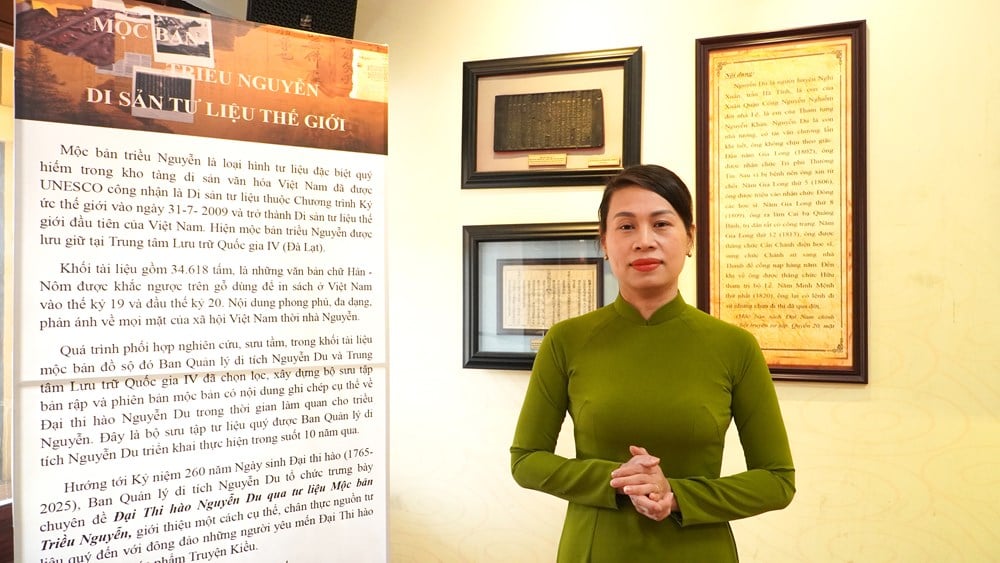
“We have a standardized system of guided tours, but we don’t apply it mechanically. Each group of visitors, from ordinary tourists and students to cultural researchers, needs a different approach. For groups from rural areas, the tour guides will connect local stories with the history of Nguyen Du’s family to create a sense of familiarity and broaden understanding,” Ms. Vinh said.
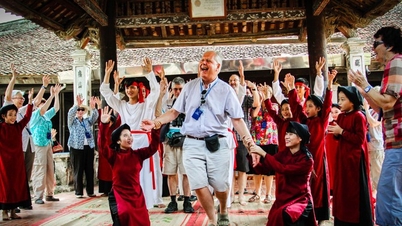
In particular, for students of all levels, the teaching method emphasizes "learning through experience." After the presentation, students participate in a lucky wheel game about the Tale of Kieu and answer questions to receive souvenirs. This approach helps them become more interested, remember better, and proactively learn about Nguyen Du.
Besides traditional methods, the Monument Management Board also applies technologies such as QR code scanning, VR, and AR experiences to help visitors access the heritage site in a more intuitive way. However, the most important thing remains helping the public understand the moral and humanistic values of Nguyen Du.
Ms. Tran Thi Vinh recalled that in 2015, the Management Board began developing a plan to integrate the Tale of Kieu into modern life and spread its value within the historical site. Since then, many activities have been implemented, such as: a competition to recite the Tale of Kieu, a Kieu performance program, and a calligraphy competition based on the Tale of Kieu held at the beginning of spring... attracting a large number of students, teachers, and tourists to participate.
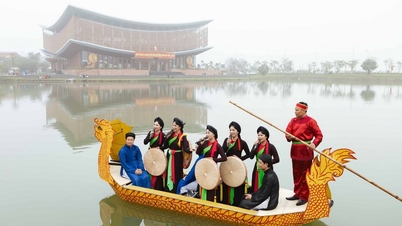
Heritage preservation is not limited to the historical site; it has spread strongly through folk art forms such as Ca Tru, Vi, Giam, Lay Kieu, and Xam Kieu. When The Tale of Kieu is adapted into music , its lyrics and melodies transcend the boundaries of space and time, spreading to many generations and different cultural regions.
With the upcoming 260th anniversary of the birth of the great poet Nguyen Du, the historical site is expected to welcome a large number of students and tourists. “This is a valuable opportunity for us to connect people with heritage, to spread and cultivate the values of life from Nguyen Du. Especially for the younger generation, this is an opportunity to help them more deeply appreciate the humanistic educational values and moral standards from the life and works of the great poet,” emphasized Ms. Tran Thi Vinh.
Source: https://baovanhoa.vn/van-hoa/noi-lan-toa-nhung-gia-tri-van-hoa-184842.html
![[Photo] The Prime Ministers of Vietnam and Russia witness the signing ceremony on cooperation in building a nuclear power plant.](https://vphoto.vietnam.vn/thumb/1200x675/vietnam/resource/IMAGE/2026/03/23/1774278492322_vna-potal-hai-thu-tuong-viet-nam-va-nga-chung-kien-le-ky-ket-hiep-dinh-ve-hop-tac-xay-dung-nha-may-dien-hat-nhan-8658380-jpg.webp)

![[Photo] Young people of the Dong Thap Border Guard actively participate in "March Border Month" activities.](https://vphoto.vietnam.vn/thumb/1200x675/vietnam/resource/IMAGE/2026/03/23/1774248483508_ndo_tl_dt3-jpg.webp)

















































Comment (0)