

Lack of control over personal hygiene
If she's the right age, An (name changed) will start first grade in a few months, but her parents may have to delay her enrollment because she doesn't speak many words, doesn't know how to use the toilet independently, and often urinates and defecates in class. Ms. Le Phuong Thao, a kindergarten teacher at a private school in Ho Chi Minh City with 6 years of experience, said that each class has 1-2 "VIP children" with disability certificates. This school year, her kindergarten class has a 5-year-old who still doesn't speak much, only knows how to count after the teacher, doesn't interact with the teacher or her classmates, doesn't eat or take care of herself independently, still wears diapers, cries when she doesn't want something, and cries when she doesn't know how to express what she wants. She's afraid of unfamiliar teachers; if it's not Ms. Thao teaching or if she doesn't see Ms. Thao lying beside her at lunchtime, she'll cry constantly.
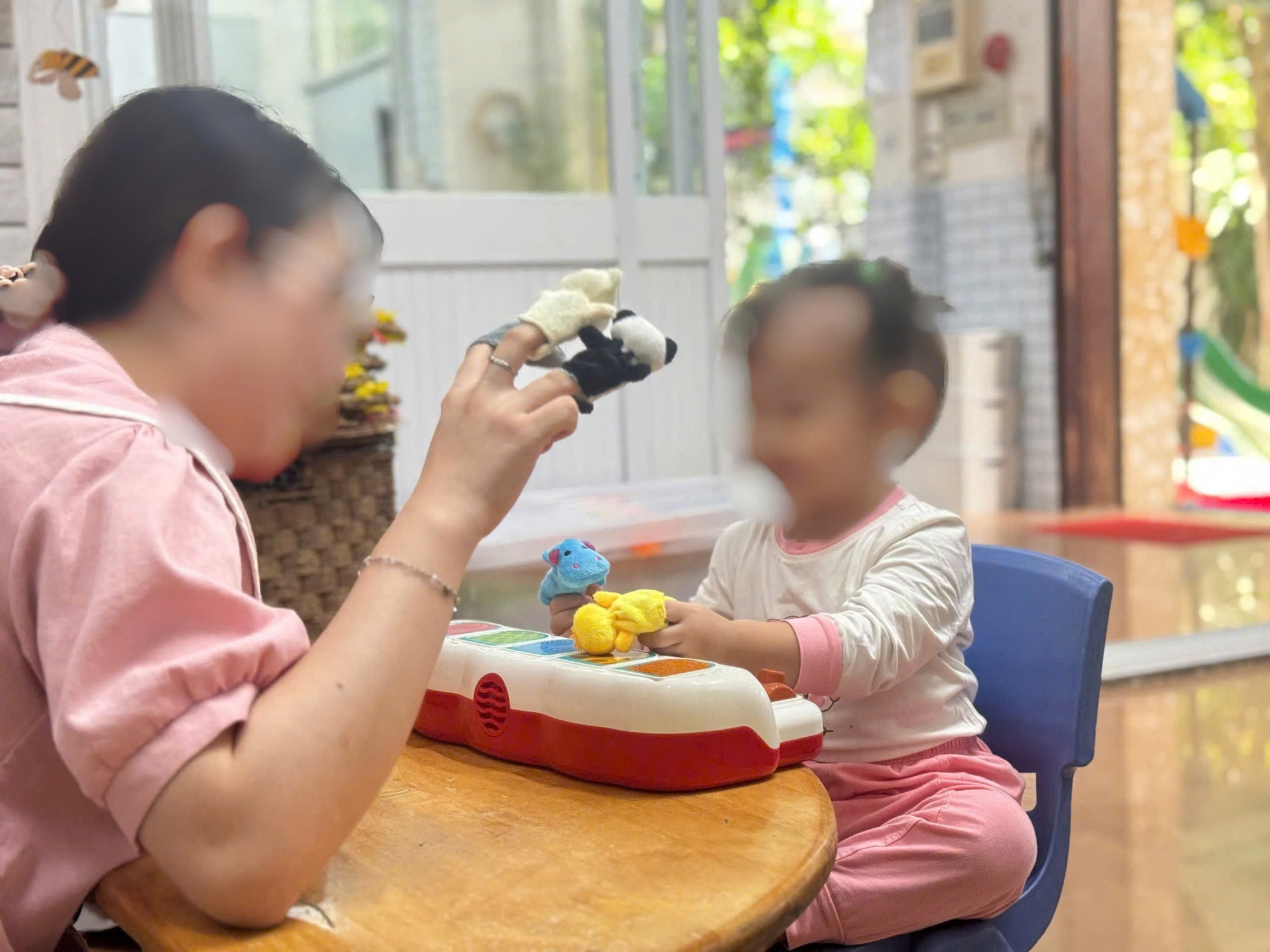
Teachers provide one-on-one intervention for "VIP children".
PHOTO: HH
"The child's mother often confides in me, hoping for my understanding and support because she feels helpless and sometimes doesn't know how to do what's best for her child. The child receives 4 hours of individual intervention per week, and the situation has improved slightly, but the journey to help a 'VIP child' like An integrate into the community is still very long. I struggle a little, but I see that the child's parents have to struggle a hundred or a thousand times more than I do, so I always tell myself that I will try my best to help the child in any way I can," Ms. Thao said.
It doesn't know how to say it's hungry, it doesn't know how to chew.
Ms. BTHM, a staff member at the Hanamiki Center for Counseling and Inclusion Support, is currently an intervention teacher for many "VIP children" attending inclusive education programs in preschools in Ho Chi Minh City. During 1-2 hours of individual intervention, Ms. M. teaches fine and gross motor skills, helping children develop communication and cognitive abilities.
"I'm currently intervening with a child who is completely unaware of and doesn't express their need to use the toilet, doesn't express their need to eat, doesn't know how to say they're hungry, doesn't know how to chew, and their sensory threshold is different from other children...", Ms. M. recounted.
Her colleagues also encountered many children with special needs who exhibited different behaviors, such as banging their heads, walking on tiptoes, or spinning around because they only felt dizzy when standing still. Some children deliberately avoided using the toilet; some had severe sensory disturbances, with some constantly hitting their teeth with water bottles or other objects to reach a sensory threshold; and some even engaged in self-stimulation behaviors such as rubbing their bodies against the edges of tables or chairs to find a sensory threshold. According to the intervention teachers, these are common manifestations in children with developmental disorders.
"When I first started this job, I found it very difficult. The children were constantly fussy, crying, or jumping around. I sought encouragement and experience from my supervisors to overcome the initial difficulties. Once the children accepted me, from not knowing how to speak at all to babbling one word, then three words, from having no concept of words at all to being able to call familiar people by name… I felt incredibly happy, because each day I went to work, it felt like I was watering a little plant," Ms. M. confided, adding: "On this journey, accompanying parents, listening to them talk about their children's problems, including their fears that their 'VIP' children will grow up to be labeled with some kind of disorder, I feel even more compassion for these children. I only hope that children with special needs in Vietnam will be diagnosed and receive intervention early, especially during the golden period of 0-3 years old, so that they can be given opportunities and an environment to develop better and better."
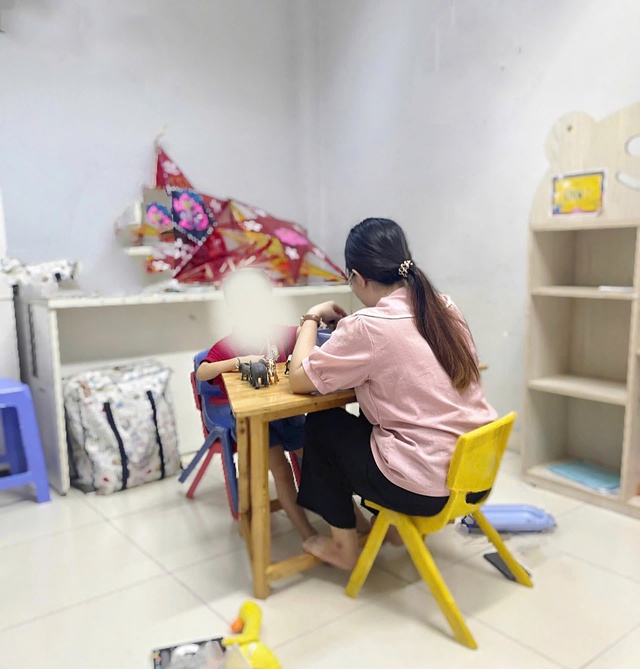
Only by caring for and raising these children can one truly understand the hardships faced by parents and families with "VIP children."
Photo: HH
UNDERSTANDING, SHARING
The rest of the school's students leave at 4:30 PM every day, but Ms. Tran Thi Hoai Nghi, a second-grade teacher at Kim Dong Primary School in Go Vap District, Ho Chi Minh City, often lingers, sitting next to little Tam (name changed), teaching her to read until 5:15 PM or 5:30 PM, waiting for her mother to pick her up. Tam is a "VIP child," with a certificate, and her mother has to travel to two different schools each afternoon to pick up her children, so she can't manage everything. Worried about Tam's safety waiting alone, Ms. Nghi stays, talks to her, teaches her to read a few more words from the book, and only feels at ease when Tam gets on her mother's motorbike to go home. "Teaching a special needs child, even for just a few hours a day, is very difficult. Parents struggle their whole lives, so I try my best to help them in any way I can," Ms. Nghi shared.
Ms. Nguyen Hoang Ngan Thuy, owner of Hoa Anh Dao Kindergarten in Chanh Hung Ward, Ho Chi Minh City, said that in recent years, the school has welcomed children with special needs into inclusive education. The school dedicates a separate classroom for these children to receive one-on-one intervention with teachers from centers supporting the inclusion of children with special needs (parents will negotiate and agree with the intervention teacher on the schedule, cost, and duration of each session). "Seeing many parents rushing to take their children to another center for intervention right after school is heartbreaking. We create conditions for 'VIP children' to learn with their peers; when it's time for individual intervention, the teacher will take the child downstairs and then return to the classroom," Ms. Thuy said.
Ms. Thuy also mentioned that some children's families noticed unusual behaviors compared to their peers from the age of 6 months or 1 year, so they took their children for early check-ups and intervention, after which the children made significant progress. For some children, the school had to skillfully communicate with parents to encourage them to take their children to the hospital for tests and assessments. However, the changes in children are not the same in every case. Some children, even at 4-5 years old, still cannot independently use the toilet and cannot speak many words; if teachers do not remind and assist them, they will still have great difficulty in daily life and learning.
"Only by caring for and nurturing these children do I truly understand the hardships faced by parents and families with 'VIP children.' I always tell the teachers to be patient, to give them more love and understanding. These 'VIP children' especially love being hugged and feeling the love that the teachers give them," Ms. Thuy shared.
Overseas Vietnamese bring their children back to Vietnam for intervention.
Mr. Hoang Ha, Director and co-founder of Hanamiki Integration Counseling and Support Center (Ho Chi Minh City), said that there is a growing trend of overseas Vietnamese bringing their "VIP children" back to Vietnam for personalized intervention.
Mr. Ha stated that social awareness regarding children with special educational needs has significantly increased recently, with many parents accepting their children as "VIP children" and helping them receive early intervention. However, some parents still believe that at some point, children with autism spectrum disorder, ADHD, etc., will go to school and live normally; that medication/acupuncture, or even participating in healing courses will make them normal. This very belief leads parents to spend considerable money on "quacks."
"Taking children to reputable and trustworthy medical facilities for early examination, assessment, diagnosis, and intervention, right from the moment a child's special education needs are detected, is considered early intervention," Mr. Hoang Ha said, adding: "Each 'VIP child' has a different pace and developmental path; comparisons between children are impossible."
At the same time, according to Mr. Ha, even with early intervention, it cannot replace the time, interaction, and attention that parents give their children. At home, with just a minimum of 30 minutes each day, parents can play peek-a-boo with their children, color together, teach them fine motor skills, play games involving finding objects, animals, or body parts, etc., which can also bring significant benefits to children.
Source: https://thanhnien.vn/noi-niem-nuoi-day-tre-vip-185251222213114215.htm






























































































Comment (0)