

 |
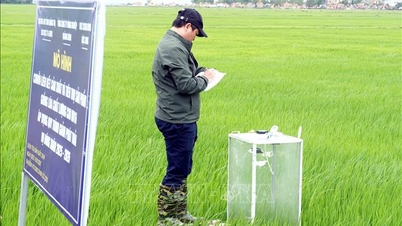
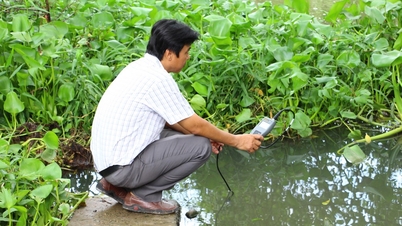
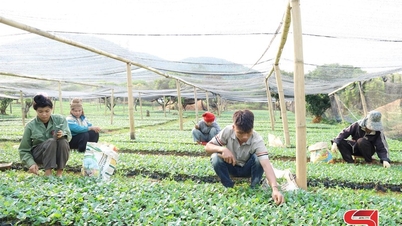
| Farmers in Kha Son commune inspect their fields for pests and diseases. |
In the fields of Van Dinh hamlet, Viet Ninh (Kha Son commune), the spring rice crop is growing uniformly, covering the fields in green, thanks to favorable weather conditions. Areas planted before the Lunar New Year have entered the tillering stage. According to expert recommendations, this is the time to focus on supplementing nutrients to increase the number of effective tillers and improve the plant's resistance.
The Kha Son Commune General Service Center has guided farmers to strictly adhere to the "four correct principles" in fertilization (including the correct type, the correct dosage, the correct timing, and the correct method) to ensure production efficiency.
Ms. Nguyen Thi Binh, from Van Dinh hamlet, said: "My family is focusing on early topdressing with specialized NPK fertilizer as recommended. Balancing nitrogen and potassium helps the rice plants become stronger, produce healthier tillers, and also helps limit pest and disease outbreaks, reducing production costs. Farmers also combine mud stirring when fertilizing to kill weeds and increase the rice roots' ability to absorb nutrients."
In Van Dinh hamlet, with 27 hectares of rice fields primarily using high-quality varieties such as J02 and Khang Dan 18, the people maintain a daily routine of inspecting their fields. Mr. Nguyen Van Tinh, the hamlet head, said: "The villagers focus on tending the crops while closely monitoring water levels and pest and disease situations to proactively address problems in a timely manner."
In Nui hamlet, where 183 households cultivate over 40 hectares of spring rice, irrigation is given special importance. Ensuring sufficient water helps fertilizers dissolve well, allowing rice plants to absorb nutrients effectively and limiting pests and diseases.
While clearing the water flow into his family's 9 sao (approximately 0.9 hectares) of rice fields, Mr. Nguyen Van Ban shared: "The warm weather creates favorable conditions for rice growth, but it also increases the risk of golden apple snails, rats, and rice blast disease. Therefore, farmers must constantly monitor the fields to proactively prevent and control these problems."
Besides the proactive efforts of the people, the Kha Son Commune Production Steering Committee advises farmers to pay attention to pests and diseases that cause damage at the beginning of the season, such as leaf-rolling caterpillars and root rot with yellowing leaves, especially in areas where rice is sown directly.
For the spring crop of 2026, Kha Son commune aims for stable production with 1,200 hectares of rice, 60 hectares of corn, and 220 hectares of various vegetables.
Ms. Dinh Thi Ngan, Deputy Head of the Economic and Social Affairs Department, said: The locality has strictly directed the seasonal schedule, while reviewing and strengthening the irrigation system after the rainy season to ensure water supply for irrigation; disseminating information and guiding people to regularly visit their fields, inspect, detect, and promptly handle pests and diseases...
Source: https://baothainguyen.vn/kinh-te/202603/nong-dan-kha-son-tap-trung-cham-soc-lua-xuan-b805b10/


![[Image] 500 regional dishes introduced to the people of Ho Chi Minh City and tourists.](https://vphoto.vietnam.vn/thumb/1200x675/vietnam/resource/IMAGE/2026/03/27/1774576163392_001-jpg.webp)





































































Comment (0)