

 |
| Ms. Uong Lan (on the left), Director of Nguyen Viet Safe Tea Cooperative, introduces the tea growing region to tourists. |
A region with unique land, water, and climate.
Trại Cài, formerly part of Minh Lập commune (old Đồng Hỷ district), is now part of Đồng Hỷ commune after administrative reorganization. Despite the change in place name, the tea plants continue to bud on the rolling hills along the Cầu River. Locals recall the origins of the "Cài" tea, which was supposedly a production team from the agricultural farm. Here and there, tea plants grown from seeds 60-70 years ago still sprout abundantly alongside newer varieties, a testament to the enduring vitality and loyalty of this traditional tea.
Unlike many tea-growing regions of Thai Nguyen , which often display their beauty along the roadsides for tourists to admire, the Trai Cai tea region is not easily visible. Thanks to the guidance of local people and navigating numerous turns along a small, winding road on the hillside, I was finally able to see countless rolling hills of tea plants, adorned with rows of fragrant flowering betel nut trees.
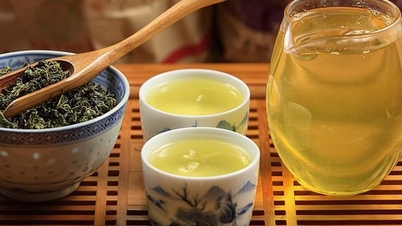
Visiting any house in the tea-growing region, I was always offered tea. The tea growers offered me a pot of freshly harvested tea leaves, just after the "painful pruning" in November of the previous year. It truly lived up to its reputation as "the finest fragrant tea." As soon as the boiling water touched the dry tea leaves, the aroma wafted up from the teapot. And when the hot tea was poured into the cup, the captivating fragrance permeated the space, lingering in the mouth, nose, and even in the hair of the tea drinker. Not only was it fragrant, but Trai Cai tea also had a rich, creamy, and appealing taste that lingered on the tongue, a quality rarely found in tea I'd tasted elsewhere.
Explaining the precious qualities of their local tea, tea makers here assert: It's a gift from nature. It's the transformation of trace minerals into fine sand within the earth over thousands of years. This chalky rock cools the soil, retains moisture, and is very much "loved" by tea plants. It's also due to the weather: mornings often have dew, afternoons usually have gentle sunshine, and the day-night temperature difference is significant. In addition, there's the refined sensibility of the tea makers. They dedicate their love, care, and passion to each tea bud and each batch of tea.
Therefore, Trai Cai tea attracts attention with its aroma and captivates tea connoisseurs with its rich, creamy flavor, long-lasting brew, and beautiful color.
These are not far-fetched plans.
Without prior arrangement, Ms. Uong Lan, Director of Nguyen Viet Safe Tea Cooperative (Ca Phe Hamlet), left her busy household chores to take us to a place she is planning to develop into an eco-tourism area, introducing us to the unique and distinctive culture of the Trai Cai tea region.
It's a valley about 1 hectare in size, surrounded by gently sloping tea hills. Standing high above, Ms. Lan sketched out for me a picture of the winding paths: there's the tea processing experience area, there's the lotus pond, and there are stalls selling local products of the Tay, Nung, and San Diu ethnic groups such as sausages, honey-dipped cakes, rice cakes, etc. If this tourist destination is developed, it will increase the income of the local people.
Lan excitedly read to me: "Water from the Cau River, hook-shaped tea leaves, a deep, rich flavor unmatched anywhere else in Cai," this is a line from a documentary about Cai Cai tea broadcast on Vietnam Television many years ago, which the people of Cai still cherish and know by heart.
 |
| The grounds of the temple dedicated to the Two Goddesses of Thac Nhat are a cultural hub and a place to showcase Trai Cai tea products. |
Then, Lan eagerly led me to the check-in point invested in by the province's New Rural Development Program, not far from the Tea Market. The sign indicated a vast tea plantation under the sun, and across a wide concrete road lined with blooming bauhinia flowers was the Temple of the Two Goddesses of Thac Nhat Waterfall.
The temple, considered sacred by locals, overlooks the gently flowing Cau River, with a suspension bridge leading to Phu Do commune (formerly Phu Luong, now Vo Tranh commune) in the distance. The temple grounds also host cultural events and showcase local products. According to Ms. Lan, with proper media coverage and investment, the Trai Cai tea-growing region has many attractive destinations that are no less appealing than the currently famous destinations in Thai Nguyen.
Belonging to the group of "Four Famous Teas" and possessing a superior aroma, Trai Cai tea has not yet been widely recognized by tea drinkers. A friend of mine, who frequently buys tea as gifts for business partners, said: For tea connoisseurs, the packaging doesn't need to be fancy, as long as the tea is clean, delicious, and has a rich flavor. But for most people, brand, label, and packaging remain the top priority.
The tea growers here also hope that scientists will study the soil, water, and climate to have a basis for discussing the "ultimate" aroma that the tea plants here are offering.
They also hope to conduct research on the nearly 70-year-old tea-making tradition in this land, focusing on the elderly artisans who, by observing the sky and listening to the dew, know whether today's tea will be good or bad, and how this tradition is gradually diminishing. Furthermore, more planning is needed to prevent the tea-growing region from being fragmented and divided by other crops.
There is still much work to be done to spread the fragrance of this tea region further, but the core issue remains how we recognize the value of this tea region and how we should give it the attention it deserves.
Trai Cai tea is rich in aroma and flavor, and it's not lacking in people who have a deep love for tea. What's missing, perhaps, is a "touch" between the product and the story, so that the tea's fragrance doesn't just spread within the small teapots in the home garden, but also travels further afield.
I left Trai Cai with the scent of tea still lingering on my fingertips, in my hair, in a feeling of longing that's hard to name. Suddenly, the phrase "tea brewing" in the corner of my garden, which I'd heard so long ago, was no longer a solitary feeling, but an echo. "The finest tea," that title wasn't a spontaneous compliment, but the culmination of the earth, the sky, the tea makers, and an entire cultural region silently resonating.
Perhaps today, Trai Cai tea hasn't truly "soared" as far as expected. But I believe that one day, when someone mentions Thai Nguyen tea, Trai Cai will be mentioned – a quiet yet profound tea-growing region, like the flavor of the tea itself, unforgettable after just one sip.
Source: https://baothainguyen.vn/xa-hoi/202603/o-noi-nhat-dinh-huong-tra-9ba04bb/

![[Photo] General Secretary and President To Lam presides over a working session with the Central Policy and Strategy Committee on the development of the materials industry.](https://vphoto.vietnam.vn/thumb/1200x675/vietnam/resource/IMAGE/2026/05/21/1779359935432_a3-bnd-3129-1412-jpg.webp)
![[Photo] National Assembly Chairman Tran Thanh Man working with the Standing Committee of the Law and Justice Committee](https://vphoto.vietnam.vn/thumb/1200x675/vietnam/resource/IMAGE/2026/05/21/1779378929214_ndo_br_1-4610-jpg.webp)



































































Comment (0)