

Text and photos: AN NAM
Despite lacking formal training in mechanics and manufacturing engineering, Mr. Nguyen Quang Chi (Ut Chi), residing in Tan Ha B hamlet, Tan Hoa commune, Tan Hiep district ( Kien Giang province), has successfully created a series of versatile and useful machines with a passion for invention. With this success, Mr. Ut Chi not only helps farmers reduce their workload in the fields but also exports his products abroad, further affirming the talent and intelligence of the Vietnamese people.
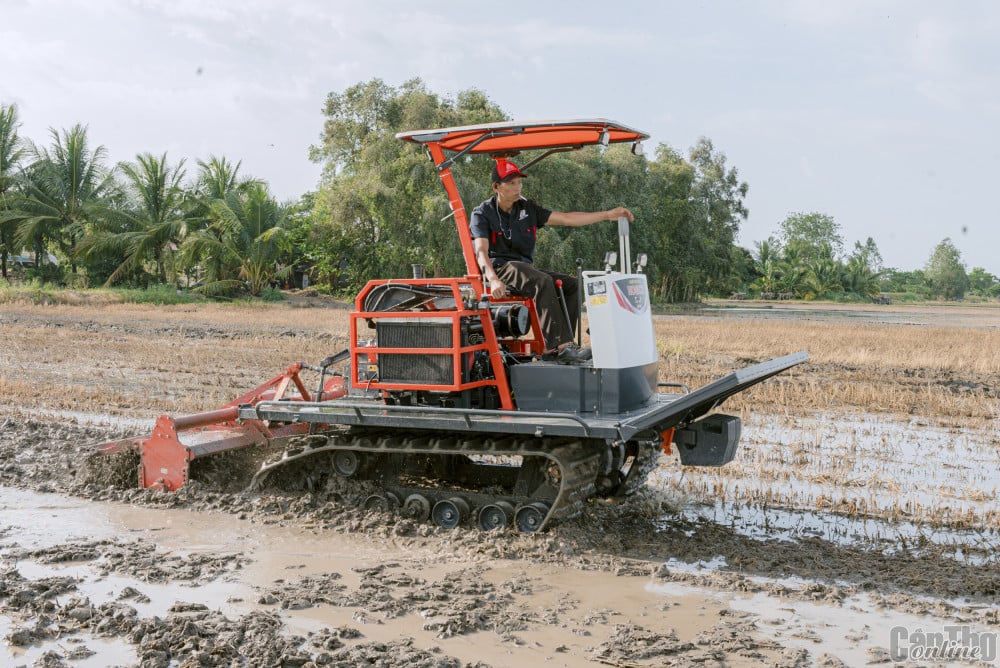
Equipped with rubber tracks, the agricultural tractor invented by Mr. Nguyen Quang Chi can easily move across all terrains and is resistant to getting stuck in muddy environments.
He was the youngest of five siblings, but Ut Chi inherited his father's profession of repairing agricultural machinery. Ut Chi often accompanied his father to plow land for hire for the villagers. His childhood was spent working in the fields, and growing up witnessing the hardships his parents faced in the farms instilled in him a desire to find solutions to alleviate the suffering of farmers.
In 2004, his family bought a combine harvester to rent out for harvesting. Three years later, realizing that mechanization of the fields was an inevitable trend, Mr. Chi discussed with his family importing combine harvesters to sell. "Also that year, the combine harvesters manufactured in China were constantly breaking down and there were no spare parts, so I decided to buy machinery and equipment to produce spare parts myself. With my tools readily available, I tinkered and researched, and then produced the first rice transport vehicle," Mr. Chi recounted. After the initial success of manufacturing rice transport vehicles, Mr. Chi found ways to successfully export rice transport vehicles to the Philippines, Africa, the Middle East, Central America, and South America starting in 2014.
Recognizing that the soil in the Mekong Delta is characterized by weak, muddy foundations due to three rice crops per year, making it difficult for rice tractors with rubber wheels to get stuck and move, Mr. Chi embarked on research to overcome this drawback. With the diligence and creativity of a farmer, Mr. Chi found a solution to help the tractor move smoothly across all terrains by replacing the rubber wheels with a track system that provides a wider contact surface. With this improvement, Mr. Chi's rice tractor is now able to resist getting stuck in muddy environments, especially in fields with weak or waterlogged foundations.
Mr. Chi's designed machine weighs 2.06 tons, has a load capacity of 5 tons, and is powered by a diesel engine with a power of 56kW/2,400 rpm/75HP. The mechanical gearbox with a 6-speed forward and 2-speed reverse gear system allows for flexible movement. Notably, Mr. Chi has improved this tractor using a one-way hydraulic lifting system that automatically raises and lowers agricultural tools when encountering obstacles. The machine has been inspected and certified by relevant authorities to meet the international standard ISO 9001:2015. Mr. Chi is currently completing the procedures to register intellectual property rights for his "brainchild."
At the start of the year 2023 (Year of the Rabbit), Mr. Chi's company successfully exported two containers containing 18 tracked tractors and tillers to the Philippines market, fulfilling an order from a partner. This is an improved agricultural tractor with a "2-in-1" function. The machine integrates both agricultural product transport and the connection of tools for tilling the soil before sowing. "I added a furrowing, tilling, and embankment building attachment, integrating multiple functions into the rice tractor so that farmers can do more work, saving labor and costs…," Mr. Chi explained.
To fulfill his passion for innovation, Mr. Chi invested in a 6,500m2 mechanical workshop, along with a robotic manufacturing system and production technology imported from advanced countries around the world . Mr. Chi said he will focus on strongly developing the domestic market for tracked tractors, increasing the workshop's production capacity from 2 machines/day to 3 machines/day.
Source link


![[Photo] General Secretary and President visit the China-ASEAN AI Application Cooperation Center](https://vphoto.vietnam.vn/thumb/1200x675/vietnam/resource/IMAGE/2026/04/17/1776404277677_vna-potal-tong-bi-thu-chu-tich-nuoc-tham-trung-tam-hop-tac-ung-dung-ai-trung-quoc-asean-8706616-2286-jpg.webp)








![[Photo] National Assembly Chairman Tran Thanh Man attends the policy seminar to promote Vietnam-Türkiye cooperation.](https://vphoto.vietnam.vn/thumb/1200x675/vietnam/resource/IMAGE/2026/04/16/1776351415367_vna-potal-chu-tich-quoc-hoi-tran-thanh-man-du-toa-dam-chinh-sach-thuc-day-hop-tac-viet-nam-tho-nhi-ky-8705791-jpg.webp)


















































Comment (0)