

"Rescuing" renewable energy projects.
This was the assessment shared by Dr. Ha Dang Son, Director of the Center for Energy and Green Development, at an online seminar on electricity prices. Commenting on the recently approved Power Development Plan 8, Dr. Son stated: "This is an important basis for implementing power generation projects to meet the ever-increasing demands of the economy and society, solving the problem of power source structure, combining renewable energy with traditional sources such as coal and gas power... At the same time, the plan is the legal basis for implementing a series of investment projects to expand power transmission projects, an important legal basis for Vietnam Electricity Group (EVN) to address difficulties regarding prices and policies related to renewable energy; resolving capacity issues for solar and wind power projects that are facing difficulties and developing rooftop solar power. The goal is that by 2030, 50% of office and household roofs nationwide will be covered with solar panels, meeting self-consumption electricity needs."
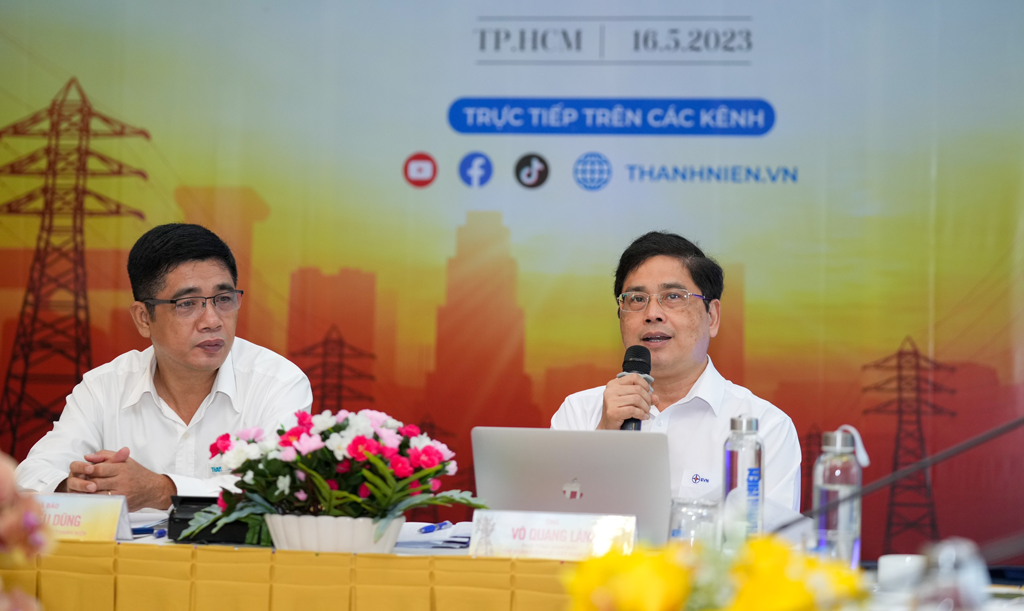
Journalist Lam Hieu Dung (left), Deputy Editor-in-Chief of Thanh Nien Newspaper, and Mr. Vo Quang Lam, Deputy General Director of EVN, at an online discussion on electricity prices on May 16.
Responding to numerous readers' questions about the wasteful use of renewable energy and the legal status of 85 transitional solar and wind power projects awaiting electricity sales, Dr. Ha Dang Son stated that these 85 projects have been added to the revised Power Development Plan 7. In principle, and assuming no changes, these projects should be included in the newly issued Power Development Plan 8. Furthermore, Mr. Vo Quang Lam, Deputy General Director of EVN, added that 31 out of 85 projects have worked with the Group's Electricity Trading Company. Of these, 15 projects have reached an agreement with the Electricity Trading Company, completed their documentation, and are currently negotiating prices; 11 projects have not yet submitted complete documentation and require clarification on legal issues; and 5 projects have recently submitted documentation and are under review.
However, according to Dr. Ha Dang Son, the biggest challenge in implementing Power Development Plan 8 is how to simultaneously ensure Vietnam's international commitments on reducing electricity and greenhouse gas emissions, while also guaranteeing social welfare, energy security, and especially adjusting electricity supply costs to suit international conditions and people's affordability.
According to Mr. Son, wind and solar power projects built and implemented in recent years have very large capacities, but in reality, the actual electricity generated is not very stable and depends on many factors. For example, solar power has a generation time from 6 to 18 hours, with peaks occurring between 9 and 13 hours, which is not suitable for the electricity consumption patterns of typical households. Meanwhile, wind power depends on the specific characteristics of each area where the project is built. Currently, the power generation capacity of this source in April and May only reaches about 10-20% of its capacity.
"The data above shows that the actual supply of wind and solar power is very limited, and it is difficult to expect a stable power supply to meet the increased demand during the hot season," Mr. Son commented.

The online discussion on electricity prices organized by Thanh Nien Newspaper attracted readers from all walks of life.
The risk of rolling power outages is very high.
One issue of great concern to many readers is the risk of power shortages and rolling blackouts. This situation has actually occurred in many provinces and cities. The Deputy Editor-in-Chief of Thanh Nien Newspaper, journalist Lam Hieu Dung, emphasized: "We have been experiencing historically hot days. Therefore, the issue of greatest concern to the people right now is the electricity supply. Recent information from EVN shows that the risk of power shortages in both the North and the South is very high. In the context of such extreme weather, the risk of power cuts is causing many people anxiety."
Responding to this issue, Mr. Vo Quang Lam stated: "Based on supply and demand calculations, if sufficient coal is supplied for power generation, the national electricity supply will be basically guaranteed during the dry season and throughout the year." Currently, demand in the South is lower than in 2022, and there is no shortage of supply like in the North. However, the Northern region faces the potential risk of peak power shortages due to overlapping incidents during hot weather and sudden spikes in demand.
However, it is not possible to mobilize all the power from the South to transmit to the North due to the transmission capacity limitations of the transmission line system. Statistics show that, during the period from April to June, the North is likely to experience a situation where it cannot meet peak load demand, with the largest power deficit estimated at up to 3,900 GW in June if there is unusually hot weather (assuming a 15% growth) and some power sources do not meet operational requirements, such as Thai Binh 2 Thermal Power Plant, unit S1 of Vung Ang 1 Power Plant (currently experiencing prolonged malfunctions), and imported power from Laos will not be operational in June.
For example, June 5th was a weekend, and electricity consumption reached 895 million kWh/day – a record high compared to previous years, an increase of more than 12% compared to the same period in 2022. "The overall picture is not simple at all, as hydropower reservoirs are currently at quite low water levels. Specifically, 12 out of 12 hydropower reservoirs in the North have water inflows of only 50-60% of the annual average; the South and Central regions also have many reservoirs such as Tri An, Dak R'Tih, Song Con 2... with very low water levels, and many reservoirs are near dead water levels or below the minimum operating water level... In addition, according to forecasts this year, there is a high possibility that the El Nino phenomenon will arrive early from the end of 2023 and last into 2024, affecting the water inflow into hydropower reservoirs and causing difficulties for electricity production," Mr. Lam said, acknowledging the risk of rotational power cuts on peak hot days, inability to meet peak load... High.
The possibility of further electricity price increases remains open.
One of the most frequently asked questions from readers is why EVN chose the hot weather period to increase electricity prices, potentially leading to a double increase in electricity bills. Mr. Vo Quang Lam explained: "Every year, after reviewing EVN's electricity production and business costs, the average electricity selling price is considered and adjusted according to objective fluctuations in input parameters at all stages compared to the parameters used to determine the current average electricity selling price. The most recent adjustment was on March 2, 2019. This means that for the past four years, retail electricity prices have not been adjusted according to Decision 24/2017 of the Prime Minister. Therefore, EVN has faced many difficulties in ensuring sufficient electricity supply for the national economy, and has had to contend with the continuous increase in global fuel prices."
This statement also caused concern among many, as with losses exceeding 26,000 billion VND, a 3% increase in electricity prices would add approximately 8,000 billion VND to EVN's losses, leaving 18,000 billion VND in outstanding losses. Will the electricity sector continue to raise prices? Mr. Vo Quang Lam explained: 2022 was also a year of dramatic increases in input materials. If one ton of coal purchased in 2020 cost around 60 USD, it rose to 137 USD in 2021 and then surged to 384 USD/ton in 2022. This represents an increase of more than six times compared to 2020 and about three times compared to 2021. In the first four months of the year, raw material prices decreased, such as the price of imported coal from Indonesia, which was 87% of last year's price.
"However, according to Decision 24, electricity price adjustments can only be made once every six months and must be approved by the competent authorities. The increase in electricity prices is based on costs that the authorities have reviewed and controlled. We are aware that the difficulties of the corporation are also the difficulties of the community. Therefore, any change must harmonize the interests of the corporation, the people, and businesses," Mr. Vo Quang Lam shared.
"Vietnam has enormous potential for electricity conservation. If each citizen and business can make slight adjustments in their usage, a great deal can be saved. For example, during Earth Hour, simply switching off unnecessary electrical devices can save approximately 500 million kWh in one hour."
Mr. Vo Quang Lam, Deputy General Director of EVN
Source link
![[Photo] General Secretary and President To Lam presides over a meeting on assessing national development resources.](https://vphoto.vietnam.vn/thumb/1200x675/vietnam/resource/IMAGE/2026/05/20/1779253785852_a1-bnd-2943-8519-jpg.webp)




![[Photo] National Assembly Chairman Tran Thanh Man working with the Standing Committee of the Economic and Financial Committee](https://vphoto.vietnam.vn/thumb/1200x675/vietnam/resource/IMAGE/2026/05/20/1779249584387_ndo_br_1-jpg.webp)






































































Comment (0)