

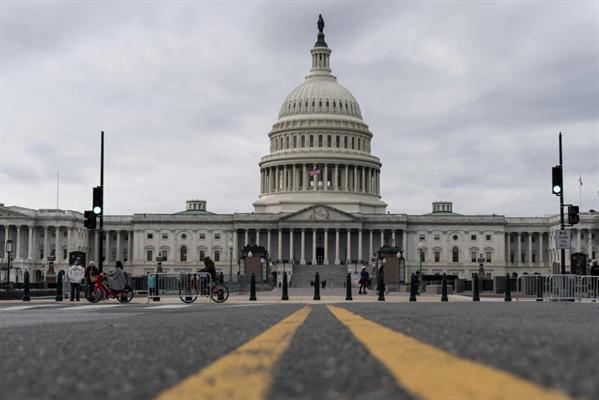
America breathed a sigh of relief as the US House of Representatives passed a last-minute temporary bill. (Photo: GETTY)
The bill, proposed by House Speaker Kevin McCarthy, aims to fund the government for 45 days but does not include additional aid for Ukraine. It passed with 335 votes in favor and 91 against. Of the 335 votes in favor, 209 were from Democrats and 126 from Republicans. The bill was signed into law by President Joe Biden, temporarily preventing a partial government shutdown until mid-November.
Earlier, the entire United States held its breath as House Speaker Kevin McCarthy's final plan to provide temporary funding for the government failed to pass the House on September 29th, facing opposition from hardline Republican lawmakers. With 232 votes against and 198 in favor, the House rejected the bill proposed by Speaker McCarthy, which would have cut spending and restricted immigration to extend government funding by 30 days, preventing federal agencies from shutting down at the start of the new fiscal year (October 1, 2023 to September 30, 2024). This move comes just one day before the deadline for both houses of the US Congress to agree on the budget for fiscal year 2024 at 00:01 local time on October 1 (11:01 AM Vietnam time), bringing the US government closer to a potential shutdown, risking more than 4 million federal employees going unpaid and disrupting all government activities from financial oversight to scientific research. In addition, many government programs and services will be interrupted.
Many U.S. officials have warned of the consequences of a government shutdown. In a speech on September 29th at Savannah, Georgia, U.S. Treasury Secretary Janet Yellen argued that a government shutdown could impact the country's economic progress due to the disruption of essential programs for small businesses and children, as well as delays in infrastructure upgrades. She stated that Republican House members need to act to keep the government running and adhere to the budget agreement reached at the end of May. The Treasury Secretary clarified: “The irresponsible actions of Republican House members will hurt American families and create headwinds for the economy, potentially impacting the progress we have made.”
Earlier that day, White House economic adviser Lael Brainard warned that the risk of a government shutdown this weekend was an “unnecessary risk” to a resilient economy with moderate inflation. Speaking on CNBC , Brainard cited data from the U.S. Commerce Department showing that in August, the country's annual core inflation, excluding food and energy, fell below 4% for the first time in over two years. She considered this “good news” for the economy, and therefore a government shutdown would be “a completely unnecessary risk to an economy that has proven to be resilient.”
Unfortunately, the issue of the US debt ceiling is a topic of discussion not only in the US media, but also in the international media community due to its importance to the US and international economies. If the US government defaults, household and government spending will be affected, thereby impacting global trade.
Despite its importance, the US has always been haunted by the debt ceiling. Economic experts point out that since 1960, the US Congress has raised the debt ceiling 79 times, most of which went smoothly. However, in some cases, especially in recent years, debt ceiling negotiations have become a dangerous and contentious cycle in Washington, as members of both parties have "weaponized" the issue. Accordingly, parties that do not hold power in the White House or have a minority in Congress often use the debt ceiling issue as leverage to seek policy concessions or send political messages. Negotiations on raising the debt ceiling are therefore often protracted and tense, and any miscalculation by lawmakers could put the US government at risk of default.
However, many in the economic community also believe that, although the risk of a US government default exists, the likelihood is not high, because raising the debt ceiling is a procedure that the US Congress has regularly undertaken. Professor Juan Carluccio at the University of Surrey (UK) commented, "A default would not benefit anyone, so it is highly likely that the Republicans will ultimately accept raising the debt ceiling." History over the past decades shows that this possibility has largely materialized. That is also why, whenever the debt ceiling issue is raised, the US and the rest of the world worry and hold their breath, but not to the point of pessimism, because everything will eventually fall into place, and everyone breathes a sigh of relief.
TUNG QUANG
Source




































































































Comment (0)