 |
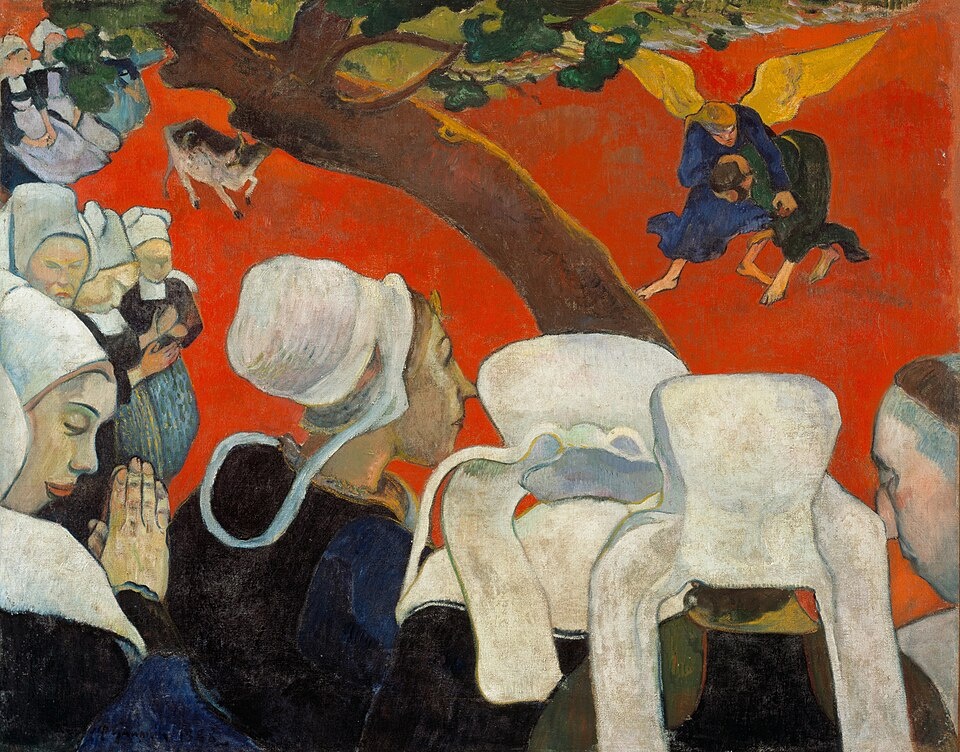
The painting Vision After the Sermon was painted by Paul Gauguin in 1888. Photo : Wikipedia. |
The illusion after the lecture
In Pont-Aven, living among the artistic community that would later become known as a school, Gauguin discovered his new aesthetic sense.
This style could be called Synthetic or Partition, characterized by flat surfaces of bright colors, disregarding virtual space and shapes defined by sharp outlines. With the intention of reproducing both reality and imagination, this style is also known as Symbolism.
One of the most famous works, *The Illusion After the Sermon * or * Jacob's Struggle with the Angel* , depicts Breton women praying while listening to a sermon recounting an event in Genesis: Jacob's battle with the angel.
In a letter to Vincent Van Gogh dated September 26, 1888, Gauguin perfectly described his work and his intentions: “I have just finished a religious painting that is very difficult to execute, but it delights and satisfies me. I want to give it to the Pont-Aven church. Of course, they don’t like it.”
Breton women gather for prayer in deep black attire. Their bonnets are a bright white and gold. The two bonnets on the right resemble devil's hats. An apple tree stretches across the painting, its dark purple foliage depicted in patches like emerald green clouds with gaps of golden-green sunlight. The ground (pure cinnabar). The church slopes downward and is reddish-brown.
The angel wore a dark blue robe and Jacob a bottle-green one. The angel's wings were pure chrome gold. The angel's hair was also chrome and its feet were orange.

![[Video] Typhoon No. 1 will have the strongest impact from afternoon to night on July 4th.](https://vphoto.vietnam.vn/thumb/192x108/vietnam/resource/IMAGE/2026/07/04/1783156241866_z8006974377164-31f28eff5ad2fabd021d4e38ded952eb-9518-jpg.webp)

I think I portrayed the characters in an extremely simple, unadorned, and sincere way. Everything is very solemn. The cow under the tree is too small for its actual size and looks like it's rearing up. For me, in this painting, the landscape and the battle exist only in people's imaginations as they pray during the sermon.”
From Gauguin's own words, we understand the artist's task: to find a way to represent both reality and illusion, refusing to prioritize one over the other. This simplicity, interpreted through color contrast and the outlines that define the frames, appears as an effective and complete synthesis of what the author intended to express.
Gauguin did not attempt to demonstrate his own emotions or imagination, but rather, the complexities of the characters depicted. To do this, he decided to divide the space into two parts using the tree trunk: on one side, the women praying; on the other, what they were thinking while praying; one side a realistic image, the other a spiritual one.
Arranged in a unique composition, the work clearly draws on the Japanese (Japonisme) style, with the tree trunk used as a kind of perspective axis, and especially the posture of the “wrestlers”¹ inspired by a photograph of Japanese wrestlers.
Although less influenced by Japanese art than Vincent Van Gogh or the Impressionists, Gauguin still employed a new perspective design that allowed him to off-center the entire scene and create a flat, ethereal feel, making all elements appear to be placed on equal footing.
The most striking feature of the painting is the strong contrast between the black and white attire of the Breton women and the red of the ground; the work is evident in its simplified color palette.
By eliminating local tones, meaning colors supposedly taken from nature, Gauguin emphasizes this effect by not painting shadows, as if to more clearly express the absurdity of the scene.
The background is equally meticulously handled: the group of women in the second layer are depicted only superficially, if not ghostly, to highlight the single woman in the foreground whose face is visible.
The woman's closed eyes suggest she is meditating, and at the same time, the artist creates a distance from the viewer, an uninvited participant in the scene; someone who cannot understand the experience of these women living simple lives, steeped in folklore and spirituality.

Here, we can see an undisguised critique of the society that Gauguin was trying to escape...
---------------
1. Original text: “lutteurs”. The title of the painting uses the French word “lutte,” meaning “battle” or “fight”; while “lutteurs” means both “participants in the battle” and refers to Japanese wrestlers.
Source: https://znews.vn/buc-tranh-noi-thuc-tai-va-ao-anh-cung-ton-tai-post1666014.html