


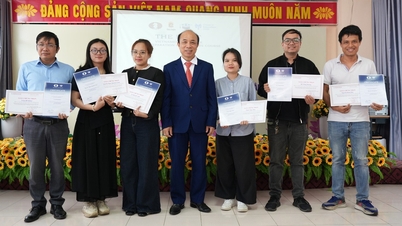
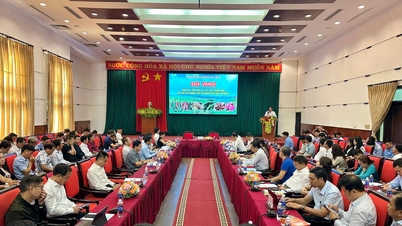
Professor Nguyen Ngoc Ha ( pictured ) stated: The high school graduation exam from 2025 onwards will have several important points: Firstly, the exam will include new question formats: true/false multiple-choice questions and short-answer multiple-choice questions. Secondly, this is the first year the exam will be conducted according to the 2018 General Education Program instead of the 2006 Program, so the requirement to test and evaluate students' abilities will be prioritized.
The best questions from various localities will be selected for the exam question library.
The Ministry of Education and Training advocates that exam question development should leverage the collective intelligence of the entire sector and be open-ended. So, how is "open-ended" understood in the context of building an exam question bank, and will this affect the security of the exam questions, sir?
Previously, the entire process of constructing exam questions was kept strictly confidential and carried out by a select few individuals; now, however, it is done with the spirit of leveraging the collective strength of the entire industry.
Specifically, good questions and well-executed test papers used locally and with proven results will be selected and included in the exam question library. This method allows teachers and students to easily access and refer to exam papers from different localities. This is an open approach. However, from the question library to the final exam, additional steps, following established procedures and established processes, will be required to ensure the absolute confidentiality of the exam papers.
Not only for the high school graduation exam, but also during the process of conducting tests, assessments, and surveys, schools and localities will send good and well-designed questions to the Ministry of Education and Training. The Ministry will have a department to evaluate the quality of the questions using test theory. The evaluation results will point out the strengths and weaknesses of the questions, and send them back to the provincial Departments of Education and Training for appropriate adjustments to improve the quality of questions in regular and periodic tests and assessments at the local level.

According to the Ministry of Education and Training, the content of the high school graduation exam from 2025 onwards will closely follow the required learning outcomes of the curriculum, not just the textbooks.
With the aim of leveraging the collective intelligence of the entire education sector in building a question bank, what approach will the Ministry of Education and Training take in training teachers in the process of creating and evaluating test questions?
The Ministry of Education and Training always places the task of training teachers as extremely important. In preparation for the 2025 high school graduation exam, starting in 2023, the Ministry has implemented training on examination procedures for over 3,000 officials and teachers from provincial Departments of Education and Training and universities. In the near future, the Ministry will continue to conduct focused training sessions on exam question compilation according to the new structural guidelines.
However, the 12th-grade curriculum has not yet been implemented, so schools do not have a system of questions for the Ministry to compile. Therefore, will the first year of testing using the new question format be enough to create a question bank based on the open-ended approach you mentioned?
We have considered this situation. In fact, when constructing exam questions, we have many approaches. One solution being considered is to utilize a team of experts. The Ministry will invite experts who are both knowledgeable about the new 2018 General Education Program and have practical teaching experience, such as those who compiled the curriculum, wrote textbooks, participated in the textbook evaluation council, and especially those teachers who participated in training teachers to teach the new program… to propose exam questions.
Therefore, even though the new textbooks are not yet widely available and there are no 12th-grade students studying the new curriculum, we can proactively draft questions to build a question bank for the 12th-grade exam starting now.
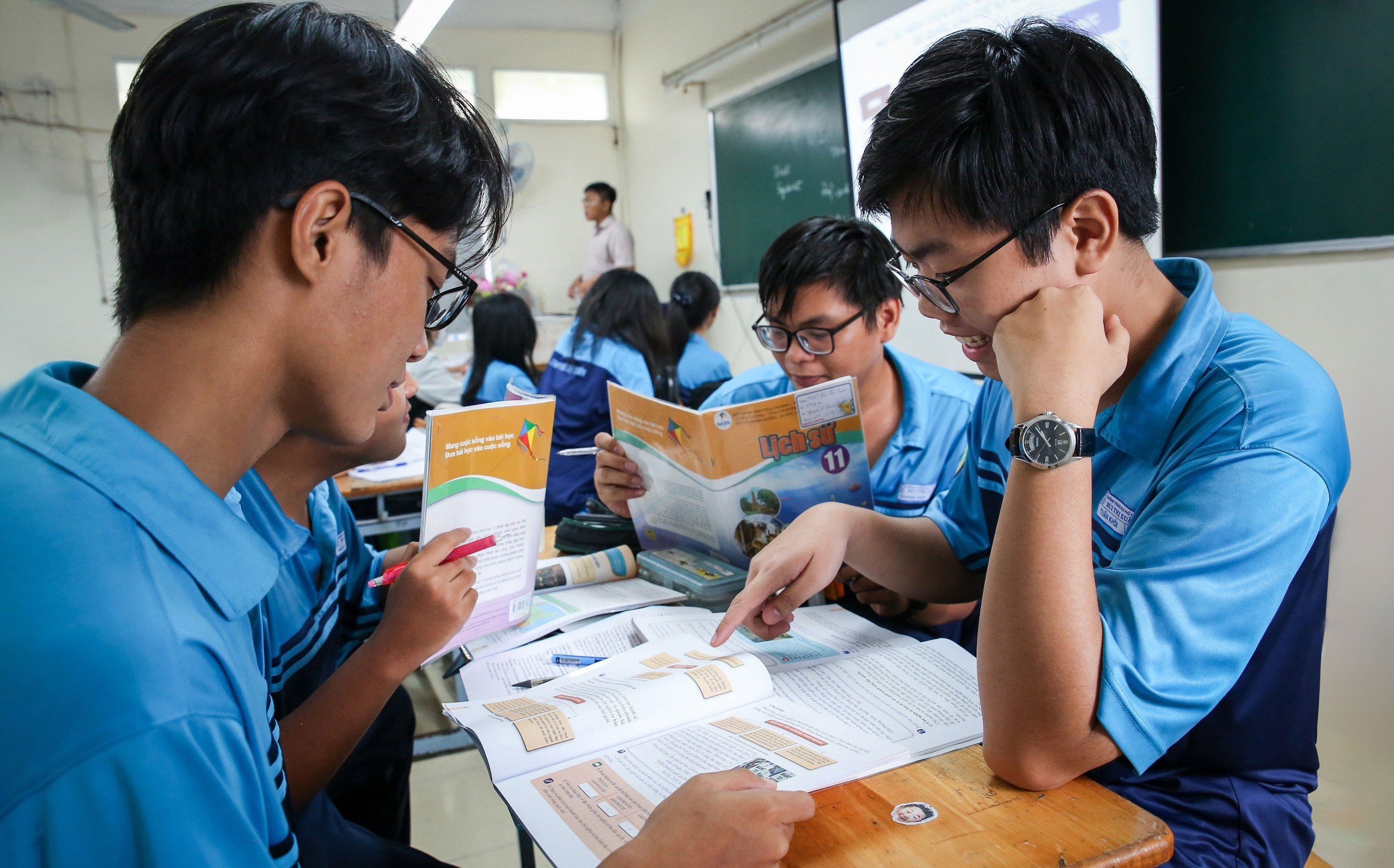
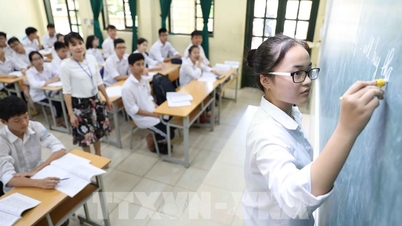
The 2025 high school graduation exam will officially be applied to 11th-grade students this academic year.
REDUCE THE PROBABILITY OF GETTING POINTS FROM "RANDOMLY CHOOSING" ANSWERS
One of the changes to the exam format from 2025, as confirmed by the Ministry of Education and Training, is that it will reduce the probability of getting points from "randomly selecting" answers. Could you explain this change in more detail?
With the new exam format, multiple-choice questions are divided into three parts. Part 1 consists of multiple-choice questions with four options to choose from, with each correct answer worth 0.25 points.
Part 2 consists of true/false multiple-choice questions. Each question has four options, and for each option, the candidate chooses true or false. A candidate who correctly answers one option in a question receives 0.1 point; two options correctly receive 0.25 points; three options correctly receive 0.5 points; and all four options correctly receive 1 point.
Part 3 consists of multiple-choice questions with short answers. Candidates should mark their answers in the corresponding boxes. For mathematics, each correct answer in Part 3 is worth 0.5 points. For other subjects, each correct answer in this section is worth 0.25 points.
The 2024 high school graduation exam will focus on practical applications to assess students' abilities.
With the new exam format structure, the probability of getting points through random selection decreased from 2.5 points to 1.975 points for mathematics, and to 2.35 points for the remaining multiple-choice subjects.
The 2025 exam is suitable for students who have completed 9/12 years of the old curriculum.
The 2025 high school graduation exam will be the first year using the 2018 general education program, but in reality, students only study under this program for three years, while for the remaining nine years they still study the 2006 program. So how will the Ministry of Education and Training plan the exam design to ensure that the reform is appropriate for both programs that students have studied?
We also took that into account and had to ensure continuity so that there weren't too many changes. For example, the exam structure still includes a section with traditional multiple-choice questions alongside new question types.
The 2018 curriculum includes many different textbooks, but each book, once reviewed and approved by the Ministry of Education and Training, must meet the curriculum standards. Therefore, the exam content will closely follow the required learning outcomes of the curriculum, not just the textbooks. Regardless of the materials used, the structure, the format, or the way questions are asked, everything must be based on the required learning outcomes for each subject in the new 2018 General Education Curriculum.
Therefore, during the teaching and learning process, teachers should adhere closely to these requirements, and students should learn well, thoroughly, and completely the knowledge content that teachers have taught in class.
An increase in differentiation is expected within the segment with scores above 5 points.
The Ministry of Education and Training recommends that higher education institutions use exam results for admissions. Universities, however, want the exam questions to be more differentiated to facilitate the admissions process. So, how will the differentiation of the exam questions be calculated and reflected in the exam papers, sir?
One of the three objectives of the high school graduation exam is that higher education institutions can use the results for admissions. For the high school graduation exam from 2025 onwards, we have focused our research on improving the quality of the exam questions to ensure greater differentiation, but it's important to emphasize that greater differentiation doesn't necessarily mean increased difficulty. First and foremost, this exam serves the purpose of determining high school graduation; increasing the difficulty would lower the graduation rate.
It is expected that the differentiation in the score range above 5 will be increased to accurately assess which students are excellent and capable of achieving 9 or 10 points; average students can approach scores of 7 or 8.
The differentiation will be based on two factors: Firstly, technically, specifically the exam format with true/false multiple-choice questions and short-answer questions with different point values for each answer, reducing the probability of success. The same question will require students to have a strong and comprehensive knowledge base to achieve the maximum score. Initial test results on 10,000 students have confirmed this.
Secondly, the questions aim to assess students' competence and ability to apply knowledge to solve real-world problems, rather than being difficult or trick questions. These questions are aligned with the curriculum and learning objectives.
Source link


























































































Comment (0)