According to the French Meteorological Agency (Meteo France), the national heat index – the average temperature measured from 30 meteorological stations across the country – has reached 29.8 degrees Celsius.
This figure officially broke the previous record of 29.4 degrees Celsius set during the heatwaves of 2003 and 2019.
In many areas, daytime temperatures exceeded 40 degrees Celsius. In particular, in the Pissos region of Landes province, the temperature reached a record high of 44.3 degrees Celsius.
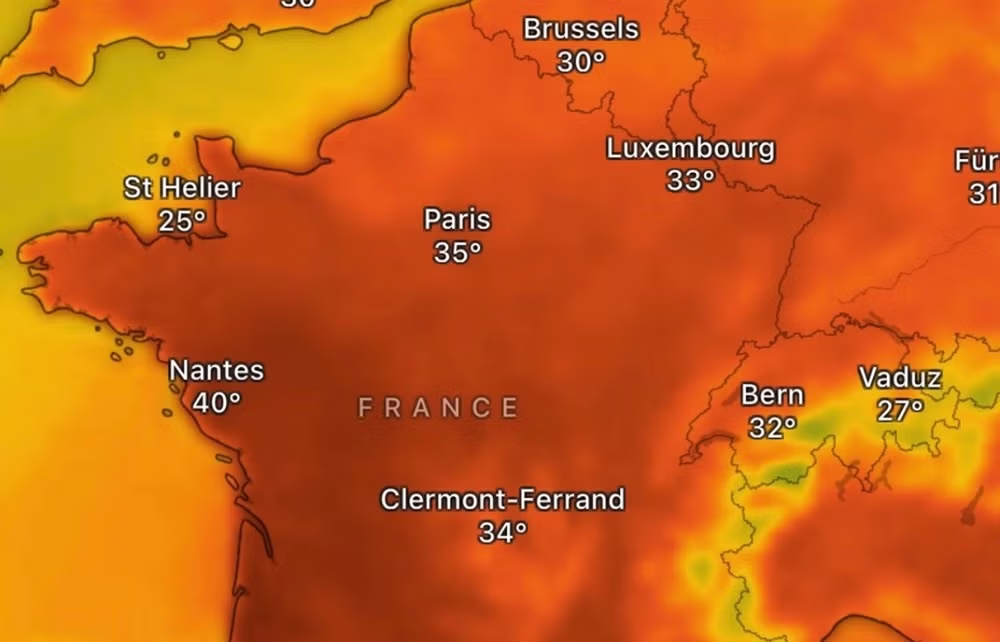
Meteo France also warned of the possibility of continued temperatures "that could surpass all previous records, regardless of the time of year."
Record-breaking heatwaves have forced some of the world's most famous tourist attractions to adjust their operating hours. The Eiffel Tower announced it would close in the afternoon instead of staying open late at night as usual to ensure safety. The Louvre Museum also decided to close two hours earlier than normal from June 24th to June 27th.



Representatives from the Louvre Museum stated: "While parts of this historic building are naturally resilient, the museum remains vulnerable and not fully adapted to climate change." They further explained: "Temperatures are highest at the end of the day and are exacerbated by the large number of visitors."
Not only tourism, but daily life and production have also been severely affected. Approximately 845 primary and secondary schools in France have had to close completely, while another 1,800 schools have had to adjust their schedules to avoid the hottest hours. Health experts also warn that unusually high temperatures can cause exhaustion and heatstroke, posing a direct threat to life.
Since June 18th, France has recorded at least 40 deaths from drowning as people flocked to unsupervised rivers and lakes to cool off. French Prime Minister Sébastien Lecornu called it a "catastrophe" and stressed that most of the victims were young people: "They are the first victims of the crisis we are facing."
This heatwave is being compared to the devastating heatwave of August 2003, which killed around 15,000 people in France. Scientists warn that human-induced climate change is making extreme weather events like this more frequent and intense.
Related news
Extreme heatwave in Europe kills at least 18 people.



Extreme heatwave grips Europe, France reports 3 deaths.
Keywords:
Source: https://congluan.vn/phap-ghi-nhan-ngay-nong-nhat-lich-su-post351034.html


![[Image] National conference summarizing one year of operation of the overall organizational model of the political system, the three-tiered government model.](https://vphoto.vietnam.vn/thumb/1200x675/vietnam/resource/IMAGE/2026/07/01/1782882811691_ndo_br_1-jpg.webp)