

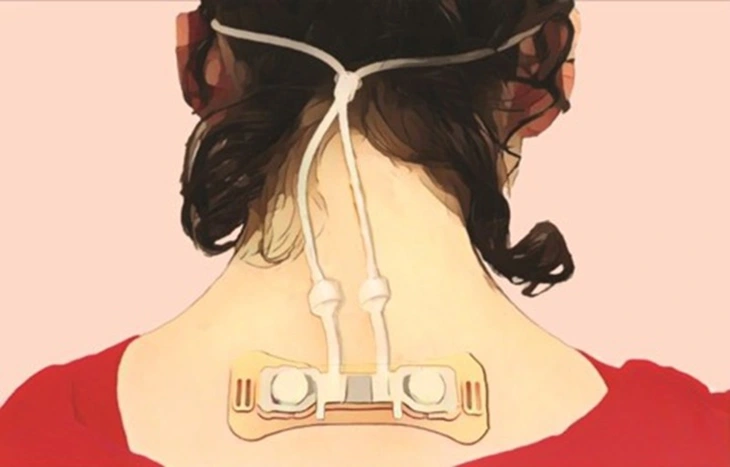
Wearable devices help monitor each person's breathing - Photo: SOROKA/CURRENT BIOLOGY
New research has discovered a unique characteristic of each individual: breathing is what sustains life. Accordingly, each person has a particular inhalation and exhalation pattern, according to ScienceAlert on June 13th.
The research team, led by brain scientist Timna Soroka, working at the Weizmann Institute of Science (Israel), fitted study participants with wearable devices that tracked their breathing through their noses.
Data analysis revealed that participants' breathing patterns were detailed enough for the research team to identify each individual with up to 96.8% accuracy. The team believes this "respiratory fingerprint" could spur new ways to understand and treat physical and mental illnesses.
The team studied how the brain processes scents when inhaled. During the research, they made small strides toward studying the concept of "respiratory fingerprints."
"The idea of using each person's breathing pattern as a unique identifier has been discussed for decades. You can easily notice each person's unique breathing pattern when you measure the breaths of different people," said Soroka.
However, until now there has been no convenient way to measure breathing. The research team developed a small wearable device capable of recording the flow of breath through each nostril over an extended period. This allowed the team to monitor the breathing of 100 participants for 24 hours.
After just one hour of recording breaths, the team was able to achieve an accuracy rate of 43%, and this rate increased rapidly after 24 hours. The respiratory logs were then analyzed using a protocol called BreathMetrics, which examines 24 nasal respiratory parameters of a person.
Because respiration is typically measured over short periods, around 20 minutes, the data collected by the group is much more comprehensive and provides a more holistic view of each individual's respiration, from rest to exertion. This allows the group to better understand the concept of "respiratory fingerprinting."
Researchers not only discovered a "respiratory fingerprint" to identify a person, but the study also revealed that a person's breath is related to their body mass index (BMI).
Participants in the study completed questionnaires about their mental health. The results showed that those experiencing anxiety problems tended to inhale more slowly and had more variability in the pauses between breaths while sleeping.
Soroka said the next step for the team will be to focus on applying the research to diagnoses. "We may gain a better understanding of how breathing can predict different diseases. However, we will have to test whether changing breathing patterns can help treat diseases," Soroka said.
The study was published in the journal Current Biology.
Source: https://tuoitre.vn/phat-hien-dau-van-tay-ho-hap-o-nguoi-2025061310545289.htm

![[Photo] General Secretary and President To Lam meets with National Assembly delegates from ethnic minorities.](https://vphoto.vietnam.vn/thumb/1200x675/vietnam/resource/IMAGE/2026/04/20/1776696701056_a1-bnd-8331-3342-jpg.webp)
![[Image] National Assembly discusses the implementation of the socio-economic development plan.](https://vphoto.vietnam.vn/thumb/1200x675/vietnam/resource/IMAGE/2026/04/20/1776696707422_ndo_br_img-20260420-185419-jpg.webp)























































































Comment (0)