

Building a leading cultural industry.
Compared to the Strategy for the Development of Vietnam's Cultural Industries to 2020, with a vision to 2030, approved in 2016, the new strategy has fundamentally changed. For example, while previously the general goal was for the cultural industries to create many jobs, the new strategy, for the first time, quantifies that the workforce in these industries will account for 6% of the total workforce of the economy by 2030 and 8% by 2045. The new strategy also narrows down Vietnam's cultural industries to 10 sectors (compared to 12 previously) and focuses on 6 key sectors: film, performing arts, software and entertainment games, advertising, handicrafts, and cultural tourism.
The new strategy also sets very high targets, such as: Revenue contributing 9% to GDP by 2045; an average annual growth rate of 7% in export value of cultural industries by 2030 and 9% by 2045; and an average annual growth rate of 10% in the number of economic establishments operating in cultural industries... These indicators are similar to those of the cultural industries of developed countries around the world today. Therefore, it is easy to see the State's determination to achieve the following: By 2045, the 100th anniversary of the founding of the Democratic Republic of Vietnam (now the Socialist Republic of Vietnam), our country will have a leading cultural industry, with influence in the region and the world, becoming a creative growth sector that serves as a foundation for the economy.
 |
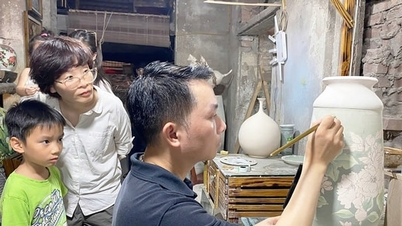
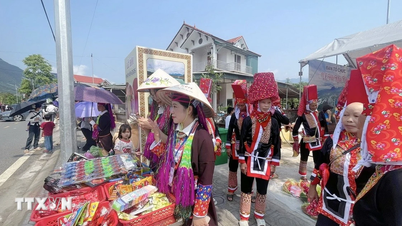
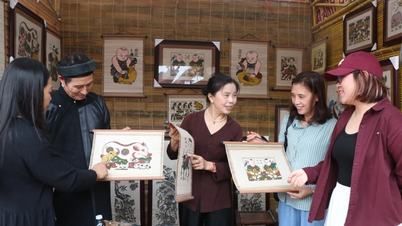
Handicrafts are a cultural industry with high export value in Vietnam. Photo: PHAM DINH THANH |
The new strategy also demonstrates foresight and foresight by setting a target for digital cultural products to account for over 80% of all cultural products. This figure aligns with the changing reality where life in general, and culture in particular, is closely linked to the digital transformation process. Many cultural products today do not require customs clearance or warehousing; they reach the public directly with just a click. If we know how to leverage digital platforms, costs will be drastically reduced, while reach will increase exponentially.
Dr. Tran Thi Thuy, from the Asia-Pacific Research Institute, Vietnam Academy of Social Sciences, stated: "The new strategy is clear and very comprehensive. The core issue is that ministries, sectors, and localities need to have specific and creative plans to implement the strategy in accordance with the viewpoint that: 'Developing Vietnam's cultural industries is the task of the entire political system, all levels, sectors, and society as a whole, and is an investment in the sustainable development of the country; ensuring harmony between political, economic, cultural, social, diplomatic, and scientific and technological goals.'"
Pioneering and leading the way.
One of the newly set strategic goals is to export cultural and artistic products. This decision reflects the results of a long process of intellectual development; an important aspect demonstrating the in-depth development of Vietnam's cultural and artistic industries. Associate Professor, Dr. Bui Hoai Son, a full-time member of the National Assembly's Committee on Culture and Society, believes that: When socio-economic capacity reaches a certain level, the cultural and artistic industries will become a new driving force for national growth and soft power. Vietnam currently has many conditions: the fourth largest economy in ASEAN, a rapidly growing middle class, strong digital infrastructure development, an increasingly open creative environment, along with a unique, long-standing, and distinctive cultural value system capable of "touching" the emotions of international friends. Therefore, setting the goal of exporting culture at this time is a logical step, consistent with the country's new stature.
While the revenue from direct exports of cultural and artistic products is certainly important, experts believe that equally crucial is how Vietnam is perceived by the world, and how attractive and appealing Vietnam and its people are to international friends. When the international public is captivated by cultural and artistic products, they will undoubtedly develop a positive impression of Vietnam, be willing to spend money on tourism, and trust our country's export goods. Developed countries have successfully used culture as a catalyst, paving the way for political and economic development.
Compared to 10 years ago, Vietnam's cultural industries have produced cultural products and artists known to the international public, but the number and level of influence remain modest. In many seminars and discussions, international experts advising Vietnam have emphasized the need to research international public tastes and create trendy products. When planning the production of a cultural industry product, one should not only think about domestic consumption but also consider selling it globally. Simultaneously, it is necessary to focus on easily marketable products such as children's books, animated films, television series, and music videos. A shift in mindset towards creating truly meaningful products is linked to the training of new human resources for the cultural industries.
For the value of cultural industry exports to grow continuously and sustainably, it is difficult to rely solely on the current scale and potential of small and medium-sized enterprises. Therefore, to export culture, we must first export the trust of investors in Vietnam's creative environment. This requires perfecting the institutions and infrastructure for the creative economy. Culture can only be exported when it truly becomes an economic sector operating according to market principles. This demands that policies on intellectual property, taxation, ordering and bidding in the creative sector, venture capital funds for the cultural industry, public-private partnership mechanisms, etc., be truly open and encourage innovation.
The role of the State also needs to be clearly defined in terms of investing in physical resources as "seed capital," while simultaneously showing concern and encouragement for artists and producers to confidently conquer the international market. Vietnam needs cultural and artistic products bearing national brands to enhance its competitiveness; to achieve this, it must be closely linked to national communication and promotion, cultural diplomacy, and international cooperation. These are things that the private sector cannot do on its own and require a public-private partnership.
All solutions are only truly effective when we connect the State, businesses, artists, and the community. The State creates institutions; businesses invest and organize production; artists create; and the community preserves and disseminates values. When these four entities work towards a common goal, cultural export is not just an economic issue, but also a journey to affirm the position and mindset of a nation reaching out to the world through soft power.
Source: https://www.qdnd.vn/van-hoa/doi-song/phat-trien-chieu-sau-cong-nghiep-van-hoa-1019960























































Comment (0)