

 |
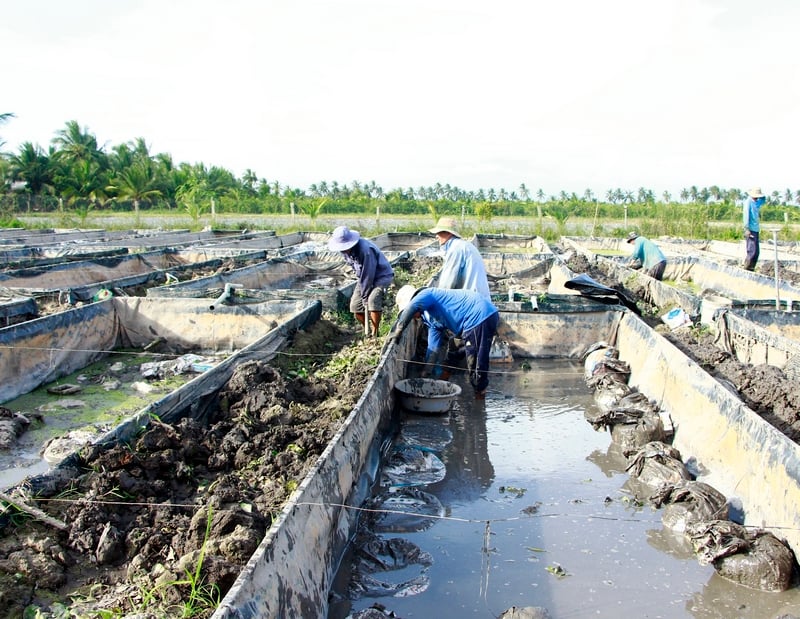
| The model of raising eel fry and juvenile eels is developing strongly. |
Eel farming has proven effective, creating jobs and increasing income. According to many locals, eel farming is not difficult; farmers can utilize their free time to care for the eels, it requires little time and effort, and uses minimal land. In particular, the model of raising eel fry and breeding eels brings relatively high income to farmers.
Nguyen Van Hao (Cai Nhum town, Mang Thit district), who has 6 plots for breeding eels, said: "Raising breeding eels, juvenile eels, adult eels, and young eels yields higher income compared to raising eels for commercial purposes, because commercial eels need to be raised for 12-14 months before they can be sold."
As for eel farming, from newly hatched eel larvae, it only takes about two more months to generate income. This provides farmers with a regular source of income.
According to Mr. Hao, raising and selling eel fry and fingerlings seems simple, but it requires a thorough understanding of eel behavior; the process of eel mating, egg laying, embryonic development, and hatching. In addition, attention must be paid to the diet of parent eels, fry, and fingerlings to ensure a high success rate.
Sharing his experience in raising eels from broodstock to fry, Mr. Nguyen Van Nam (Chanh An commune, Mang Thit district) said: "To raise eels effectively, it's best to buy broodstock from different farmers to avoid inbreeding."
When selecting broodstock eels, observe the following: mature female eels have thin belly skin; the best eels should be at least 10 months old and weigh between 30-100g.
When transporting eels, before releasing them into the tank, pour them into a large basin or tub to rest for 1-2 hours. Then, bathe them in a 5% salt solution or potassium permanganate solution for 30 minutes to remove fungi and parasites. Continue soaking them in vitamin C at a concentration of 5-10 g/m³ before releasing them into the tank. The stocking density should be 8-10 eels/m², avoiding overcrowding.
Place the food on a feeding platform in a fixed position in the tank. After feeding the parent eels for about 2 hours, check the amount of food on the feeding platform. If there is any leftover, remove it to avoid water pollution.
“It’s necessary to prepare a clean pond with a good mud bottom, stock the pond at the right time and density, provide quality and nutritious feed, and regularly check the health and treat diseases. Importantly, you must know how to harvest at the right time and according to the prescribed size,” Uncle Nam added.
According to Mr. Le Minh Tu, Vice Chairman of the Farmers' Association of Chanh An commune (Mang Thit district): In the last two years, the model of raising broodstock eels, eel eggs, and mature eels has developed strongly.
With the high price of eel eggs, successful processing will bring high profits to farmers. Currently, the commune is also compiling statistics on the number of households raising eels to balance production, and at the same time, aims to organize training courses on eel farming techniques for the people.
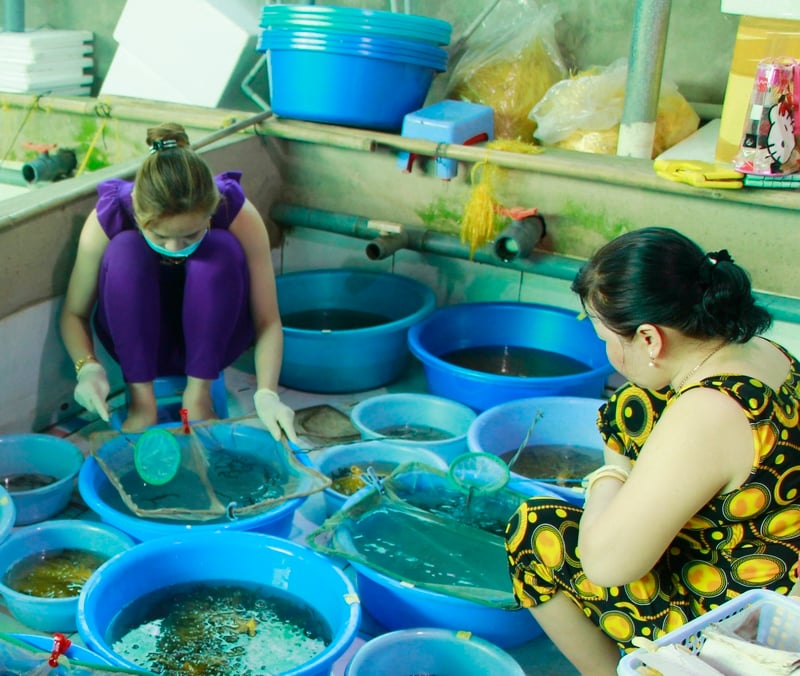 |
| Eel farmers need to master farming techniques to ensure efficiency, productivity, and quality. |
Mr. Huynh Chan Quoc, Deputy Head of the Fisheries Department (Department of Animal Husbandry, Veterinary and Fisheries, Department of Agriculture and Environment), said: Currently, the model of breeding and raising eels for reproduction is developing and is widespread in Mang Thi, Tam Binh, and Long Ho districts…
This is an economic model with low investment costs and relatively simple farming techniques, yet it yields high returns. Eels are also an aquatic species that can tolerate a relatively low salinity of about 0.3‰.
In eel breeding, the most important aspect is ensuring a clean water source and effective disease control; otherwise, eels are very susceptible to disease. When eels become ill, the disease spreads very quickly, leading to significant losses.
Currently, the province has approximately 200 households engaged in breeding and raising livestock, covering an area of 45 hectares. On average, a 20-30m2 breeding tank, when successfully cultivated, can yield a profit of 20 million VND.
Recently, the agricultural sector has also organized training courses and provided guidance on technical procedures for transferring technology for mudless eel farming, eel breeding, and eel fry production to the people.
Currently, farmers have converted many areas of low-yield crops to eel farming, so the eel farming model is developing widely, sometimes with supply exceeding demand. Therefore, when wanting to raise eels, farmers should not start with large areas but should conduct trial runs first to reduce risks.
Simultaneously, when raising livestock, it is necessary to ensure the quality and quantity of products supplied to the market, focusing on a close link between production and consumption, and changing from traditional farming methods to new ones, in order to create safe products for consumers.
| To breed eels, each breeding tank has an area of 20-30m2 and a depth of about 40cm. The bottom and sides of the tank are lined with thick nylon tarpaulin; on both sides of the tank are earthen banks planted with grass and covered with leaves for the parent eels to mate and reproduce. On average, eel eggs are harvested twice a month. Each kilogram of eel eggs is priced from 10-25 million VND. The eggs are then incubated for 5-10 days until they hatch into eel fry. On average, 1kg of successfully incubated eel eggs will yield 25,000-28,000 eel fry. Eel fry are raised for about 15-20 days to reach a size of 10,000 eels/kg, and after 2 months of rearing, the size of juvenile eels reaches about 1,000 eels/kg. |
Text and photos: TRÀ MY
Source: https://baovinhlong.com.vn/kinh-te/nong-nghiep/202503/phat-trien-mo-hinh-nuoi-luon-sinh-san-5fa7455/

![[Photo] General Secretary To Lam presides over a thematic session on strategic technology.](https://vphoto.vietnam.vn/thumb/1200x675/vietnam/resource/IMAGE/2026/03/18/1773838586650_anh-1-bnd-1822-7089-jpg.webp)

![[Photo] Prime Minister Pham Minh Chinh holds a phone call with Algerian Prime Minister Sifi Ghrieb](https://vphoto.vietnam.vn/thumb/1200x675/vietnam/resource/IMAGE/2026/03/18/1773849689752_ndo_br_dsc-9609-jpg.webp)





















































Comment (0)