

 |
The Artemis II crew will re-enter Earth's atmosphere in a "fireball". Photo: The Conversation . |
At approximately 7:00 AM on April 11th (Vietnam time), the Artemis II crew will land and return to Earth.
After successfully completing their historic mission on the Moon, the members of the Artemis II crew began their journey home on April 9th. During this trip, the four astronauts set a new milestone for humanity by reaching the furthest point in space ever achieved, with a maximum distance of 406,771 km from Earth.
When the Artemis II crew returns to Earth, they will face one of the most grueling technical challenges in aerospace history.
At an altitude of hundreds of kilometers above the ground, the Orion spacecraft will reach a top speed of 40,000 km/h. This is 32 times the speed of sound, creating enormous kinetic energy that the system needs to completely dissipate in order to deploy the parachutes and land safely.
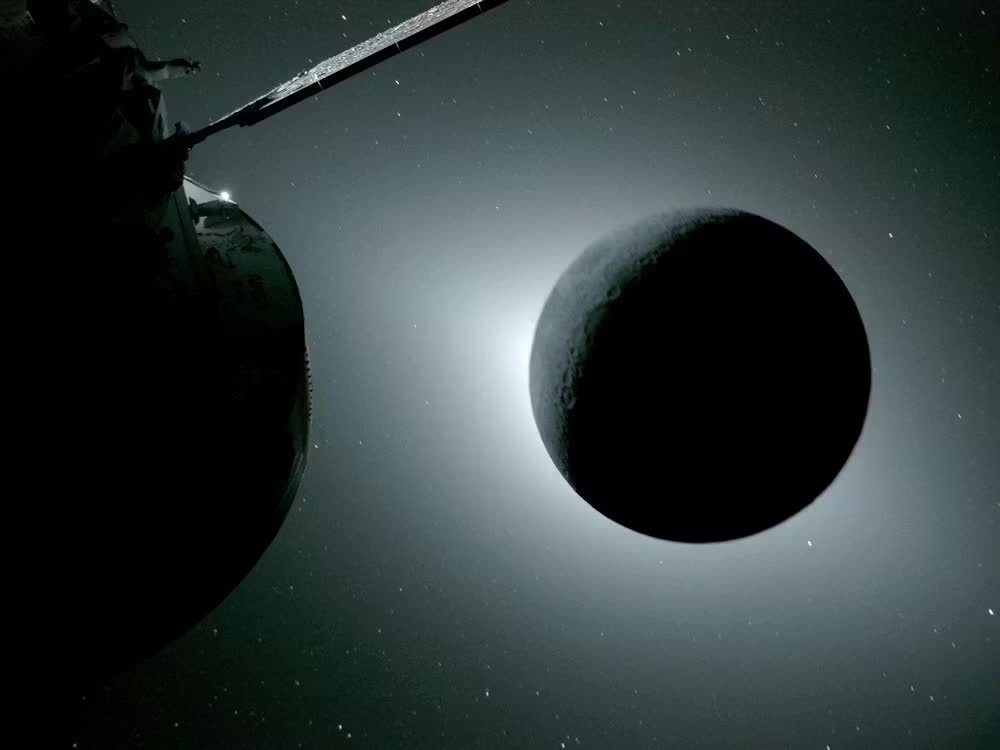 |
The Artemis II mission set a new record for the furthest distance humans have ever flown from Earth. Photo: NASA. |
According to aerodynamic experts, the most difficult challenge is converting this kinetic energy into thermal energy without burning up the cockpit. As the spacecraft plunges through dense atmospheric layers, the air is compressed to the extreme, causing the ambient temperature around the hull to skyrocket to 3,000 degrees Celsius, far exceeding the melting point of most current superalloys.
To protect the four astronauts inside, NASA designed the Orion spacecraft with a flat, blunt bottom instead of the elongated shape of an aircraft. This design creates maximum drag, pushing shock waves and hot gases (plasma) away from the spacecraft's surface, creating a cushion of air that prevents most of the heat from reaching the spacecraft's hull.
However, the remaining heat is still enough to destroy any metal material. Therefore, the "cut-off" heat shield made from Avcoat material plays a crucial role. This coating is designed to self-ignite and peel off at high temperatures, carrying heat away from the cabin.
"It's a process of sacrificing material in a controlled manner to keep people safe," explained an engineer at the Johnson Space Centre.
Another groundbreaking technique, "Skip Entry," was also applied for the first time to a crewed spacecraft. Instead of plunging straight down, the Orion spacecraft would make contact with the upper atmosphere and bounce back into space for a short distance before making its final descent. This method helps to distribute the heat load and reduce gravitational pressure on the astronauts' bodies.
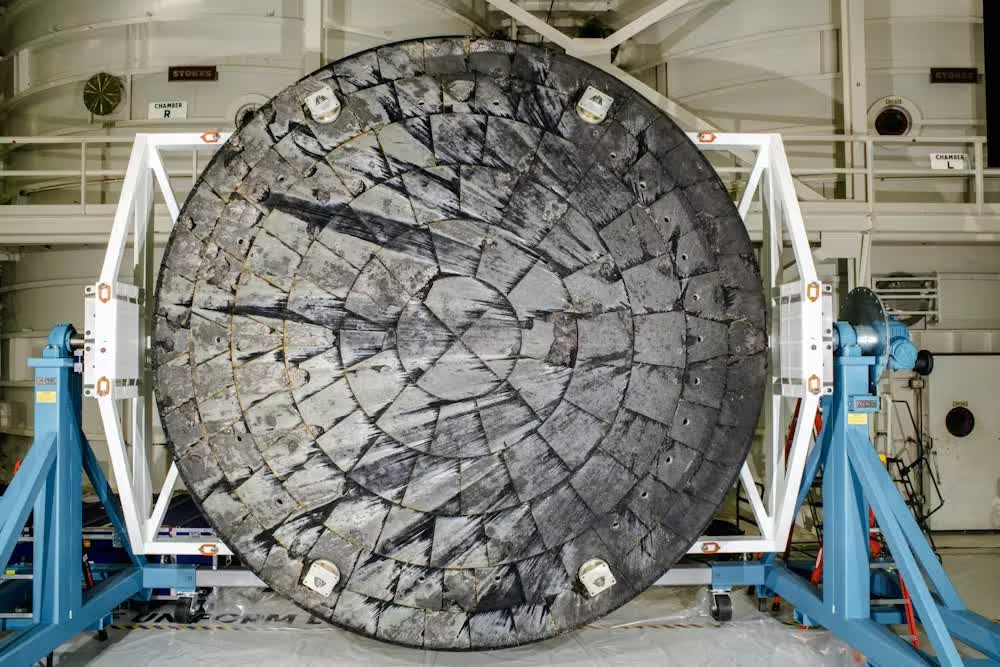 |
The heat shield of NASA's Orion spacecraft after the Artemis I mission. Photo: NASA. |
Despite the protective measures, the crew's experience will still be extremely harsh. When the spacecraft is enveloped by a layer of superheated plasma, all radio communication will be cut off for about 40 minutes.
"It feels like having an elephant standing on your chest, making breathing incredibly difficult," astronaut Reid Wiseman shared about this tremendous physical pressure.
In addition to difficulty breathing, the extreme acceleration also causes the astronauts' tears to be pushed back into their eye sockets, hindering their vision during those life-or-death moments.
After passing through the firewall and dropping below supersonic speed, the system of 11 parachutes will be activated sequentially. In the final stage, three main parachutes, each the size of a football field, will bring the spacecraft's speed down to approximately 30 km/h before landing in the Pacific Ocean.
Source: https://znews.vn/cach-phi-hanh-doan-mat-trang-song-sot-chuyen-hoi-huong-3000-do-c-post1642359.html

![[Photo] The General Secretary, President and his wife meet with Vietnamese-Chinese friendship leaders.](https://vphoto.vietnam.vn/thumb/1200x675/vietnam/resource/IMAGE/2026/04/15/1776264829725_vna-potal-tong-bi-thu-chu-tich-nuoc-to-lam-gap-mat-nhan-sy-huu-nghi-viet-nam-trung-quoc-8703641-3130-jpg.webp)
![[Photo] National Assembly Chairman Tran Thanh Man attends the opening session of IPU-152](https://vphoto.vietnam.vn/thumb/1200x675/vietnam/resource/IMAGE/2026/04/16/1776277863731_ctqh5-jpg.webp)
![[Photo] National Assembly Chairman Tran Thanh Man arrives in Türkiye to attend IPU-152](https://vphoto.vietnam.vn/thumb/1200x675/vietnam/resource/IMAGE/2026/04/15/1776261003665_tnk10-jpg.webp)
![[Photo] My Son at night: A thousand-year-old heritage site amidst the Milky Way](https://vphoto.vietnam.vn/thumb/1200x675/vietnam/resource/IMAGE/2026/04/15/1776261039184_ndo_br_chon6-jpg.webp)
![[Photo] Mrs. Ngo Phuong Ly meets and exchanges views with Mrs. Peng Li Yuan](https://vphoto.vietnam.vn/thumb/1200x675/vietnam/resource/IMAGE/2026/04/16/1776277858080_phu-nhan-1-jpg.webp)
















































































Comment (0)