

On the evening of September 24th (Vietnam time), a team from the US National Aeronautics and Space Administration (NASA) successfully recovered a capsule containing extraterrestrial materials in a challenging mission. In 2016, the OSIRIS-Rex spacecraft launched and in 2018 entered orbit around the asteroid Bennu. Two years later, the spacecraft collected materials from the surface of this celestial body and set off for its return journey to Earth in May 2021. The entire round trip covered a total distance of over 6.21 billion kilometers, Reuters reported yesterday.
A drop from space
At 3 PM on September 24th (Vietnam time), the OSIRIS-Rex mission command team in Littleton, Colorado, began assessing the overall landing conditions. Based on this information, the members voted to issue the order for the spacecraft to release the payload. At a position more than 101,000 km from Earth, the OSIRIS-Rex mother spacecraft, weighing over 2.1 tons, officially released the 46 kg payload onto Earth at 5:42 PM that same day.
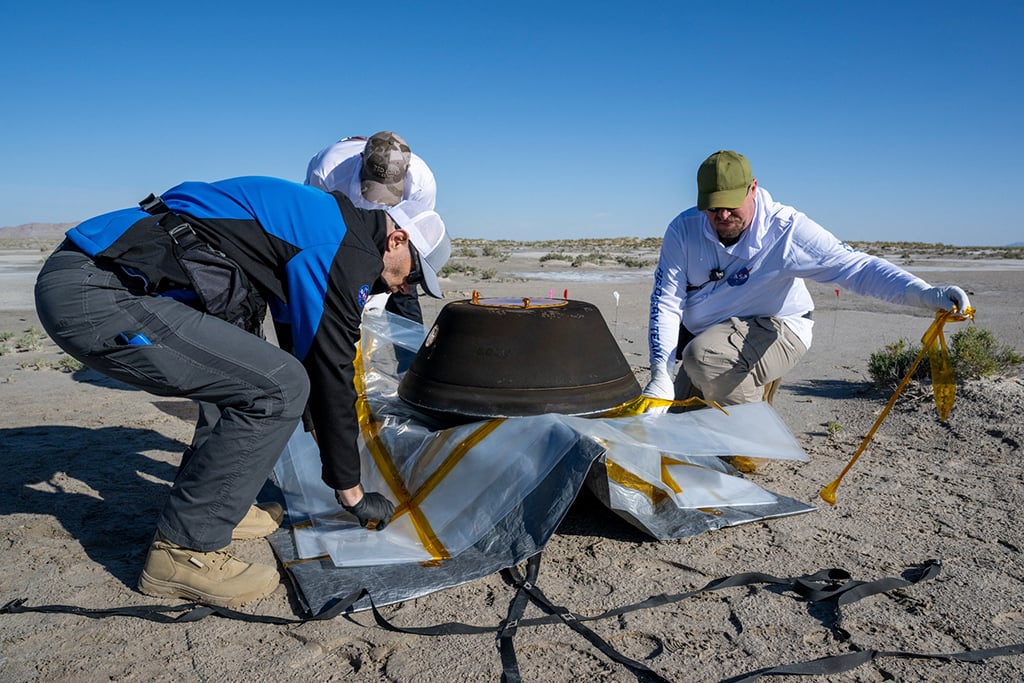
The sample container was blackened upon landing in the Utah desert.
Four hours later, at 9:42 PM, the capsule entered Earth's atmosphere at a speed of over 45,000 km/h. Cameras on a NASA aircraft captured images of the capsule plummeting as a fireball. Throughout this process, the materials inside the capsule remained safe thanks to a heat shield, despite the outside temperature exceeding 2,760 degrees Celsius.
After the atmospheric entry phase is complete, the first parachute is deployed to help stabilize the capsule at an altitude of approximately 30.5 km above the ground. Following the first parachute's deployment, the second parachute, which is also the capsule's primary parachute, is activated, allowing the capsule to reduce its supersonic speed to less than 18 km/h by the time of landing.
Before the capsule landed, NASA, in coordination with the U.S. Department of Defense , deployed four monitoring helicopters while the NASA team anxiously awaited news from the site. Because the main parachute was activated at a higher altitude than expected, the capsule landed at 9:52 PM, three minutes earlier than initially planned. The landing site was located within the grounds of the Utah Air Force Training and Testing Range, approximately 128 km west of Salt Lake City, Utah.
About 30 minutes after the capsule touched down, a team of personnel arrived and arranged for its transport by helicopter to a nearby field station. After processing, the capsule was taken to the Johnson Space Center in Houston, Texas, for analysis.
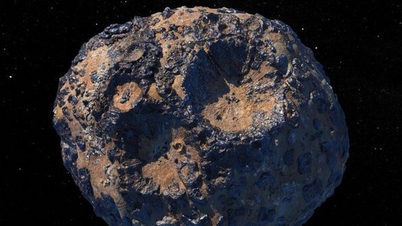
Most samples from the asteroid Bennu will have to wait for future generations to study.
A gift from heaven
"It's a gift to the world ," The New York Times quoted OSIRIS-Rex mission chief investigator Dante Lauretta as excitedly remarking. The NASA team is anxiously awaiting the moment to open the capsule, which contains approximately 250 grams of rocks and dust from Bennu. This asteroid is considered a 4.5-billion-year-old fossil of the ancient solar system, and NASA spent over $800 million and waited a grueling seven years to receive the material extracted from Bennu.
With this success, OSIRIS-Rex became the third human spacecraft, and the first American, to collect extraterrestrial material. The two previous missions were carried out by Japan, via the Hayabusa and Hayabusa 2 spacecraft in 2010 and 2020, respectively. Studying the chemical properties and history of the dust and rocks on Bennu could allow humanity to look back in time to the birth of the solar system.
"We can gain information about the evolution of the solar system, the reasons behind Earth's current state, and what makes it unique," according to expert Rich Burns, Director of the OSIRIS-Rex project.
As for the OSIRIS-Rex spacecraft, after delivering its materials, it continued on its new mission. Its next target is Apophis, a 340-meter-diameter asteroid that will come within 32,000 kilometers of Earth in 2029, according to NASA.
Source link
![[Image] National Assembly discusses the implementation of the socio-economic development plan.](https://vphoto.vietnam.vn/thumb/1200x675/vietnam/resource/IMAGE/2026/04/20/1776696707422_ndo_br_img-20260420-185419-jpg.webp)



![[Photo] General Secretary and President To Lam meets with National Assembly delegates from ethnic minorities.](https://vphoto.vietnam.vn/thumb/1200x675/vietnam/resource/IMAGE/2026/04/20/1776696701056_a1-bnd-8331-3342-jpg.webp)



















































































Comment (0)