

Tourists love the sidewalks.
Walking around the central area of Ho Chi Minh City, it's easy to spot sidewalks always packed with people. Many eateries have survived for decades thanks to the sidewalk space in front. Conversely, many indoor spaces, even with air conditioning and neat tables and chairs, remain deserted.
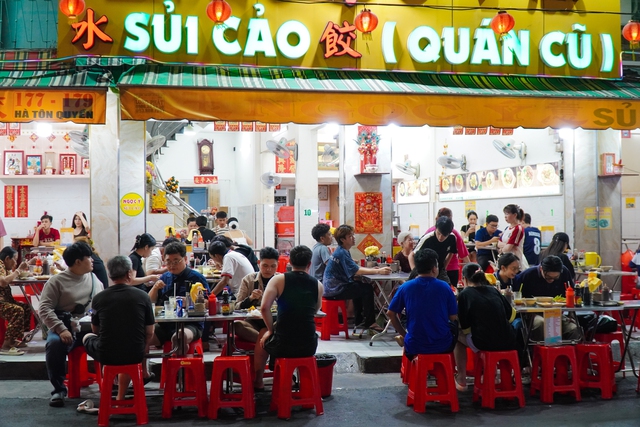
Ha Ton Quyen food street, with its long-standing dumpling shops, is loved by diners for its spacious atmosphere and ample seating.
PHOTO: PHAN HUONG
Quoi Tu, 28, residing in Xuan Hoa Ward, said that his group often chooses Vy Da restaurant on Ly Tu Trong Street, Ben Thanh Ward, to eat and drink when they meet. He joked that even sitting on the sidewalk at this restaurant requires some "connections" because it's always packed. Going out for dinner, especially on weekends, is impossible without a reservation or a friend's help. "Nobody likes sitting inside because it feels cramped and stuffy. Sitting outside is cool and breezy, you can watch the street, and not only does the food taste better, but the conversation is also more lively," Tu shared. Even though it's their usual restaurant, if all the outdoor tables are taken, Tu's group refuses to go inside and insists on finding a place with outdoor seating.
Along Tran Hung Dao and Bui Vien streets (Ben Thanh Ward), sidewalk cafes are bustling with both Western and Vietnamese tourists; meanwhile, the intersection of Nguyen Sieu and Ngo Van Nam streets (Ben Nghe Ward), the area at the foot of Ba Son bridge, is considered by many to be a "cafe paradise" for young people and office workers. Every evening, egg coffee, milk tea, and juice shops are packed with customers sitting outside; staff arrange chairs close together but still cannot meet the demand.
Not only restaurants in the city center, but also traditional food areas are bustling with diners eating on the sidewalks. For example, Vinh Khanh snail street (Khanh Hoi Ward), only about 1 km long, is home to hundreds of snail and seafood stalls selling their wares on the sidewalks, and is packed with people every night. Vinh Khanh street was ranked 10th in the list of " The World's Most Interesting Streets 2025" published by the British magazine Time Out in November 2025. Oanh snail restaurant, 20 years old, is famous for being the only place on this street to be named on the Michelin Selected list, so it attracts more and more Western tourists.
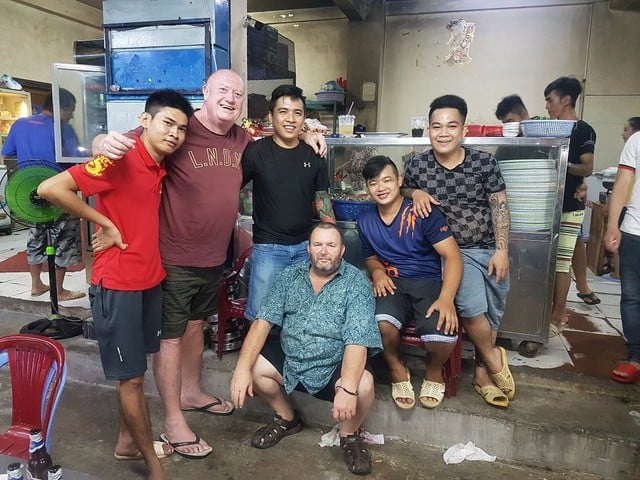
Western tourists enjoy taking photos with the staff at Oanh's snail restaurant on Vinh Khanh snail street in Ho Chi Minh City.
PHOTO: PROVIDED BY THE SUBJECT
Michelin once commented that the outdoor dining experience (specifically on the sidewalk) is a highlight of Oanh's snail restaurant, blending seamlessly with the atmosphere of Vinh Khanh Street. Time Out noted that the clanging of pans, the clinking of glasses, and the street-side karaoke combine to create the unique character of the street. The owner of Oanh's snail restaurant also shared that the restaurant focuses solely on cooking and selling, with no intention of expanding into a large restaurant, as they want to maintain the sidewalk eatery style. It is this casual, airy atmosphere that appeals to customers, especially foreigners.
The Lunch Lady restaurant on the ground floor of the Nguyen Dinh Chieu apartment building in Tan Dinh Ward is similar. Famous after a fateful encounter with the late chef Anthony Bourdain, the "king of American cuisine," who dined there in 2009, the restaurant was named The Lunch Lady, attracting many international tourists and Vietnamese expats. The late owner once affirmed that, despite having the opportunity to open a larger restaurant, she chose to maintain the sidewalk cafe model to preserve its unique style: "Going to a restaurant would lose its essence. Here, people with 50,000 dong can still sit and eat comfortably; that's what I want to preserve."
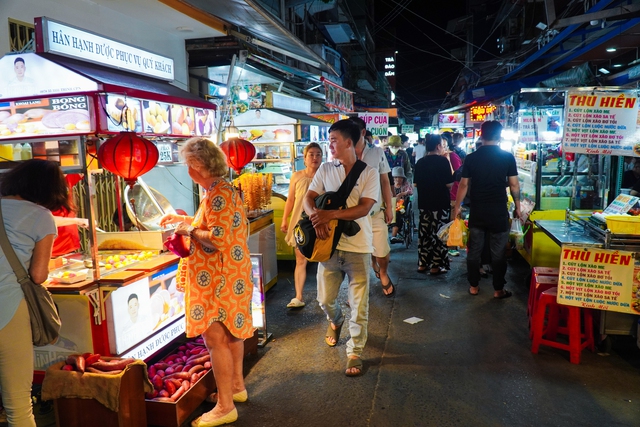
Ho Thi Ky night food street is bustling with customers, with rows of food stalls packed closely together on the sidewalk.
PHOTO: PHAN HUONG
Mr. Tran Tuong Huy, Deputy Director of the Institute for Social Tourism Research, said that the appeal of sidewalks lies in their direct interaction with urban life. The closeness, hustle and bustle, and even the somewhat crowded nature of the streets provide an authentic experience, allowing tourists to observe local life vividly. Mr. Huy also believes that sidewalks are not only traffic spaces but also social spaces, livelihood spaces, and a form of cultural resource. In many Asian cities such as Bangkok (Thailand) or Seoul (South Korea), street food is well-planned and managed, becoming a distinctive tourism product that attracts a large number of international tourists.
Standardizing sidewalks will attract tourists.
According to Mr. Tran Tuong Huy, current management is mainly based on regulations on urban order and administrative penalties, lacking specific criteria for sidewalk business culture. Meanwhile, residents need space for trading, while tourists need space for experiences.
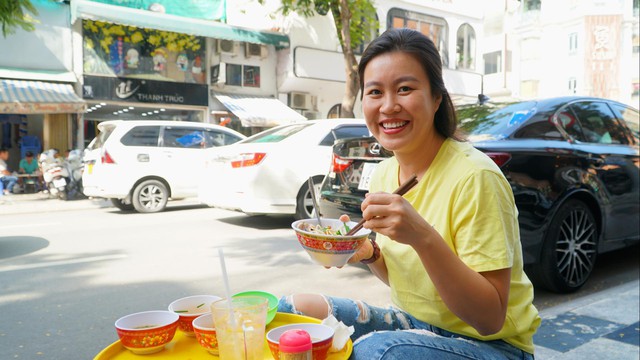
Many people enjoy eating and drinking coffee on the sidewalk.
PHOTO: LE NAM
Mr. Mai Thuan Loi, a master's degree holder in tourism (University of Social Sciences and Humanities - Vietnam National University Ho Chi Minh City), and Director of Golden Journey International Travel Company, also agrees that instead of banning, localities could consider bringing sidewalk business activities into an official management system through licensing, standardized design, and operational standards.
Specifically, authorities can classify sidewalk spaces by function. In central areas with high tourist traffic, businesses should be allowed but must adhere to clear standards regarding design, food hygiene, and space organization. In residential areas, these activities should be restricted by time slots to avoid disrupting daily life. The creation of specialized food streets or experiential zones will help concentrate street vending activities, making them easier to manage and improving service quality.
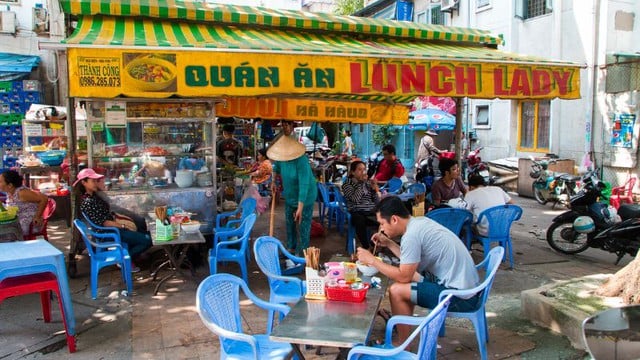
The owner of Lunch Lady in Ho Chi Minh City once said that she turned down many offers to open a restaurant in order to preserve the familiar sidewalk cafe space, serving a wide range of customers.
PHOTO: PHAN HUONG
Dr. Le Hong Vuong, Head of the Tourism Department at Van Hien University, suggested that instead of "clearing" sidewalks, it's necessary to plan and reorganize them, as this is the livelihood of a large segment of the population. Therefore, planning should consider creating suitable spaces to both ensure urban order and maintain income for them. A feasible approach, according to Dr. Vuong, is to reorganize this activity into a centralized model with clear planning. Commercial areas could be designed as cultural and culinary spaces, where tourists can not only eat but also experience local life. "If done well, this will not only be a place of business but also become a tourism product, linked to cuisine, traditional crafts, souvenirs, or tangible and intangible cultural elements," Dr. Vuong emphasized.
According to Dr. Le Hong Vuong, sidewalk renovation needs to be considered within the overall urban development plan, ensuring a harmonious balance between modernity and preserving cultural identity. Central areas with historical and architectural value should be prioritized for rearrangement in a more civilized and aesthetically pleasing manner. This process needs a roadmap, avoiding abrupt changes. Gathering public opinion, especially from businesses operating on sidewalks, is essential to find suitable and feasible solutions and foster consensus.
Source: https://thanhnien.vn/vi-sao-via-he-hap-dan-du-khach-18526041822152378.htm
![[Image] National Assembly discusses the implementation of the socio-economic development plan.](https://vphoto.vietnam.vn/thumb/1200x675/vietnam/resource/IMAGE/2026/04/20/1776696707422_ndo_br_img-20260420-185419-jpg.webp)
![[Photo] General Secretary and President To Lam meets with National Assembly delegates from ethnic minorities.](https://vphoto.vietnam.vn/thumb/1200x675/vietnam/resource/IMAGE/2026/04/20/1776696701056_a1-bnd-8331-3342-jpg.webp)













![[PHOTO] The most beautiful sidewalks in Saigon that captivate people, captured with smartphones.](https://vphoto.vietnam.vn/thumb/402x226/vietnam/resource/IMAGE/2026/04/21/1776707735189_anh14_rlcz.jpeg)



















































Comment (0)