

 |
Wiz and Google logos. Photo: Bloomberg . |
In March 2020, four Israeli tech entrepreneurs decided to found the cybersecurity startup Wiz. Within days, they were all beginning to regret it.
All four had quit their jobs before the pandemic hit, causing market panic and fears about the future. In other words, it was almost the worst time to start a company.
"Looking back now, that was the smartest time to start the company," said Assaf Rappaport, CEO of Wiz.
Five years after its founding, Wiz was acquired by Alphabet, Google's parent company, for $32 billion . This was the largest acquisition in Google's history, one of the most expensive deals in Silicon Valley. Five years ago, no one would have dared to imagine this scenario.
Running a startup during a pandemic.
"It's not the boom period, but the dark period that's the best time to start a company," said Doug Leone, a partner at Sequoia Capital, which provided the initial investment in Wiz.
According to the explanation, recruitment competition is less intense during dark times, with fewer companies pursuing new ideas. This is also when entrepreneurs bold enough, "unable to sleep at night due to excitement," decide to enter the market.
Historically, many companies have been founded during difficult times and overcome adversity. Hewlett-Packard weathered the Great Recession when it was founded in 1939, Uber and Airbnb rose from the 2008 financial crisis. Google itself benefited from cheap real estate and an abundant technical workforce after the dot-com bubble burst.
However, according to the WSJ , no company has been valued as highly in such a short time, operating under such exceptional circumstances as Wiz.
 |
Wiz co-founders from the top left: Ami Luttwak, Yinon Costica, Roy Reznik, and Assaf Rappaport. Photo: WSJ . |
Years before founding Wiz, Rappaport met his co-founders, including Ami Luttwak, Roy Reznik, and Yinon Costica, while serving in the Israeli army in 2001.
At that time, all four joined the Israeli army's elite intelligence unit 8200 - one of the world's leading institutions for training technological talent.
After leaving the military, they founded a cloud cybersecurity startup in 2012, which they later sold to Microsoft in 2015 for $320 million . Rappaport served as director of R&D at Microsoft Israel until leaving the company in early 2020. That's when he built Wiz.
Wiz's software enhances cloud systems for customers, in addition to identifying and responding to cyberattacks. Over time, Wiz has raised $1.9 billion from a number of billionaires and venture capitalists.
Rappaport and his colleagues considered how to use the money, ultimately investing in cloud computing. It was a moment when Rappaport himself wasn't entirely convinced.
"Running a startup is risky, but I've never run a startup during a pandemic," Rappaport shared in 2021.
Rapid development
Compared to startups founded during the pandemic, the Wiz founding team had several advantages, having known each other for 20 years and understanding each other's skills and personalities. Their relationships with previous investors also benefited the company.
The Covid-19 pandemic spurred investment in cloud infrastructure. As companies adopted remote work, they also exposed vulnerabilities for hackers to exploit. Consequently, cloud security software became a top priority for most large companies.
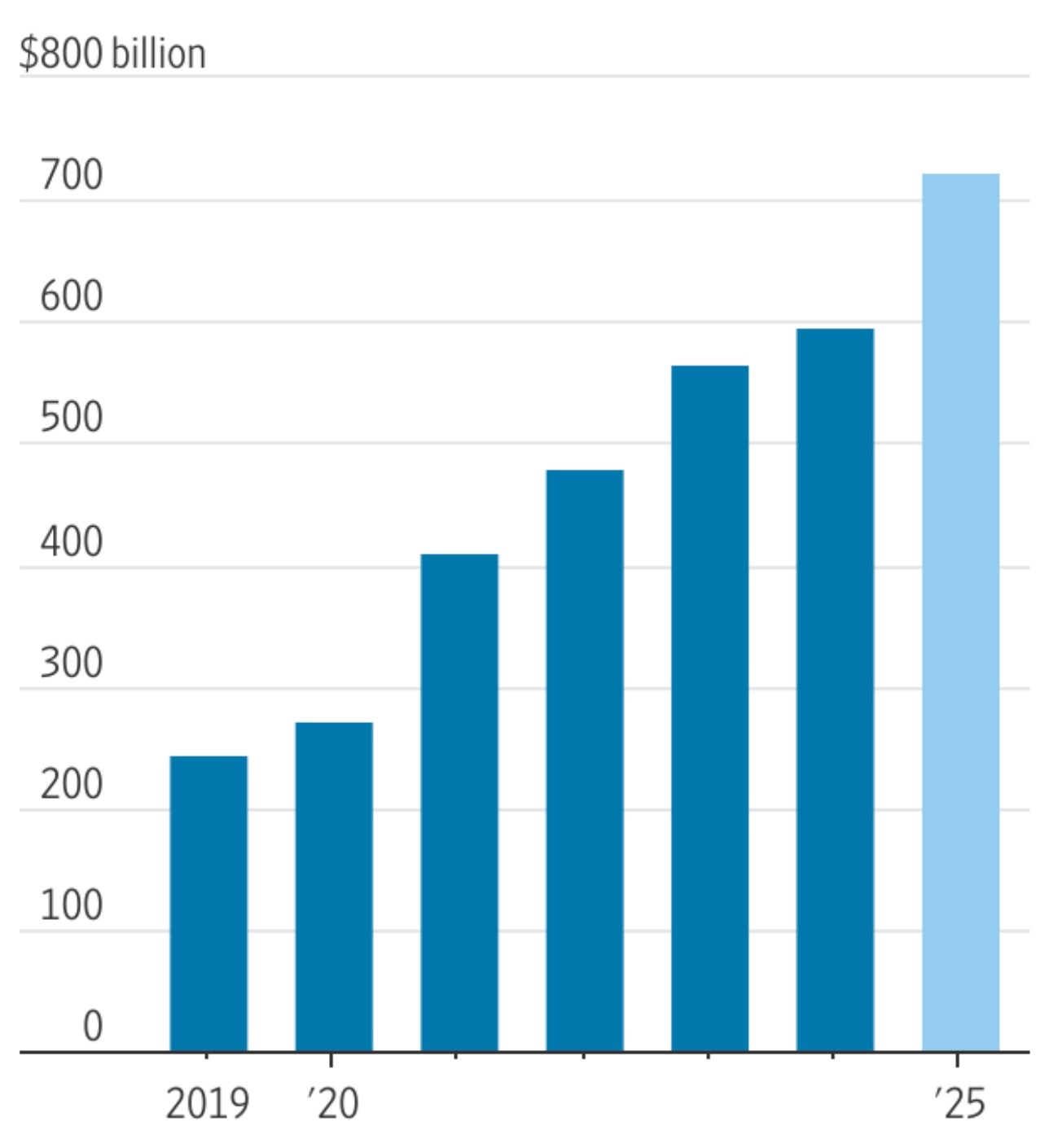 |
Investment in cloud infrastructure from 2019-2024, projected for 2025. Image: Gartner . |
Another benefit of starting a startup during a pandemic is that meetings, which used to take weeks to arrange, are now shortened to a few days or even hours. Founders don't need to leave their homes and can meet with others anytime.
It wasn't a miracle, the WSJ noted, that the right strategy was what took Wiz from nothing to a $32 billion deal in just five years.
In the context of increasingly sophisticated cyberattacks, Wiz's software is designed with simplicity in mind. The founders also invited several talented engineers from Israel to develop the product.
"What they built was so effective that Wiz employees could install the product during a sales call and identify the threat as soon as the call ended," the WSJ described.
Wiz's interface is intuitive enough for security engineers to get started, but also comprehensive enough for easy operation.
After its first deal ( $9 billion ) with Google fell through nine months ago, Wiz has grown so rapidly that the value of the deal has now more than tripled.
Source: https://znews.vn/phia-sau-thuong-vu-lich-su-cua-google-post1540385.html


![[Photo] Young people in Da Nang radiate the spirit of spring in traditional ao dai dresses.](/_next/image?url=https%3A%2F%2Fvphoto.vietnam.vn%2Fthumb%2F1200x675%2Fvietnam%2Fresource%2FIMAGE%2F2026%2F02%2F05%2F1770283565383_ndo_br_d7fd33c1bcc2329c6bd3-3439-jpg.webp&w=3840&q=75)





Comment (0)