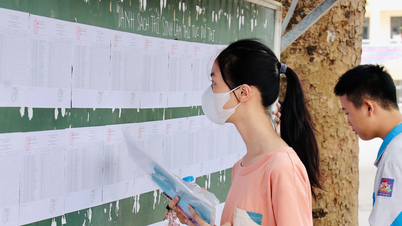
The score distribution for the 2026 High School Graduation Examination has been announced by the Ministry of Education and Training; this clarifies much information related to the appropriateness of the exam questions, the quality of teaching and learning in high schools, the adaptation of teachers and students in the process of educational reform, and the assessment of many goals in education and training. With the score distribution, the results of the High School Graduation Examination are also reflected through a scientific, objective, and comparable data system, no longer being subjective assessments.
The most notable aspect of this year's score distribution is the clearer differentiation across most subjects. The gap between score groups has widened, and the phenomenon of "a flood of high scores" has significantly decreased, indicating that the exam questions performed better in their function of differentiating students' abilities.
Along with the exam questions being structured according to the competency-based development orientation of the 2018 General Education Program, the score distribution serves as a basis to affirm that the reform process in testing and evaluation is gradually proving effective; teachers and students are adapting to the new assessment requirements. The synchronization between curriculum reform, teaching methods, and testing and evaluation methods is gradually being confirmed.
However, the score distribution also highlights issues that require continued attention, as the percentage of below-average scores in some subjects remains quite high, especially in STEM subjects and English; sending signals for further adjustments to teaching, testing, and assessment activities in the future.



In the educational process, testing and evaluation are always considered a particularly important step; they not only reflect students' abilities and assign grades but also provide feedback for teachers to adjust their teaching methods, while simultaneously motivating students to improve their skills and knowledge. Evaluation results strongly influence teachers' teaching activities, students' learning, school management, and policy planning by government agencies.
The 2026 score distribution shows positive signs of transformation; at the same time, it also highlights the need to continue improving the innovation of teaching and assessment, ensuring consistency and uniformity in the direction of developing learners' qualities and competencies.
Teaching activities should continue to focus on organizing opportunities for students to explore , experience, think, and apply their knowledge; shifting from a focus on "what to learn" to "what to do with what they have learned" and "what they can do with what they have learned." When the goal of developing competencies becomes central, each lesson should create opportunities for students to analyze, critique, collaborate, and solve real-world problems, instead of simply reproducing knowledge from textbooks.
Assessment and evaluation must continue to innovate, emphasizing process-based assessment, diversifying and flexibly adapting assessment methods to develop qualities and competencies, and building a system of questions that stimulate students' creativity and application…; all for the progress of the learner.



Permanent Deputy Minister of Education and Training Pham Ngoc Thuong once emphasized that the exam is not the end of the process. Most importantly, through the exam results and score distribution, we can assess many goals in education and training; contributing to helping the Ministry of Education and Training adjust and develop appropriate policies. When data is used to create positive changes instead of just reflecting results, each exam will be a stepping stone to gradually improve the quality of education.
Source: https://giaoducthoidai.vn/pho-diem-va-thong-diep-tu-doi-moi-post783663.html








































































![[Live] Exchange program “80 Years of Keeping the Oath” commemorating the 80th anniversary of the People's Security Force's traditional day.](https://vphoto.vietnam.vn/thumb/402x226/vietnam/resource/IMAGE/2026/07/02/1782997764964_truc-tiep-nbsp-w1200t0-di2626d272d4194258t13840l1-banner-80-nam-n2.webp)