


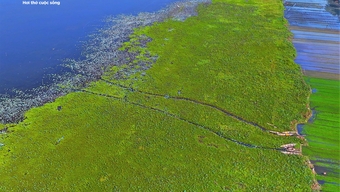
People in Hoang Tien commune visit the fields to monitor the growth of the rice plants.
In the spring of 2026, Hoang Tien commune planted nearly 447 hectares of rice, aiming for a yield of 62 quintals/hectare or more, with a total production of approximately 2,770.8 tons. Currently, the rice plants are growing well, with most areas in the late tillering stage, preparing to enter the heading and panicle formation stage, a crucial period for determining the final yield. However, the alternating drizzle and hot weather, along with large diurnal temperature fluctuations, are creating a favorable environment for the emergence and spread of various pests and diseases. Field inspections by the commune's specialized department have revealed scattered instances of pests such as yellow leaf disease, rice blast, stem borers, and rats. Although the damage is not yet significant, there is a potential risk of widespread outbreaks if not detected and treated promptly.
According to Mr. Le Duy Trong, Head of the Economic Department of Hoang Tien commune: “To proactively prevent and minimize damage, farmers need to regularly inspect their fields, closely monitor the growth of rice plants, detect pests and diseases early, and treat them promptly according to technical guidelines to avoid widespread outbreaks. For yellowing and tip-drying of leaves, a physiological disease that often appears under fluctuating weather conditions, farmers need to pay special attention to avoid confusing it with bacterial blight. The effective measure is proper care, balanced fertilization, especially pre-heading fertilization to help the plant recover naturally. Meanwhile, rice blast is identified as a dangerous disease with the potential for rapid spread. When the disease is detected, farmers need to use specific pesticides and re-spray after 3-5 days for heavily infected areas to control the source of the disease. In addition, farmers should simultaneously implement field sanitation measures, clear bushes, destroy rat habitats, and use appropriate methods.” Use traps or rat poison as directed."
In the spring of 2026, the entire province planted 111,406 hectares out of 112,000 hectares, reaching 99.5% of the plan. Currently, the rice crops are growing and developing quite well, with many areas entering the heading stage. According to field surveys by the Thanh Hoa Provincial Department of Crop Production and Plant Protection, some areas have experienced localized leaf blast disease affecting glutinous rice varieties such as Nhung, Huong, Co Tien, J02, Q5, TBR225, TBR45, etc., with an infected area of 17.45 hectares, a significant increase compared to the previous period. In addition, physiological diseases such as organic toxicity and yellowing of leaf tips due to heat shock have also appeared in some low-lying, acidic fields with an infected area of 30.7 hectares. Although the level of damage is not significant, it directly affects the growth of the rice plants if not properly treated. Bacterial blight was also recorded in localized areas covering 15.4 hectares. Notably, rats caused damage to an area of 109 hectares, concentrated in areas near residential areas, village edges, and floodplains.
Given this situation, the agricultural sector forecasts that from now until the end of the season, pests and diseases will continue to develop in a complex manner, especially with the unpredictable weather conditions. Therefore, localities and farmers need to strengthen monitoring, forecasting, and proactively implement control measures. Farmers should pay close attention to pests such as rice blast and brown planthopper, especially on susceptible varieties. When pests and diseases are detected, timely preventive spraying with specific pesticides should be carried out according to the instructions of technical staff and agricultural service centers, ensuring the "four correct principles" in the use of plant protection products.
In addition, localities assign technical staff to closely monitor the situation at the grassroots level, clearly identify each rice crop, and track the flowering time to accurately predict the timing and extent of pest and disease outbreaks, so that appropriate measures can be taken from the very beginning when pests and diseases first appear in small areas.
To support farmers, local public service centers have proactively provided a full range of quality pesticides. Simultaneously, they have implemented drone spraying services to improve pest control efficiency through faster, more even spraying, cost savings, and reduced labor. Furthermore, these units actively provide direct technical advice at each stage of rice plant growth, helping farmers understand proper care, fertilization, and pest control procedures tailored to their specific conditions.
Thanks to the proactive efforts of the agricultural sector, local authorities, and the active participation of farmers, pest and disease control measures are being implemented promptly, contributing to the protection of the spring rice crop and aiming for high yields and production.
Text and photos: Hai Dang
Source: https://baothanhhoa.vn/phong-tru-sau-benh-bao-ve-lua-vu-xuan-283504.htm
![[Photo] Prime Minister Pham Minh Chinh receives the Chinese Ambassador to Vietnam](https://vphoto.vietnam.vn/thumb/1200x675/vietnam/resource/IMAGE/2026/04/05/1775397481797_ndo_br_dsc-5512-jpg.webp)




































































Comment (0)